

Your Website Sounds Like Everyone Else , And That's Why You're Losing Jobs
Here's a hard truth: a potential client just visited your website, scrolled for about seven seconds, and clicked away to your competitor. Not because their site looked better. Not because they had lower prices. But because your website sounded exactly like every other professional in your industry.
You've invested in professional photography. You've got a clean layout. Your services are clearly listed. So why aren't you converting visitors into leads?
The answer is painfully simple, your copy is invisible. It blends into the sea of sameness that floods every industry, from real estate to consulting to trades. And in a world where prospects make snap judgments, sounding generic is the fastest way to lose jobs you never even knew were on the table.
The Hidden Cost of Sounding Like Everyone Else
Consider this: when someone lands on your website, they're not just browsing. They're actively comparing you to the three or four other tabs they have open. Your competitors. The question running through their mind isn't "Is this person qualified?" It's "Why should I choose THIS person over everyone else?"
When your website can't answer that question in seconds, you've already lost.
Generic website copy creates a trust deficit. Here's why:
- It signals laziness , If you can't be bothered to articulate what makes you different, prospects wonder what else you're cutting corners on.
- It fails to connect emotionally , People don't hire services; they hire solutions to their problems. Generic copy talks about you, not them.
- It positions you as a commodity , When everyone sounds the same, the only differentiator becomes price. And competing on price is a race to the bottom.
The businesses winning today aren't necessarily the most talented or experienced. They're the ones who've mastered strategic positioning, communicating their unique value in a way that resonates with their ideal clients.

The Copy Crimes You're Probably Committing Right Now
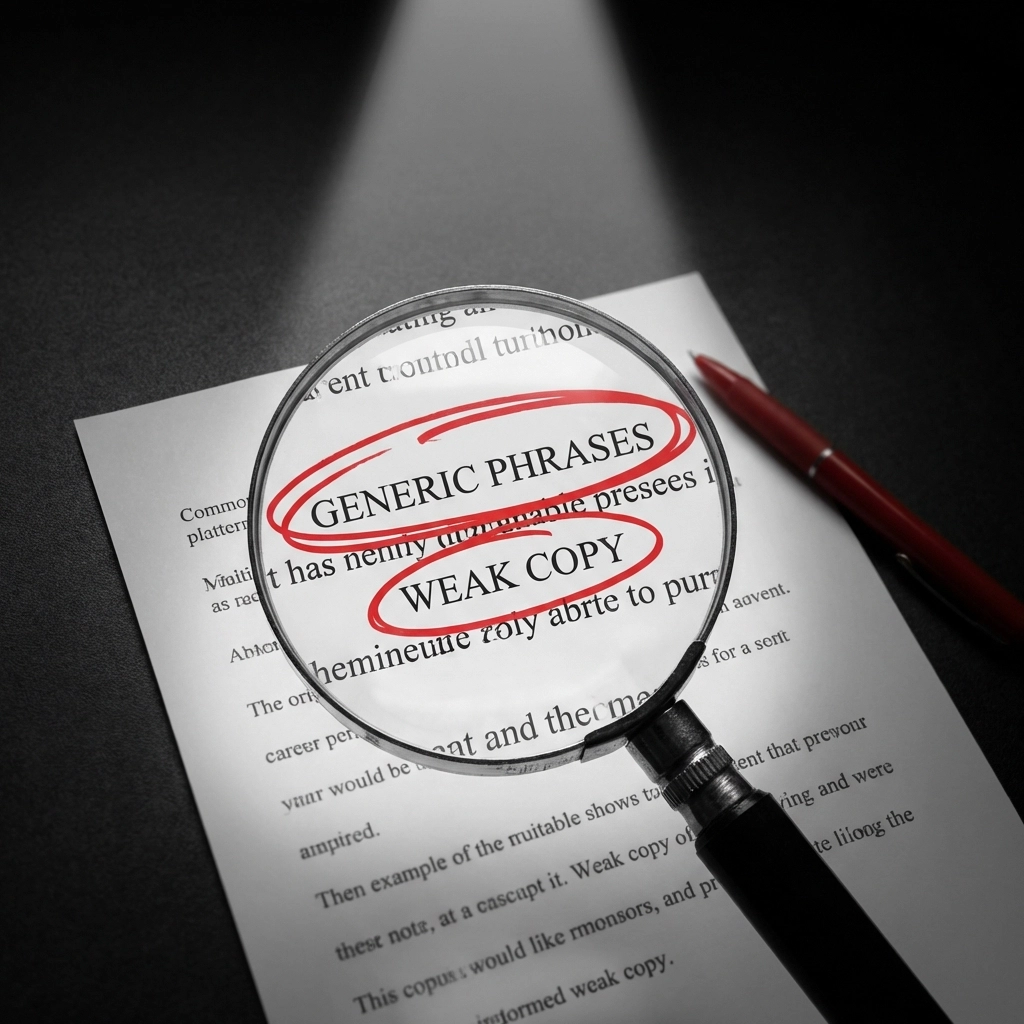
Let's get specific. Pull up your website in another tab and see how many of these phrases (or versions of them) appear on your pages:
The "Everyone Says This" Hall of Shame
| Generic Phrase | Why It's Killing You |
|---|---|
| "We're passionate about what we do" | So is everyone. This tells prospects nothing. |
| "Customer satisfaction is our priority" | Expected, not exceptional. It's table stakes. |
| "With years of experience…" | Vague and forgettable. Experience doing what, exactly? |
| "We offer quality service at competitive prices" | Translation: "We're average and we'll negotiate." |
| "Your trusted local [industry] professional" | Trust is earned through specifics, not claimed through adjectives. |
| "We go above and beyond" | Prove it. Show it. Don't just say it. |
If you cringed reading that list, you're not alone. These phrases have become so overused they've lost all meaning. They're the white noise of professional services websites.
The Real Problem Behind Generic Copy
Here's what's really happening when your website sounds like everyone else:
- You haven't identified your unique selling proposition , You know you're good at what you do, but you haven't articulated why you're different.
- You're describing features, not benefits , Listing services isn't the same as explaining how those services transform your client's situation.
- You're playing it safe , You've chosen words that can't possibly offend anyone, which means they don't resonate with anyone either.
- You've copied industry templates , That website builder template came with placeholder text, and you just… adjusted it slightly.
The fix isn't about being controversial or gimmicky. It's about being specific, authentic, and client-focused.
How to Make Your Website Sound Like Nobody Else
Ready to stand out? Here's your action plan for transforming generic copy into conversion-driving content.
1. Define Your "Only" Statement
Ask yourself: "What can I honestly say I'm the ONLY one who does?"
This doesn't have to be revolutionary. It could be:
- The only agent in your area who specialises exclusively in first-home buyers
- The only consultant who guarantees response within two hours
- The only tradesperson who provides video updates throughout the project
Pro tip: If you can't find your "only," look at the intersection of your skills, your process, and your ideal client. The combination is often unique even when individual elements aren't.
2. Replace Adjectives with Evidence
Every time you're tempted to write "quality," "professional," or "experienced," stop. Instead, provide proof.
| Instead of… | Write… |
|---|---|
| "Quality workmanship" | "Every project backed by our 5-year guarantee" |
| "Experienced professional" | "427 successful settlements in the Northern Suburbs since 2018" |
| "Excellent communication" | "You'll receive a progress update every Tuesday and Friday at 4pm" |
Specificity builds trust. Vague claims create skepticism.
3. Speak to One Person's Specific Problem
Generic copy tries to appeal to everyone. Effective copy speaks directly to your ideal client's exact situation.
Instead of: "We help clients achieve their real estate goals."
Try: "Overwhelmed by the Brisbane market? We help busy professionals find their first investment property, without spending weekends at open homes."
See the difference? The second version:
- Identifies a specific audience (busy professionals)
- Names their pain point (overwhelmed, no time)
- Offers a specific outcome (investment property without the hassle)
4. Inject Your Actual Personality
Here's a secret: your competitors are probably playing it safe too. Which means showing genuine personality is a competitive advantage.
This doesn't mean being unprofessional. It means:
- Using the phrases you actually use with clients
- Sharing opinions about your industry (yes, even slightly controversial ones)
- Writing the way you speak, not the way you think a website should sound
If you're known for your straightforward approach, let that come through. If clients love your sense of humour, don't sanitise it out of your copy.

5. Lead with Client Transformation, Not Your Services
The biggest mindset shift? Your website isn't about you. It's about what you do for your clients.
Restructure your key pages to follow this formula:
- Acknowledge the problem your ideal client is facing
- Agitate the consequences of not solving it
- Present your approach as the solution
- Prove it works with specific results or testimonials
- Make the next step crystal clear
This framework forces you to write from your client's perspective, which automatically eliminates generic, self-focused copy.
Your 30-Minute Website Copy Audit
Before you close this article, take action. Set a timer for 30 minutes and do the following:
- Read your homepage out loud. Does it sound like you, or like a template?
- Count how many times you say "we" versus "you." Flip the ratio.
- Highlight every generic phrase. Replace each with something specific.
- Ask yourself: "Would my competitor's name work just as well on this page?" If yes, rewrite.
- Check your headline. Does it speak to a specific problem, or just announce your existence?
The businesses that thrive don't just deliver great work: they communicate their value in ways their competitors haven't figured out yet.
Your website is often your first impression. Make it impossible to forget.
Need help transforming your website copy from forgettable to magnetic? Explore how Content Charlie can help you craft messaging that actually converts.