
- You are here:
- Home »
- suburb guides
Tag Archives for " suburb guides "

Content Creation Process Guide for Real Estate SEO Success
Ok. Your now you need it but how to do Content Creation Process Guide for Real Estate SEO? Let me expand for you.
Did you know over 90 percent of home buyers now start their search online? Standing out in digital real estate has never been more vital. With so many listings and guides available, your content must be more than just informative. Developing a step by step strategy helps you reach the right people, build trust, and turn clicks into real clients by matching your expertise to what home seekers really need.
Quick Summary
| Key Point | Explanation |
|---|---|
| 1. Define clear content objectives | Establish specific goals to align your content strategy with audience needs and market authority. |
| 2. Conduct targeted keyword research | Identify and utilize local SEO keywords that resonate with your target audience’s search behavior. |
| 3. Create a strategic content calendar | Organize and schedule content based on local market trends to maintain engagement and relevance. |
| 4. Craft SEO-optimized, engaging content | Develop valuable content that integrates keywords while prioritizing reader experience and solutions. |
| 5. Regularly review and refine content | Conduct quarterly audits to ensure content remains accurate, relevant, and aligned with current market trends. |
Table of Contents
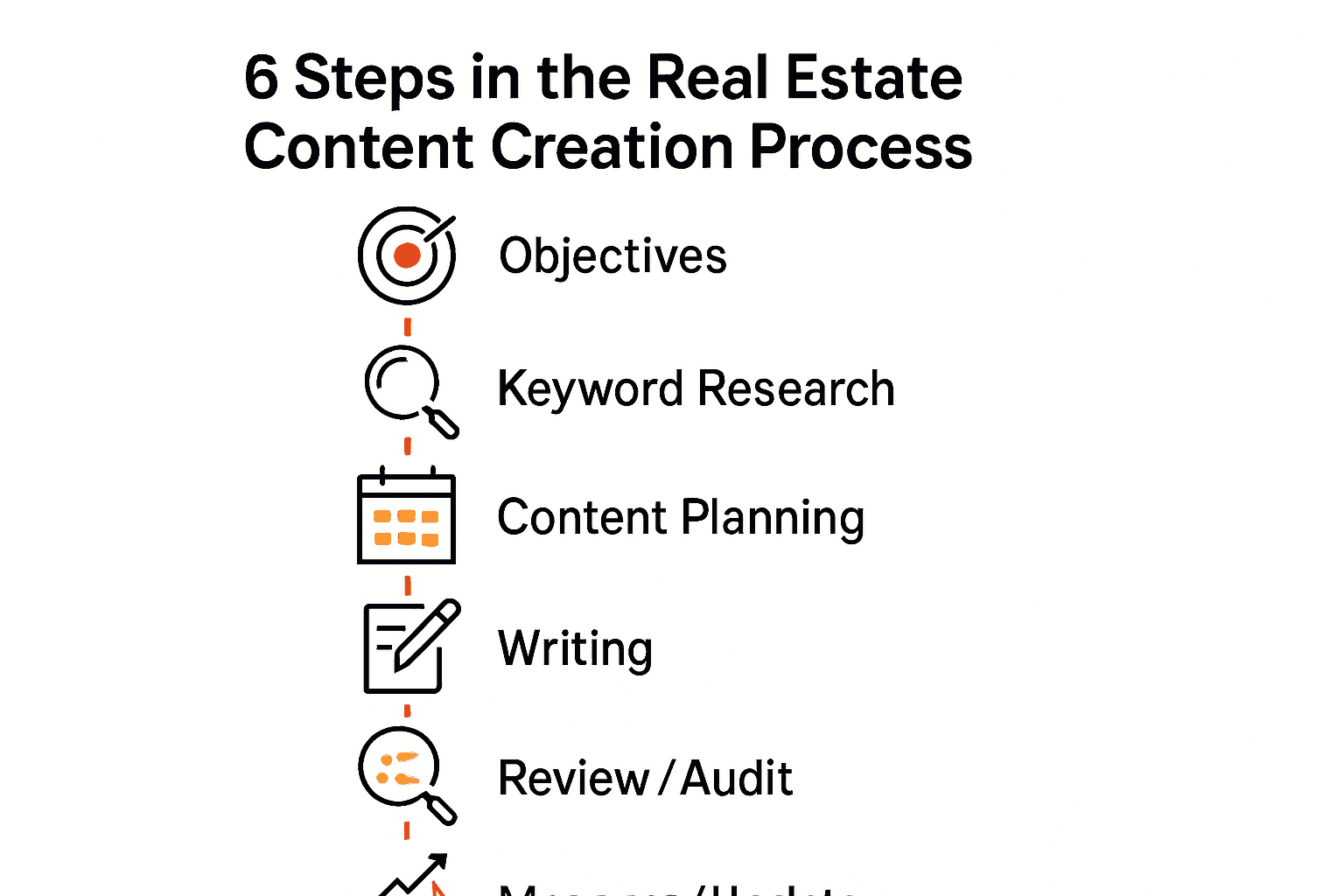
- Step 1: Define Content Objectives And Target Audience
- Step 2: Research Local Seo Keywords And Topics
- Step 3: Plan A Content Calendar For Property Niches
- Step 4: Craft Seo-Optimized Content With Conversion Focus
- Step 5: Review And Refine Content For Quality And Accuracy
- Step 6: Measure Performance And Update As Needed
Step 1: Define content objectives and target audience
Your Content Creation Process Guide for Real Estate SEO starts with crystal clear objectives and a deep understanding of who you are actually talking to. Think of this step like mapping out a journey before hitting the road. Without knowing your destination and the passengers, you will likely end up somewhere random and unsatisfied.
Start by asking yourself some fundamental questions. What do you want your content to achieve? For real estate professionals, this might mean generating qualified leads, establishing local market authority, or attracting specific buyer segments like first-time homeowners or property investors. According to research from Sell.do, effective content strategies align closely with Google’s E-E-A-T principles, which means demonstrating expertise, experience, authoritativeness, and trustworthiness.
To nail down your target audience, create detailed personas. Who are they? Young professionals seeking starter homes? Retirees looking to downsize? Investors hunting for development opportunities? Each group needs different messaging, search terms, and content approaches. Research their demographics, pain points, aspirations, and online behavior.
Pro Tip: Don’t just guess. Use real data from your past clients, local market reports, and analytics to build accurate audience personas.
Once you understand your objectives and audience, you are ready to craft content that speaks directly to their needs and search intentions. This targeted approach will help you create more relevant, engaging material that actually converts.
Up next? Keyword research that connects your objectives with your audience’s search behavior.
Step 2: Research local SEO keywords and topics
Now that you understand your content objectives and target audience, it is time to dig into the research that will make your real estate content discoverable. Local SEO keyword research is like being a detective who knows exactly where to look for hidden treasure. Learn more about why local SEO matters for real estate agents.
Start by thinking like your potential clients. What would they type into Google when searching for real estate services in your area? Content Creation Process Guide for Real Estate SEO must be a strategic part of your tinking.
These search terms might include neighborhood names, property types, buyer specific phrases like “first home buyer” or investor terms like “property investment opportunities”. Your goal is to uncover the exact language your target audience uses.
Use free tools to expand your keyword universe. Google Keyword Planner, SEMrush, and Ahrefs can reveal search volumes and related terms. Pay special attention to long tail keywords that are specific and less competitive. For instance instead of just “Brisbane property” you might target “affordable 2 bedroom apartments in West End Brisbane”.
Pro Tip: Local keywords are gold. Always include suburb names location descriptors and property specific terms that reflect how locals actually search.
Dont just collect keywords randomly. Group them strategically based on user intent. Some keywords indicate someone wanting to buy right now. Others suggest research mode. Understanding these nuances helps you create precisely targeted content that speaks directly to where a potential client is in their property journey.
Up next? Transforming those keywords into a content plan that attracts and converts your ideal real estate clients.
Step 3: Plan a content calendar for property niches
With your keywords researched and audience defined, it is time to map out a strategic content roadmap that keeps your real estate marketing consistently engaging. According to research, a 12-month content calendar synchronized with local real estate trends can dramatically improve your lead generation and audience engagement learn more about creating effective social media calendars.
Start by understanding the seasonal rhythm of your local property market. Spring might highlight new listings and garden home features. Summer could focus on waterfront properties or vacation investments. Autumn might explore family home relocations near school districts. Winter could cover investment strategies and year end property assessments.
Create content themes that align with these seasonal shifts. A young professional audience might want different content compared to retiree investors. Break down your calendar into quarterly focus areas. Each quarter should have a mix of educational content, market insights, neighborhood spotlights, and direct lead generation pieces.
Pro Tip: Plan 3-4 months ahead. This gives you breathing room to adjust for market changes while maintaining a consistent publishing schedule.
Organize your content ideas in a spreadsheet or project management tool.
 Track publication dates, content types, target keywords, and potential promotional channels. Remember that flexibility is key. While planning is crucial, be ready to pivot when unexpected market opportunities or local events arise.
Up next? CraftingContent Creation Process Guide for Real Estate SEO compelling content that transforms your strategic calendar into actual engaging real estate resources.
Step 4: Craft SEO-optimized content with conversion focus
With your content calendar ready, it is time to transform those strategic plans into compelling real estate content that both Google and potential clients will love. Content Creation Process Guide for Real Estate SEO is not just about keywords but creating genuinely helpful resources learn more about on page optimization strategies.
According to research, successful real estate content typically runs around 2000 words and focuses intensely on providing rich human-centered information. Your goal is to answer every possible question a potential buyer or seller might have. Think comprehensive neighborhood guides, deep-dive market analysis reports, and step by step tutorials that showcase your expertise.
Embrace strategic keyword placement. Weave your target keywords naturally into titles, headings, image alt tags and throughout the content. But here is the critical part avoid keyword stuffing. Your writing must sound conversational and authentic. Google rewards content that genuinely helps readers solve problems.
Pro Tip: Always prioritize reader experience over search engine tricks. Useful content that genuinely helps people will naturally rank better.
Include visual elements that support conversion. High quality property images, infographics showing market trends, and clear call to action buttons can dramatically increase engagement. Use internal links strategically to guide readers through your content ecosystem and showcase your comprehensive local real estate knowledge.
Up next? Implementing technical SEO elements that make your content discoverable and user friendly.
Step 5: Review and refine content for quality and accuracy
Content Creation Process Guide for Real Estate SEO. It is an ongoing process of refinement and improvement. According to research from real estate SEO experts, learn more about maintaining content quality with AI tools, regular content reviews are essential to staying relevant and competitive.
According to research from Sell.do, maintaining E-E-A-T (Experience, Expertise, Authoritativeness, and Trustworthiness) is critical in real estate content. This means quarterly SEO audits are not just recommended they are necessary. Focus on checking several key areas: performance metrics, content freshness, local relevancy, meta data accuracy, and internal linking strategy.
Start by reviewing your existing content through a critical lens. Are your neighborhood guides still accurate? Do your market trend articles reflect the current real estate landscape? Update statistics, refresh property information, and ensure all local references are current. Remove or update any outdated information that could mislead potential clients.
Pro Tip: Set calendar reminders for quarterly content reviews. Consistency is key in maintaining high quality SEO content.
Pay special attention to seasonal content. A summer property investment guide from two years ago might need significant updates to remain valuable. Check your analytics to see which pieces are still driving traffic and which might need a complete overhaul. Remember that Google rewards fresh, accurate, and genuinely helpful content.
Up next? Implementing a systematic approach to ongoing content management and optimization.
Step 6: Measure performance and update as needed
You have crafted and refined your real estate content. Now comes the critical part measuring what works and what needs improvement. According to research from LinkedIn, real estate SEO success demands continuous tracking and strategic refinement learn more about performance measurement tools.
Start by setting up comprehensive tracking in Google Analytics and Google Search Console. These tools will reveal crucial insights about your content performance. What keywords are driving traffic? Which articles are generating leads? Look beyond basic metrics. Analyze engagement rates, bounce rates, and time spent on page to understand how your audience truly interacts with your content.
Conduct quarterly performance audits. Compare your content against current market trends and competitor strategies. Are your keyword rankings improving? Are you capturing the right audience segments? Be prepared to pivot quickly. A neighborhood guide that worked six months ago might need complete reconstruction based on current market dynamics.
Pro Tip: Create a performance dashboard that tracks key metrics monthly. Consistency in monitoring helps you spot trends faster.
Dont just collect data. Transform insights into actionable content updates. If a particular property investment article is attracting significant traffic but low conversion rates, investigate why. Perhaps the call to action needs refinement or the content requires more specific local market insights. Treat your content as a living document that evolves with your audience needs.
Up next? Building a sustainable real estate content strategy that grows with your business.
Here’s a summary of each key step in a real estate content strategy:
| Step | Main Focus | Key Actions |
|---|---|---|
| 1. Define Objectives & Audience | Set goals Identify target groups |
Build personas Analyze data |
| 2. Keyword & Topic Research | Uncover search terms | Use tools (Google, SEMrush) Group by intent |
| 3. Content Calendar Planning | Schedule & theme content | Align with seasons Organize by audience |
| 4. SEO-Optimized Content | Write Engage & convert |
Use keywords Add visuals & CTAs |
| 5. Review & Refine | Quality assurance | Audit quarterly Update & optimize |
| 6. Measure & Update | Track performance | Analyze metrics Adjust strategy |
Struggling to Turn Real Estate Content Into Actual Leads?
If you have ever mapped out buyer personas, spent ages on keyword lists, or tried to keep your real estate blog fresh and still wondered why your content is not driving real results, you are not alone. Many real estate professionals get stuck bridging the gap between well-structured content strategies and the kind of suburb-specific copy that actually brings in qualified leads. The article you just read highlights common pain points, from scattered keyword research to the challenge of maintaining accurate local information, and the need to keep content relevant and authoritative for both Google and real buyers and sellers.
You do not have to navigate the content creation process alone. At Content Charlie, we help you transform every step of your real estate SEO strategy into a simple, results-driven system. Whether you want expert guidance on building a content calendar, writing suburb guides, or optimizing for local search, our team will save you hours while positioning you ahead of your competition. Move from theory to action—visit Content Charlie and let us help you create search-ready content that turns readers into new business. Ready to update your approach? Start with us now and give your content the edge it deserves.
Frequently Asked Questions
What are the key objectives I should define for my real estate content creation?
To ensure your content effectively supports your business, start by setting clear objectives like generating leads, establishing market authority, or attracting specific buyer segments. Assess your past performance data to refine these goals and align them with your target audience’s needs.
How do I conduct keyword research specifically for real estate SEO?
Begin by thinking like your potential clients and brainstorm relevant search terms they might use. Utilize tools to identify these keywords, focusing on long-tail phrases that reflect specific local and property-related queries.
What steps should I take to create a content calendar for my real estate marketing?
Map out a calendar by understanding the seasonal rhythms of your local property market and organizing content themes that resonate with your audience. Plan at least 3-4 months ahead to adapt to any market changes while ensuring a consistent publishing schedule.
How can I ensure my real estate content is SEO-optimized and engaging?
Incorporate strategic keyword placement throughout your content and avoid keyword stuffing to maintain a natural tone. Aim for comprehensive material that answers common questions and includes engaging visuals and clear calls to action to enhance user experience.
Why is it important to regularly review and update my real estate content?
Regularly reviewing your content ensures it remains accurate and aligned with current market trends, which is crucial for maintaining trust with your audience. Schedule quarterly audits to assess performance metrics and refresh outdated information, keeping your content valuable and relevant.
What metrics should I track to measure the performance of my real estate SEO content?
Focus on metrics like traffic from specific keywords, engagement rates, bounce rates, and conversion rates to gauge content effectiveness. Set up a performance dashboard and conduct quarterly reviews to adapt your strategy based on these insights.
Recommended
- Why Use Blog Content: Essential Guide for Real Estate – Content Charlie
- Role of Content in SEO: Everything You Need to Know – Content Charlie
- 7 Types of Real Estate Content Every Agent Should Use – Content Charlie
- consistent content creation Archives – Content Charlie
- SEO for Real Estate Agencies: Simple Strategies to Grow Your Business

Role of Content in SEO: Everything You Need to Know
Did you know that over 70 percent of people start their property search online? Today, the Role of Content in SEO shapes more than just first impressions. It decides how visible and credible you are in the eyes of both clients and search engines. Understanding how content shapes modern SEO can put you ahead of your competition and ensure your expertise gets noticed where it matters most.
Key Takeaways
| Point | Details |
|---|---|
| Content Quality is Essential | High-quality content drives SEO rankings by demonstrating expertise and meeting user needs. |
| Diversify Content Types | Utilizing various content types, like suburb guides and market reports, enhances SEO and engages potential clients. |
| Focus on Local SEO | Developing hyperlocal content tailored to specific communities improves visibility and attracts relevant clients. |
| Avoid Common Pitfalls | Steer clear of mistakes like keyword stuffing and outdated information to maintain credibility and effectiveness in content marketing. |
Table of Contents
- Defining Content’s Role In Modern SEO
- Types Of SEO Content For Real Estate
- How Content Drives Search Rankings
- Local SEO: Content Strategies That Work
- Common Content Mistakes To Avoid
Defining Content’s Role in Modern SEO
In the rapidly evolving digital landscape, content is no longer just words on a page—it’s the strategic engine driving search engine optimization (SEO). Our comprehensive content marketing guide reveals how modern search algorithms prioritize content that genuinely serves user needs and demonstrates expertise.
According to research from Search Engine Journal, Google now considers content quality as a core ranking factor. The 2024 study highlights critical attributes that elevate content’s SEO performance:
- Relevance to user search intent
- Depth of information provided
- Semantic clarity and topical comprehensiveness
- User engagement signals
Recent academic research on Generative Search Engine Optimization reveals an even more sophisticated evaluation framework. This multi-dimensional approach moves beyond traditional metrics, analyzing content’s substantive impact through semantic influence. For real estate agents, this means creating hyperlocal, expertise-driven content that doesn’t just include keywords, but provides genuine value to potential property buyers and sellers.
The message is clear: exceptional content isn’t just recommended—it’s essential. Search engines now reward content that demonstrates authentic expertise, answers user questions comprehensively, and creates meaningful connections with the target audience.
Types of SEO Content for Real Estate
In the competitive world of real estate digital marketing, content diversity is your secret weapon for attracting potential buyers and sellers. Learn more about effective content strategies that can transform your online presence and drive targeted traffic.
Real estate professionals have several powerful content types at their disposal to boost SEO and engage potential clients:
- Suburb Guides: Comprehensive neighborhood profiles
- Property Market Reports: Local market trend analysis
- Client Success Stories: Testimonial and case study content
- Buyer and Seller Advice Blogs: Educational content addressing common questions
- Local Area Listings: Hyperlocal property insights
- Virtual Property Tours: Multimedia content with descriptive narratives
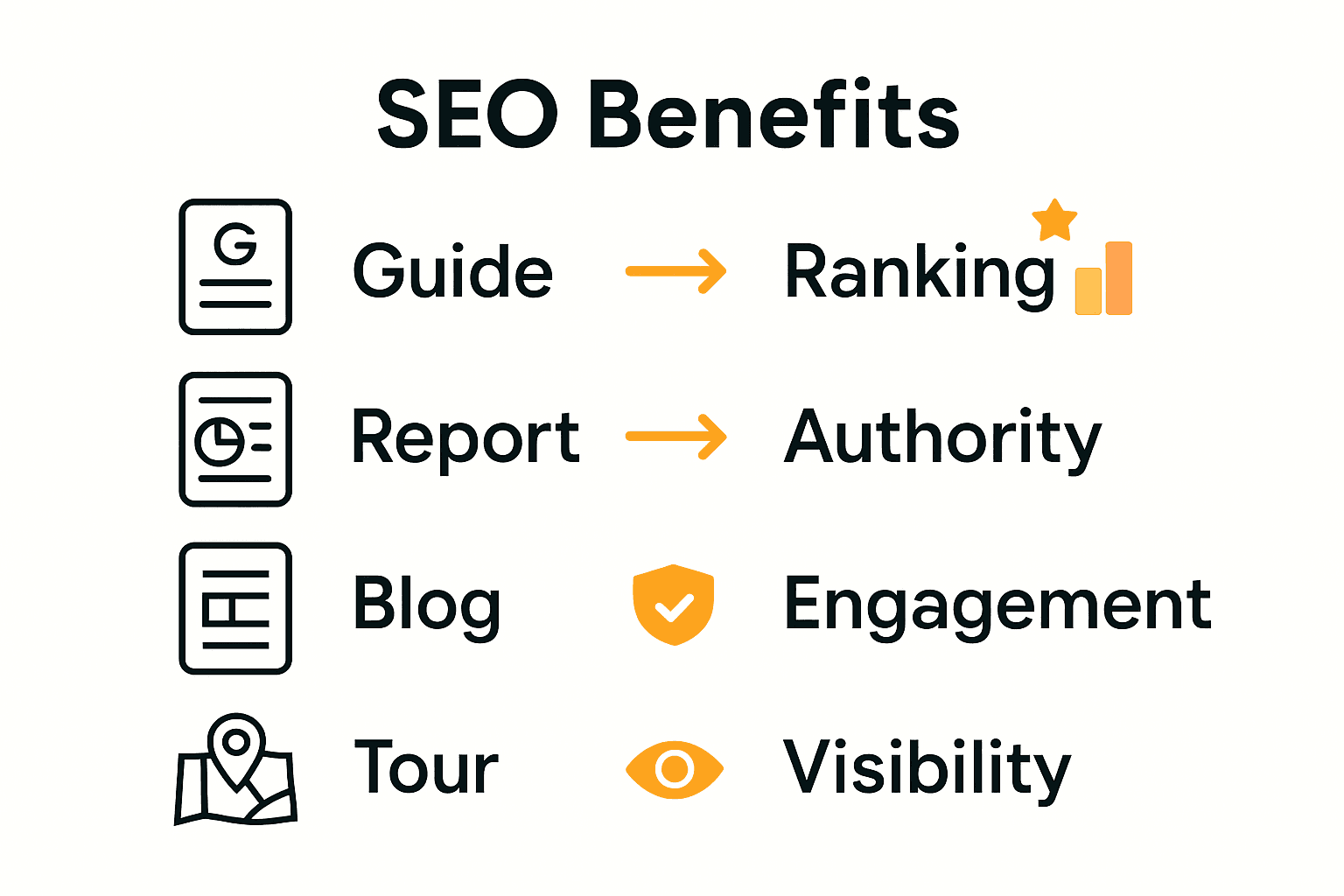
Each content type serves a unique purpose in your SEO strategy. Suburb guides, for instance, help you rank for hyperlocal search terms while providing immense value to potential clients researching specific areas. Property market reports establish you as a local market expert, attracting both search engine algorithms and potential clients seeking knowledgeable guidance.
Here’s a summary of key real estate content types and their SEO advantages:
| Content Type | Main Purpose | SEO Benefit |
|---|---|---|
| Suburb Guides | Neighborhood profiles | Ranks for hyperlocal keywords |
| Property Market Reports | Market trend analysis | Boosts authority & trust |
| Client Success Stories | Showcase expertise | Enhances credibility & engagement |
| Buyer/Seller Advice Blogs | Inform & educate clients | Targets long-tail search queries |
| Local Area Listings | Property details by area | Improves local search visibility |
| Virtual Property Tours | Visual property showcasing | Increases time on site |
The key is creating content that balances informational depth with strategic keyword targeting. By diversifying your content approach, you’re not just improving SEO—you’re building a comprehensive digital resource that positions you as the go-to real estate authority in your local market.

How Content Drives Search Rankings
In the intricate world of search engine optimization, content quality is the ultimate determining factor for ranking success. Our comprehensive content marketing insights reveal the complex mechanisms by which exceptional content propels websites up search result pages.
According to research from Search Engine Journal, Google’s algorithms assess content through multiple critical lenses:
- Relevance to user search intent
- Comprehensiveness of information
- Semantic depth of topic coverage
- User engagement metrics
Recent academic findings highlight a sophisticated, multi-agent framework for evaluating content. This approach goes beyond traditional keyword matching, analyzing content’s substantive influence through semantic complexity. For real estate professionals, this means creating content that doesn’t just include keywords, but provides genuine, in-depth insights that demonstrate true expertise.
The search ranking process is now more nuanced than ever. Search engines prioritize content that not only answers user questions but does so with authority, clarity, and comprehensive understanding. By crafting content that truly serves user needs—whether it’s a detailed suburb guide, a market trend analysis, or a comprehensive property buying walkthrough—real estate agents can significantly improve their visibility and credibility in search results.
Local SEO: Content Strategies That Work
For real estate agents, local SEO is the lifeline of digital marketing success. Our comprehensive link building strategies can help you transform hyperlocal content into a powerful ranking tool that attracts potential clients right in your neighborhood.
According to research from Search Engine Journal, strategic content approaches can dramatically improve local visibility:
- Structured data markup for property listings
- Localized social media content with targeted hashtags
- Neighborhood-specific landing pages
- Google Business Profile optimization
- Geo-targeted blog content
The key to effective local SEO lies in creating content that speaks directly to your community’s unique characteristics. This means developing suburb guides that go beyond generic descriptions, sharing market insights specific to local neighborhoods, and demonstrating deep understanding of micro-market trends that matter to potential buyers and sellers.
Successful local content strategies aren’t about keyword stuffing—they’re about genuine connection. By crafting content that provides real value to your local audience, you’re not just improving search rankings, you’re establishing yourself as the go-to real estate expert in your specific market. Think hyperlocal, write with authenticity, and watch your local search visibility soar.
Common Content Mistakes to Avoid
In the competitive realm of real estate digital marketing, content missteps can dramatically undermine your SEO efforts. Learn about strategic content approaches that help you sidestep common pitfalls and maintain a strong online presence.
Real estate professionals frequently encounter content challenges that can hurt their search rankings and audience engagement:
- Keyword Stuffing: Overloading content with repetitive keywords
- Generic Content: Using bland, non-specific property descriptions
- Outdated Information: Failing to update market data and listings
- Inconsistent Publishing: Irregular content creation schedules
- Ignoring Local Context: Writing without hyperlocal insights
One of the most critical mistakes is treating content as a mere SEO checkbox rather than a genuine communication tool. Real estate content should tell a story, provide meaningful insights, and address potential clients’ specific needs and questions. This means moving beyond surface-level property descriptions to create narratives that showcase neighborhood character, market trends, and the unique value you bring as a local expert.
Successful content strategy requires consistent, thoughtful execution. By avoiding these common pitfalls and focusing on creating authentic, valuable content, real estate agents can transform their digital presence from forgettable to remarkable. Remember: great content isn’t just about ranking—it’s about building trust, demonstrating expertise, and connecting with your local community.
Transform Your SEO Content Into Real Results With Content Charlie
Are you frustrated that your efforts with suburb guides or market reports are not turning into higher local rankings or more real estate clients? This article makes it clear that in today’s market, generic or keyword-stuffed content will only hold you back. You need tailored writing that demonstrates authority, connects with your local audience, and keeps you ahead in suburb-level searches. At Content Charlie, we know your challenges and we solve them by crafting SEO-driven copy and engaging blog articles that give your business lasting visibility.
It is time to stop guessing and start attracting clients who are ready to take action. Work with specialists who help real estate agents and local businesses master local SEO and content strategy every single day. Visit Content Charlie now to discover how we can turn your content into the secret weapon for ranking, engagement, and trust. Start seeing more leads from Broadbeach to Burleigh today. Book a strategy call and get your business found before your competition does.
Frequently Asked Questions
What is the role of content in modern SEO?
Content plays a crucial role in modern SEO as it serves as the strategic engine driving search engine rankings. High-quality, relevant content that addresses user needs is prioritized by search algorithms, enhancing visibility and user engagement.
How can real estate professionals use content to improve their local SEO?
Real estate professionals can enhance their local SEO by creating hyperlocal content, such as suburb guides, neighborhood-specific landing pages, and localized blog posts. This approach ensures that content resonates with local audiences and ranks well in search results.
What types of content are effective for enhancing SEO in real estate marketing?
Effective content types for real estate marketing include suburb guides, property market reports, buyer and seller advice blogs, client success stories, local area listings, and virtual property tours. Each type serves distinct purposes, from providing local insights to establishing authority in the market.
What common mistakes should real estate professionals avoid when creating content for SEO?
Common mistakes to avoid include keyword stuffing, using generic or outdated content, having inconsistent publishing schedules, and ignoring local context. Instead, focus on creating authentic, insightful narratives that connect with your target audience.
Recommended

Why Use Blog Content: Essential Guide for Real Estate
Nearly 80 percent of homebuyers start their search online, yet most real estate agents miss out by only sharing property listings. Modern buyers crave local market insights, unique neighborhood details, and personal stories that help them make smarter decisions. Strong blog content positions you as a trusted expert, builds credibility, and turns curious visitors into loyal clients who see you as their go-to resource in the community.
Key Takeaways
| Point | Details |
|---|---|
| Strategic Importance of Blogging | Real estate blogging serves as a vital channel for establishing trust and authority through valuable local insights and market analyses. |
| Diverse Content Types | Utilizing various content strategies, such as market trend reports and neighborhood guides, enhances engagement and showcases expertise. |
| Boosting Local SEO | Blogging improves digital visibility by targeting hyperlocal search queries, thus enhancing relevance and attracting potential clients. |
| Building Trust Through Authenticity | Consistent and relatable content that addresses client concerns helps establish you as a genuine advisor in the real estate journey. |
Table of Contents
- Defining Blog Content And Its Role
- Types Of Blog Content For Real Estate Agents
- How Blog Content Boosts Local Seo Rankings
- Building Trust And Authority With Blog Content
- Common Pitfalls When Using Blog Content
Defining Blog Content and Its Role
Blog content represents a strategic digital communication channel where real estate professionals share valuable insights, market analyses, and local property information to engage potential clients. Real estate blogging goes far beyond simple property listings – it’s about creating a comprehensive narrative that positions you as a local market expert.
According to Agent Ascension, blogging plays a crucial role by providing critical local market insights such as:
- Current property trends
- Pricing dynamics
- Market demand fluctuations
- Seasonal behavior patterns
These data-driven posts help establish your blog as an authoritative resource, building significant trust and credibility with potential clients. Search Engine Journal reinforces this perspective, highlighting that real estate blogs offer additional opportunities to target relevant keywords and showcase hyperlocal expertise.
At its core, blog content serves multiple strategic purposes for real estate professionals. It’s not just about information transmission – it’s about creating a compelling digital presence that demonstrates your deep understanding of local neighborhoods, market nuances, and client needs. By consistently producing high-quality, informative content, you transform your online platform from a simple listings site into a valuable community resource that attracts, educates, and ultimately converts potential buyers and sellers.
Pro Tip: Focus on creating content that answers real questions your potential clients are asking – about neighborhoods, market conditions, buying/selling processes, and local lifestyle insights.
Types of Blog Content for Real Estate Agents
Real estate agents have multiple blog content strategies to connect with potential clients and showcase their expertise. These content types range from informative market analyses to engaging personal storytelling, each serving a unique purpose in building trust and attracting potential buyers and sellers.
Here are the primary types of blog content real estate professionals can leverage:
Here’s a comparison of popular real estate blog content types and their primary benefits:
| Content Type | Key Focus | Main Benefit |
|---|---|---|
| Market Trend Reports | Data analysis Trends |
Establishes authority |
| Neighborhood Guides | Local insights Amenities |
Demonstrates hyperlocal expertise |
| Buyer Journey Stories | Personal narrative Emotion |
Builds trust and relatability |
| Process Explanations | Step-by-step Education |
Simplifies complex topics |
| Local Business Features | Community connections | Strengthens local relevance |
- Market Trend Reports: Detailed analyses of local property market conditions, price movements, and investment opportunities
- Neighborhood Guides: Comprehensive overviews of specific suburbs, highlighting local amenities, schools, lifestyle, and community features
Storytelling and Informative Content
Personal narrative blogs offer another powerful approach. Buyer journey stories that walk readers through successful property purchases, renovation challenges, or first-time homeowner experiences create emotional connections. These posts humanize your brand and demonstrate your understanding of client experiences.
Read our guide on content ideas for agents to explore more innovative ways of crafting compelling real estate blog content. By diversifying your content strategy, you transform your blog from a simple information platform into an engaging resource that potential clients will actively seek out and trust.

How Blog Content Boosts Local SEO Rankings
Local SEO represents a critical strategy for real estate agents looking to dominate neighborhood-specific search results. Blog content acts as a powerful mechanism for improving your digital visibility, allowing you to target hyperlocal search queries and demonstrate expertise in specific geographical areas.
Search Engine Journal highlights that publishing targeted neighborhood content can significantly enhance search engine relevance. By crafting blog posts that cover rich local details, agents can strategically incorporate valuable keywords and information such as:
- Neighborhood walkability scores
- Local school district information
- Cost of living comparisons
- Restaurant and amenity highlights
- Interviews with local business owners
Strategic Keyword Integration
Effective blog content goes beyond simple keyword stuffing. It’s about creating genuine, informative narratives that naturally incorporate location-specific terms. When you consistently produce high-quality, geographically targeted content, search engines recognize your website as a authoritative local resource.
Pro Strategy: Focus on creating in-depth, authentic content that answers real questions potential clients have about specific neighborhoods. This approach not only improves your SEO rankings but also establishes you as a trusted local market expert who truly understands the nuanced landscape of your service area.
Building Trust and Authority With Blog Content
Trust and authority are the cornerstones of successful real estate marketing, and blog content provides a powerful platform for establishing these critical qualities. By consistently sharing valuable, transparent, and insightful information, real estate agents can transform their online presence from a simple transactional platform into a trusted resource for potential clients.
Demonstrating Expertise Through Content
Building authority requires more than just listing properties. Your blog becomes a strategic tool to showcase:
- Deep local market knowledge
- Understanding of complex real estate processes
- Genuine commitment to client education
- Transparent insights into market trends
- Personal approach to client relationships
Learn more about building community trust and how consistent, high-quality content can position you as the go-to local real estate expert. The key is creating content that goes beyond surface-level information and provides genuine value.
Successful blog content connects with readers on an emotional and intellectual level. By addressing potential client concerns, explaining complex processes in simple terms, and sharing real-world insights, you demonstrate that you’re not just selling properties – you’re a trusted advisor who genuinely cares about helping clients navigate their real estate journey.
Pro Tip: Authenticity is your greatest asset. Share personal experiences, client success stories, and behind-the-scenes insights that humanize your brand and make potential clients feel like they already know and trust you before the first conversation.
Common Pitfalls When Using Blog Content
Real estate blog content can quickly become ineffective when agents fall into common strategic traps. Understanding these potential missteps is crucial for creating a blog that genuinely attracts and engages potential clients, rather than becoming another forgettable online resource.
Critical Mistakes to Avoid
Real estate professionals often encounter several recurring blog content challenges:
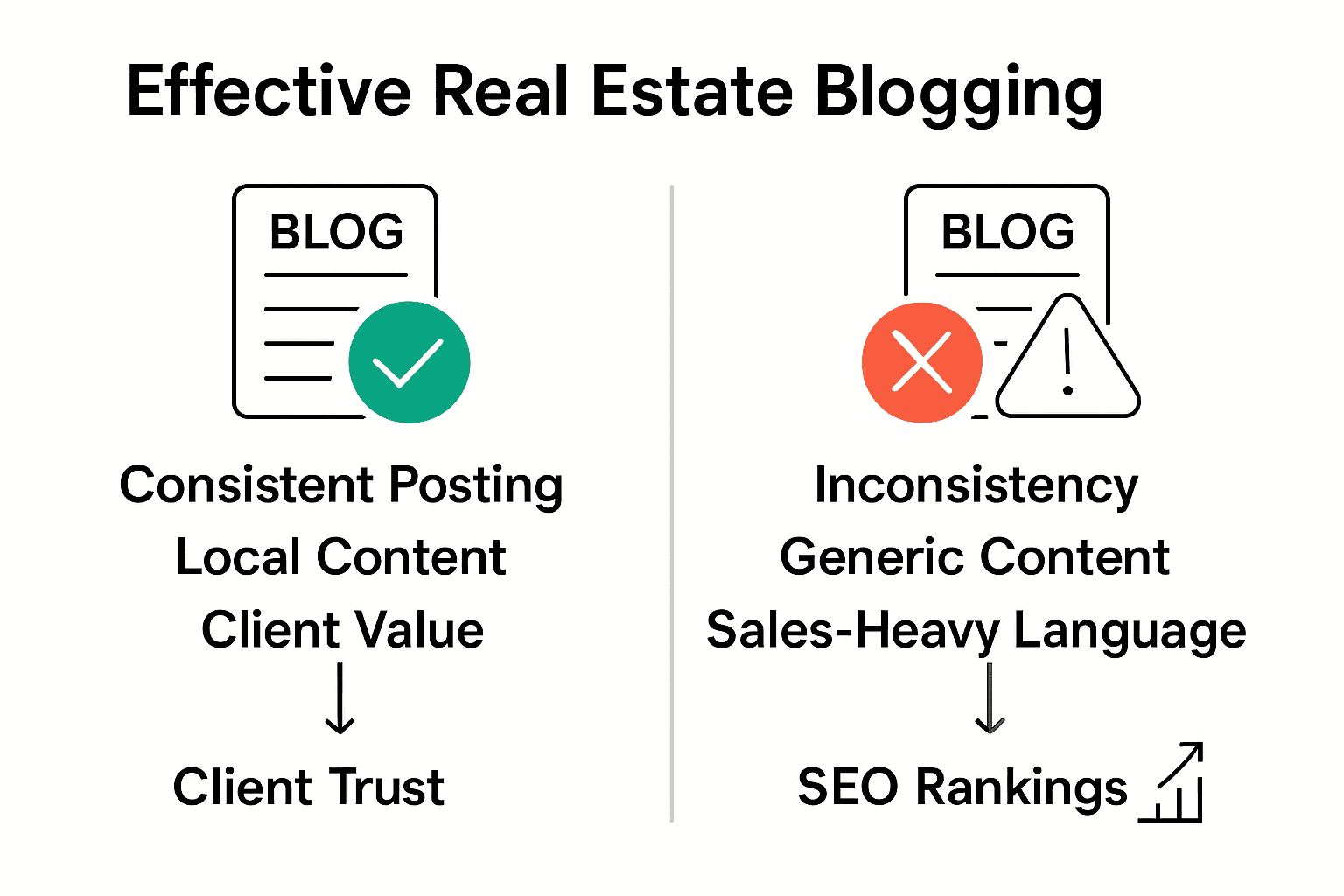
- Inconsistent Posting: Sporadic content publication that fails to build momentum or reader expectations
- Generic, Uninspired Writing: Bland posts that could apply to any location or agent
- Overly Sales-Driven Content: Aggressive marketing language that turns readers away
- Neglecting Local Specifics: Missing opportunities to showcase neighborhood expertise
- Poor SEO Optimization: Content that doesn’t strategically target relevant search terms
Learn more about compounding content strategies that can help you avoid these common pitfalls. The most successful real estate blogs create a narrative that feels personal, informative, and genuinely helpful.
The key is understanding that blog content is not about pushing immediate sales, but about building long-term relationships.
 Potential clients want insights, understanding, and a sense that you truly know and care about their real estate journey. By focusing on education, transparency, and genuine value, you transform your blog from a potential liability into a powerful client attraction tool.
Pro Tip: Think of your blog as a conversation, not a billboard. Write as if you’re speaking directly to a client, addressing their real concerns, fears, and aspirations in the real estate process.
Turn Your Blog into a Real Estate Magnet — Let Content Charlie Guide You
Are you frustrated by your blog getting lost in the crowd or failing to connect with local buyers and sellers? The article highlighted how crucial it is to produce expert, neighborhood-focused content that goes beyond listings. Many agents struggle to build trust and authority online or waste hours publishing posts that do not move the needle for local SEO. If you recognize the challenges of inconsistent content, lack of local relevance, or missing out on suburb-level Google searches, you are not alone.
Start attracting ready-to-act clients sooner with Content Charlie. We specialize in local SEO-driven copywriting for real estate agents who want to get found first by local buyers and sellers. From suburb guides and blog articles that showcase your expertise to high-converting web pages that turn readers into leads, our tailored approach ensures your digital presence grabs attention and builds genuine community trust. Do not wait for your competition to dominate local searches while you fall behind. Visit Content Charlie to amplify your authority and become the go-to agent in your neighborhood now.
Frequently Asked Questions
What is the role of blog content for real estate professionals?
Blog content serves as a strategic channel for real estate professionals to share insights, market analyses, and local property information, establishing them as local market experts and building trust with potential clients.
How does blog content enhance local SEO rankings for real estate agents?
Blog content enhances local SEO by targeting hyperlocal keywords and providing valuable information about specific neighborhoods, which improves search engine relevance and visibility in neighborhood-specific queries.
What types of blog content can real estate agents create to engage clients?
Real estate agents can create various content types, including market trend reports, neighborhood guides, personal client stories, process explanations, and local business features, each serving to build trust and demonstrate expertise.
How can real estate professionals avoid common pitfalls when creating blog content?
To avoid pitfalls, real estate professionals should maintain consistent posting schedules, focus on unique and localized content, avoid overly sales-driven language, and ensure their content is optimized for relevant SEO keywords.
Recommended
- Understanding Why Blogging Boosts SEO for Real Estate – Content Charlie
- blog publishing Archives – Content Charlie
- content publishing Archives – Content Charlie
- blogging Archives – Content Charlie
- SEO for Real Estate Agencies: Simple Strategies to Grow Your Business
- 7 Content Curation Strategies Every Business Owner Needs – My Blog

7 Types of Real Estate Content Every Agent Should Use
There are 7 Types of Real Estate Content that really move the need for a real estate agents website. Do these and see your traffic grow.
Did you know that nearly 90% of home buyers research local agents and neighborhoods online before making a move? In a market where first impressions happen through screens, valuable content is your most powerful tool. From in-depth suburb guides to stories of real client success, the right materials position you as the trusted local expert buyers and sellers are searching for. Stand out by sharing knowledge that makes every visit to your website or profile more meaningful.
Quick Summary
| Takeaway | Explanation |
|---|---|
| 1. Create suburb guides for local expertise | Develop comprehensive neighborhood guides to establish yourself as a trusted local authority and improve search visibility. |
| 2. Write compelling property descriptions | Use vivid storytelling and strategic language to create emotional connections with potential buyers in your property listings. |
| 3. Optimize your agent profile for trust | Transform your online profile into a personal brand storyteller that highlights your expertise and community connections. |
| 4. Produce blog articles to answer client questions | Create educational content that addresses common client questions and positions you as a go-to resource in real estate. |
| 5. Showcase client testimonials and case studies | Leverage specific success stories and measurable outcomes to build credibility and demonstrate your ability to solve real estate challenges. |
Table of Contents
- Suburb Guides That Showcase Local Expertise
- Property Listings With Compelling Descriptions
- Agent Profile Pages That Build Trust
- Blog Articles Answering Buyer And Seller Questions
- Google Business Profile Posts To Attract Locals
- Market Update Reports That Demonstrate Authority
- Client Testimonials And Case Studies For Social Proof
1. Suburb Guides That Showcase Local Expertise
Real estate agents who want to stand out need more than just property listings. Suburb guides are powerful tools that transform you from a simple property seller to a neighborhood authority.
These comprehensive neighbourhood spotlights go far beyond basic information. They are Types of Real Estate Content that are essential. According to research from ThinkProp, creating detailed community guides helps agents establish themselves as trusted local experts while simultaneously boosting their search engine visibility through location specific keywords.
When you craft a suburb guide, you’re essentially creating a narrative about community living that potential buyers find irresistible. Your guide should cover critical elements that help buyers understand the neighborhood’s unique character:
• Local school performance and ratings
• Demographic insights
• Nearby amenities and recreational spaces
• Historical background of the area
• Upcoming community events
• Local business ecosystem
The magic happens when you blend data with storytelling. Instead of just listing facts, paint a picture of what life looks like in that specific suburb. Show readers why this neighbourhood is more than just a collection of streets and houses.
Pro tip: Leverage neighborhood spotlights as evergreen content that continues attracting potential clients month after month. By creating comprehensive guides, you’re not just selling properties you’re selling lifestyles and community experiences.
Remember: Buyers aren’t just purchasing a home. They’re investing in a community. Your suburb guide can be the bridge that helps them make that emotional connection.
2. Property Listings With Compelling Descriptions
Property descriptions are more than just a list of rooms and square meters. They are Types of Real Estate Content that your digital sales pitch that can transform a casual browser into an excited potential buyer.
According to research from Media Junkie, effective property listings require strategic storytelling that goes beyond basic information. Your goal is to create an immersive narrative that helps potential buyers imagine themselves living in the space.
Crafting a standout property listing involves several key elements:
• Write an attention grabbing headline
• Use vivid sensory language
• Highlight unique property features
• Create an emotional connection
• Include strategic location keywords
Innovate Estate suggests integrating location specific keywords naturally to improve search visibility. This means moving beyond generic descriptions and painting a picture of lifestyle and potential.
Your description should answer the key questions buyers are asking: What makes this property special? How will it improve my life? What opportunities does this home offer?
Consider this example transformation. Instead of “3 bedroom house with kitchen”, write “Sun drenched Paddington charmer featuring a gourmet kitchen perfect for weekend entertaining with stunning city glimpses from the master balcony”.
Property listings are your opportunity to be creative. Each word should work hard to capture imagination and generate genuine interest.
Pro tip: Always write as if you are speaking directly to your ideal buyer. Authenticity sells more effectively than generic marketing speak.
3. Agent Profile Pages That Build Trust
Your online profile is more than a digital business card. It is your personal brand storyteller that can make or break potential client connections. Don’t miss this Types of Real Estate Content.
In the digital real estate landscape, clients want to work with agents they feel they know and trust. Your profile page is your opportunity to transform from an anonymous professional into a relatable human with expertise and personality.
Key elements of a trust building profile include:
• Professional yet approachable headshot
• Clear statement of your professional philosophy
• Specific local market expertise
• Personal background that shows community connection
• Authentic client testimonials
• Verifiable professional credentials
Think of your profile as a narrative that answers the critical question: Why should someone choose you as their real estate agent? Your story needs to be genuine transparent and focused on the value you bring to clients.
Consider sharing specific details that demonstrate your local knowledge. Maybe you grew up in the neighborhood. Perhaps you understand the local market nuances better than anyone else. These personal touches transform you from a generic agent to a trusted neighborhood expert.
Real estate client engagement starts with showing who you are beyond your professional achievements. Your profile should feel like a conversation not a resume.
Remember: People do business with people they like and trust. Your profile is your first chance to make that critical human connection. Make every word count.
4. Blog Articles Answering Buyer and Seller Questions
Potential clients are searching for answers long before they contact an agent. These Types of Real Estate Content in the form of Blog articles that directly address their burning questions can transform you from a stranger into a trusted resource.
According to research from Illustrarch, producing educational content helps demystify complex real estate processes while simultaneously building trust and demonstrating professional expertise.
Effective blog articles should focus on solving real problems:
• First time buyer guides
• Mortgage financing explained
• Local market trend analysis
• Step by step selling processes
• Investment property strategies
• Neighborhood transition insights
• Financing options breakdown
Your blog is not just content. It is a strategic tool that positions you as the go to local expert. Think about the questions clients ask you repeatedly. Those conversations are goldmines for potential article topics.
For example instead of writing a generic article about home buying write something like “7 Hidden Costs First Time Buyers Always Forget” or “How to Save $10000 on Your First Home Purchase in Brisbane”.
Buyer needs vary widely but great content speaks directly to their specific concerns. Your goal is to answer questions before they even ask them.
Pro tip: Track the questions you receive most frequently from clients. Those are your most valuable content inspiration sources. Each article should provide clear actionable advice that helps readers feel more confident about their real estate journey.
5. Google Business Profile Posts to Attract Locals
Your Google Business Profile is not just a digital placeholder. It is your local digital storefront that can attract potential clients with strategic posting.
According to research from Nativo, regularly updating your profile with engaging content can dramatically increase your local visibility and drive critical user actions like website visits and direct inquiries. Don’t forget these Types of Real Estate Content.
Effective Google Business Profile posting requires a strategic approach:
• Share recent property listings
• Post local market updates
• Highlight community events
• Showcase client success stories
• Feature neighborhood insights
• Provide quick real estate tips
• Include high quality professional images
Think of these posts as mini marketing moments. Each post is an opportunity to demonstrate your local expertise and connect with potential clients who are actively searching for real estate guidance.
Your content should be concise visual and action oriented. Instead of lengthy descriptions use crisp compelling language that makes people want to learn more. A post about a new listing might read “Stunning 3 bedroom Paddington home just listed. Open house this Saturday” with an attractive property image.
Google Business Profile optimization is about consistency and value. Post at least weekly to keep your profile dynamic and interesting. Use a mix of professional insights local knowledge and genuine personality.
Pro tip: Always include a clear call to action. Whether its “Book a consultation” or “View full listing” make it easy for potential clients to take the next step.
6. Market Update Reports That Demonstrate Authority
Market update reports are your opportunity to prove you are the local real estate expert clients want to work with. These strategic Types of Real Estate Content transform raw data into compelling insights that position you as a trusted advisor.
Clients are hungry for information that helps them make smart property decisions. Your market update reports should go beyond simple statistics and tell a story about local real estate trends.
Critical elements of an authoritative market report include:
• Median property price movements
• Days on market trends
• Suburb specific performance analysis
• Buyer demand indicators
• Comparative sales data
• Emerging neighborhood opportunities
• Potential investment signals
Do not just present numbers. Contextualize them. Explain what these trends mean for buyers sellers and investors. For instance instead of saying “Prices increased by 3%” explain “This 3% increase suggests growing buyer confidence in our local market”.
Your reports should feel like a conversation with a trusted advisor not a boring spreadsheet. Use clear visuals infographics and plain language that makes complex information accessible.
Attract real estate clients through reports that provide genuine value. Think about answering the questions your clients are asking: What is happening in the market? Where are the opportunities? What should I know before buying or selling?
Pro tip: Distribute these reports through multiple channels email newsletter social media and your website to maximize their reach and impact.
7. Client Testimonials and Case Studies for Social Proof
Potential clients do not just want to hear how great you are. They want proof that you can solve their specific real estate challenges. Testimonials and case studies are your secret weapon for building trust and credibility.
Research from Law Crust Business reveals that detailed testimonials can drive up to 20% more inquiries. These are not just random quotes they are strategic storytelling tools that demonstrate your expertise.
Crafting compelling social proof requires a structured approach:
• Include specific client challenges
• Highlight unique solution strategies
• Showcase measurable results
• Use authentic client voices
• Add visual elements
• Provide quantifiable outcomes
• Share transformation stories
A powerful case study is not about bragging. It is about showing how you solved a real problem. For example instead of saying “We sold a house” write “We helped the Smith family sell their 4 bedroom home in Paddington 27% faster than market average and $50000 above asking price”.
Visuals make these stories come alive. Before and after photos property transformation images and client reaction shots can turn a good testimonial into an extraordinary one.
Real estate social media posts become significantly more engaging when they incorporate these authentic client stories. Your goal is to help potential clients see themselves in these success narratives.
Pro tip: Always get written permission from clients and make testimonials as specific and detailed as possible. Generic praise does not build trust specific success stories do.
Below is a comprehensive table summarizing the key strategies and elements in real estate marketing discussed in the article.
| Strategy | Implementation | Expected Results |
|---|---|---|
| Suburb Guides | Create narratives about community living with details like school ratings, demographics, and local events. | Establishes agents as local experts and improves search visibility. |
| Property Listings | Use strategic storytelling with vivid language and location-specific keywords. | Transforms browsers into excited potential buyers. |
| Agent Profile Pages | Include headshots, personal philosophy, local expertise, and client testimonials. | Builds trust by showcasing personality and expertise. |
| Blog Articles | Focus on solving real buyer/seller problems, like financing and market trends. | Positions agents as trusted resources and helps demystify real estate processes. |
| Google Business Profile | Regularly update with listings, market updates, and client stories. | Increases local visibility and drives inquiries. |
| Market Update Reports | Contextualize data to provide insights on trends and opportunities. | Demonstrates authority and helps clients make informed decisions. |
| Client Testimonials | Use stories with specific challenges and measurable results. | Builds credibility and encourages potential clients to engage. |
Make Your Real Estate Content Work Harder For You
Are you struggling to stand out in a crowded real estate market? If your suburb guides, property listings, or Google Business Profile posts are not turning leads into loyal clients, you are not alone. The article showed how crucial local expertise, trust-building, and strategic SEO are to attracting buyers and sellers. Yet, creating the right content takes time, skill, and a deep understanding of what actually motivates your audience to take action.
Let Content Charlie turn your words into your most powerful asset. Our team specializes in SEO-driven copywriting and suburb SEO content that not only ranks high but also speaks directly to local buyers and sellers. If you want property descriptions that invite connection, suburb guides that build authority, or Google Business Profile content ready to convert, we deliver results. Visit Content Charlie now and see how custom real estate content can help you get noticed and get chosen before your competition does.
Frequently Asked Questions
What types of real estate content should I create as an agent?
To effectively establish your authority, create suburb guides, compelling property listings, engaging agent profile pages, informative blog articles, Google Business Profile posts, in-depth market update reports, and client testimonials. Prioritize content that addresses the needs and questions of potential buyers and sellers.
How can suburb guides enhance my real estate strategy?
Suburb guides allow you to showcase your local expertise, establishing you as an authority. Start by compiling detailed information on schools, demographics, and local amenities within 30–60 days to attract potential buyers.
What should I include in effective property listings?
Effective property listings need attention-grabbing headlines and vivid descriptions that highlight unique features. Focus on crafting an emotional connection; for instance, describe a property’s garden as a “tranquil retreat for family gatherings” to engage potential buyers.
How can I ensure my blog addresses buyer and seller concerns?
Identify common questions from your clients and create blog articles that provide clear, actionable answers. For instance, a blog titled “7 Hidden Costs First-Time Buyers Always Forget” can directly help clients navigate the market.
Why are client testimonials important for my real estate content?
Client testimonials provide social proof that demonstrates your ability to solve clients’ real estate challenges. Gather specific stories showing measurable outcomes, like “achieved a sale 20% over asking price,” to build trust and credibility with prospective clients.
How do I create effective Google Business Profile posts?
Engaging Google Business Profile posts should include recent property listings, local market updates, and community events. Commit to posting at least weekly to keep your content fresh and encourage direct inquiries from potential clients.
Recommended
- email marketing tactics Archives – Content Charlie
- lead generation ideas for real estate Archives – Content Charlie
- lead generation real estate Archives – Content Charlie
- real estate email marketing Archives – Content Charlie
- SEO for Real Estate Agencies: Simple Strategies to Grow Your Business
- 7 Content Curation Strategies Every Business Owner Needs – My Blog

7 Essential Social Media Tips for Agents
Social media tips for agents can be a goldmine for real estate agents looking to connect with buyers and sellers. Surprisingly, not all agents see results even though research shows that visual content is shared 40 times more on social media than text-only posts. Focusing on the right audiences, platforms, and strategies flips the script and turns scattered efforts into real, measurable growth.
Table of Contents
- Understand Your Target Audience
- Choose The Right Platforms
- Create Engaging Content
- Use Visuals Effectively
- Schedule Your Posts
- Monitor And Respond To Engagement
- Analyze And Adjust Your Strategy
Quick Summary
| Takeaway | Explanation |
|---|---|
| Understand your audience’s demographics | Research your audience’s characteristics, motivations, and preferred platforms for tailored engagement. |
| Choose 2-3 primary platforms | Focus on the social media channels where your target audience is most active to maximize engagement. |
| Create visually appealing content | Use high-quality images and storytelling to captivate potential clients and showcase properties effectively. |
| Consistency in posting is crucial | Regularly schedule your posts to maintain audience interest and strengthen your online presence. |
| Monitor engagement and respond quickly | Actively engage with your followers by responding to comments and messages to build relationships and trust. |
1: Understand Your Target Audience
Successful social media tips for estate agents starts with a crystal-clear understanding of your specific audience. Your potential clients are not just a generic group but a nuanced demographic with unique preferences, behaviors, and communication styles.
Understanding your target audience means diving deep into their characteristics, motivations, and digital interactions. For real estate agents, this involves recognizing the distinct segments within your potential client base. Demographic research becomes your strategic foundation.
Consider the primary groups you might serve:
- First-time homebuyers seeking starter properties
- Families looking to upgrade their living spaces
- Investors searching for property opportunities
- Seniors considering downsizing or retirement relocations
Each group requires a tailored approach on social media. Young professionals might engage differently on platforms like Instagram compared to seasoned investors who might prefer more professional networks like LinkedIn.
Platform selection matters immensely. Not all social media channels deliver equal results. While Facebook remains popular for broader reach, platforms like Instagram and TikTok can help you connect with younger demographics more effectively.
Creating audience personas will transform your social media strategy. These detailed profiles help you craft content that resonates authentically. Include key details like age range, income levels, property interests, and preferred communication channels.
Research from Sprout Social reveals that different age groups have distinct social media preferences. Understanding these nuances allows you to create targeted, engaging content that speaks directly to your ideal clients’ needs and aspirations.
Remember, effective social media isn’t about broadcasting—it’s about meaningful connection. By understanding your audience’s motivations, challenges, and dreams, you can develop a social media presence that builds trust, demonstrates expertise, and ultimately drives client engagement.
2: Social Media Tips for Agents – Choose the Right Platforms
Selecting the appropriate social media platforms is crucial for real estate agents aiming to maximize their digital marketing effectiveness. Not all platforms deliver equal value, and strategic selection can significantly impact your reach and engagement.
Each social media platform offers unique characteristics and audience demographics. Understanding these nuances helps you allocate your time and resources more efficiently.
Key platforms for real estate professionals include:
- Facebook: Broad audience, excellent for community engagement
- Instagram: Visual platform ideal for property showcases
- LinkedIn: Professional networking and B2B connections
- TikTok: Emerging platform for reaching younger demographics
- YouTube: Long-form video content and property tours
Instagram emerges as a particularly powerful platform for real estate agents. With its visual-centric approach, agents can showcase properties through high-quality images, virtual tours, and short video content. The platform’s story and reel features provide dynamic ways to present listings and share market insights.
According to Hootsuite’s social media demographics report, platform usage varies significantly across age groups. For instance, younger professionals (25-34) dominate platforms like Instagram and TikTok, while Facebook maintains strong engagement among 35-54 year olds.
LinkedIn offers a more professional networking environment, perfect for connecting with investors, commercial real estate clients, and building industry credibility. Professional content and market analysis thrive on this platform.
Video content platforms like YouTube and TikTok allow agents to create immersive property tours, market trend analyses, and personal branding content. Short, engaging videos can capture potential clients’ attention more effectively than traditional marketing methods.
The key is not to spread yourself too thin. Instead, focus on 2-3 platforms where your target audience is most active. Quality content and consistent engagement matter more than maintaining a presence on every available platform.
Research from Sprout Social reinforces that targeted, platform-specific strategies yield better results than generic, cross-platform approaches.
3: Create Engaging Content
Content is the cornerstone of social media tips for agents. Your digital presence must transcend traditional property listings and transform into compelling storytelling that captures potential clients’ imagination and trust.
Engaging content means creating material that provides genuine value, not just self-promotion. Real estate is about relationships, and your social media should reflect authentic, informative, and inspiring narratives.
Key content strategies include:
- Share local market insights and trends
- Showcase client success stories
- Provide homebuying and selling tips
- Highlight neighborhood features
- Offer transparent market analysis
Visual content reigns supreme in real estate social media. High-quality images and videos can dramatically increase engagement. Professional property photographs, virtual tours, and behind-the-scenes glimpses of your work process create transparency and connection.
According to Sprout Social’s content marketing research, visual content generates 40% more shares compared to text-only posts. This statistic underscores the importance of investing in compelling visual narratives.
For those looking to dive deeper into crafting compelling social media content, our guide on content marketing strategies offers additional insights.
Your content should educate, entertain, and empathize. Tell stories that resonate with your audience’s dreams and challenges. A first-time homebuyer wants more than property details—they want guidance, reassurance, and inspiration.
Consider mixing content types:
- Educational videos explaining mortgage processes
- Infographics about local property market trends
- Personal stories of successful property transactions
- Quick tips for home staging and preparation
Research from HubSpot reveals that diverse content types maintain audience interest and demonstrate your professional versatility.
Consistency matters as much as quality. Develop a content calendar that ensures regular, predictable posting while maintaining high standards of value and engagement.
4: Social Media Tips for Agents – Use Visuals Effectively
Visual storytelling transforms social media marketing for real estate agents. In a digital landscape saturated with content, compelling visuals can make your posts stand out and capture potential clients’ attention instantly.
Professional photography and videography are no longer optional—they are essential. High-quality visuals communicate professionalism and attention to detail more effectively than lengthy descriptions.
Key visual content strategies include:
- Professional property photographs
- 360-degree virtual tours
- Drone footage of properties and neighborhoods
- Infographic market trend presentations
- Short video walkthroughs
Understanding visual platform dynamics is crucial. Each social media platform has unique visual requirements and audience expectations. Instagram demands crisp, aesthetic images, while YouTube allows for more comprehensive property exploration.
Research from Venngage reveals that visual content is 40 times more likely to be shared across digital platforms compared to text-based posts. This statistic underscores the transformative power of strategic visual marketing.
For real estate professionals seeking to enhance their visual storytelling skills, our guide on professional content strategies provides additional insights.
Technical quality matters immensely. Invest in professional equipment or work with skilled photographers who understand real estate visual marketing. Blurry images or poorly composed shots can diminish your professional reputation.
Consider creating visual content that tells a story:
- Showcase neighborhood amenities
- Highlight unique property features
- Share client transformation journeys
- Present market trend visualizations
According to Buffer’s social media visual content research, posts with images produce 650% higher engagement than text-only content. This dramatic difference emphasizes the critical role of visual communication in digital marketing.
Remember, visuals are not just about showcasing properties—they’re about selling lifestyles, dreams, and potential. Your images should evoke emotion and help potential clients imagine themselves in their future homes.
5: Schedule Your Posts
Consistent posting is the heartbeat of successful social media tips for agents. Random, sporadic content fails to build audience engagement and can diminish your professional credibility.
A strategic posting schedule transforms your social media from an afterthought into a powerful marketing tool. Timing and frequency matter significantly in capturing and maintaining audience attention.
Key scheduling considerations include:
- Understand peak engagement times
- Maintain consistent posting frequency
- Use scheduling tools
- Plan content in advance
- Adapt to platform-specific algorithms
Research from Sprout Social indicates that different platforms have optimal posting windows. For instance, LinkedIn sees higher engagement during weekday business hours, while Instagram performs best in early morning and evening hours.
For agents seeking to refine their approach, our guide on social media post strategies offers additional insights into effective content scheduling.
Automation tools can be game-changers in maintaining a consistent posting schedule. Platforms like Hootsuite, Buffer, and Later allow you to plan and schedule content across multiple social media channels simultaneously.
Recommended posting frequencies vary by platform:
- Facebook: 3-5 times per week
- Instagram: 4-7 times per week
- LinkedIn: 2-3 times per week
- Twitter: 1-2 times daily
According to Later’s social media research, consistency trumps volume. It’s better to post fewer high-quality, engaging pieces than to flood channels with mediocre content.
Develop a content calendar that balances property listings, market insights, personal branding, and community engagement. This approach prevents content fatigue and maintains audience interest.
Remember, scheduling is not just about quantity—it’s about delivering valuable, relevant content at the right moment. Your social media should feel like a curated conversation, not a random broadcast.
6: Monitor and Respond to Engagement
Social media is a two-way conversation, not a one-sided broadcast. For real estate agents, monitoring and responding to engagement transforms passive followers into potential clients and builds genuine professional relationships.
Prompt and thoughtful interaction is key to maintaining a strong digital presence. Every comment, message, and mention represents an opportunity to demonstrate your expertise and customer service skills.
Critical engagement monitoring strategies include:
- Track all platform notifications
- Respond within 24 hours
- Address both positive and negative interactions
- Personalize your responses
- Provide value in every interaction
Research from Sprout Social reveals that 79% of consumers expect companies to respond within 24 hours of reaching out on social media. This statistic underscores the importance of timely communication.
Utilize social media management tools that consolidate interactions across multiple platforms. These tools help you track comments, direct messages, and mentions efficiently, ensuring no potential client inquiry goes unnoticed.
For agents looking to elevate their social media engagement strategies, our comprehensive guide on social media interactions offers additional insights.
Negative comments require strategic handling. Respond professionally, offer solutions, and demonstrate your commitment to client satisfaction. Public responses show transparency and professionalism to potential clients monitoring your interactions.
Key engagement metrics to track:
- Response time
- Comment sentiment
- Message volume
- Interaction rates
- Conversion potential
According to HubSpot’s social media research, businesses that actively engage with their audience see a 20-40% increase in customer loyalty and potential conversions.
Authenticity matters more than perfection. Genuine, helpful responses build trust faster than polished but impersonal communication. Treat each interaction as an opportunity to showcase your personality and professional expertise.
7: Analyze and Adjust Your Strategy
Data-driven decision making separates successful real estate social media strategies from mediocre attempts. Regular analysis and strategic adjustments transform your digital marketing from guesswork into a precise, results-oriented approach.
Social media analytics provide invaluable insights into your content’s performance, audience behavior, and engagement patterns. Understanding these metrics allows you to continuously refine your marketing strategy.
Critical metrics to track include:
- Engagement rates
- Reach and impressions
- Click-through rates
- Audience demographics
- Content performance
Research from Hootsuite indicates that agents who consistently analyze their social media performance are 3x more likely to see significant growth in their digital audience.
Platform-specific analytics tools offer deep insights. Facebook Insights, Instagram Insights, and LinkedIn Analytics provide granular data about your content’s performance, helping you understand what resonates with your audience.
For agents seeking to elevate their analytical approach, our comprehensive guide on social media strategies offers additional strategic insights.
Quarterly strategy reviews are essential. Compare your current performance against previous periods, identifying trends, improvements, and areas requiring adjustment.
Key analytical strategies include:
- Set clear performance benchmarks
- Compare performance across platforms
- Identify top-performing content types
- Understand audience interaction patterns
- Adjust content strategy based on insights
According to Sprout Social’s research, successful marketers spend at least 4-6 hours monthly reviewing and adjusting their social media strategies.
Experimentation is crucial. Do not fear trying new content formats, posting times, or engagement techniques. Calculated risks, backed by data, can lead to breakthrough marketing strategies.
Remember, social media is an evolving landscape. What works today might not work tomorrow. Continuous learning, adaptation, and data-driven refinement are your keys to long-term digital marketing success.
The table below provides a comprehensive summary of the key strategies and takeaways from the article, helping real estate agents optimize their social media presence effectively.
| Tip/Section | Key Focus | Action Steps/Benefits |
|---|---|---|
| Understand Your Target Audience | Identify target client demographics | Conduct research, build audience personas, tailor messaging to buyer/seller types and preferred platforms |
| Choose the Right Platforms | Select platforms fitting your audience | Focus on top 2-3 channels (e.g., Instagram, Facebook, LinkedIn), align content with platform strengths |
| Create Engaging Content | Quality, value-driven, visual storytelling | Offer local insights, client stories, tips; use high-quality images, videos, and a mix of educational and inspiring posts |
| Use Visuals Effectively | Maximize impact with professional visuals | Invest in quality photography/video, leverage platform-specific visual formats, use images to evoke emotion |
| Schedule Your Posts | Consistency and timing for audience engagement | Build a content calendar, use automation tools, post at optimal times, prioritize regular quality content |
| Monitor & Respond to Engagement | Two-way interaction and audience rapport | Track notifications, reply within 24 hours, personalize responses, address both positive and negative feedback |
| Analyze & Adjust Strategy | Continuous improvement through data | Track metrics (engagement, demographics, performance), use analytics tools, review quarterly, experiment and refine |
Ready to Turn Social Engagement Into Real Leads?
You have just learned the essentials of connecting with the right audience, creating visual content, and maintaining consistent social media posts. But are your hard-won digital efforts bringing you the right clients when it counts most? If you are posting but still not showing up in suburb-level searches or struggling to convert social media interest into real property inquiries, Content Charlie bridges that gap for local agents like you.
Make your next post the one that actually appears on Google and stays top-of-mind for buyers and sellers.
Take your social media efforts further today. Discover how our SEO-driven copywriting and suburb guides can help you dominate local rankings and convert engagement into listings. Visit Content Charlie now and see how you can go beyond likes to win more clients. Don’t let another week pass without taking action on your agent marketing goals.
Frequently Asked Questions
How can I identify my target audience for social media as a real estate agent?
Understanding your target audience involves conducting demographic research about potential clients, such as first-time homebuyers or investors. Create detailed audience personas to guide your content and engagement strategies.
What social media platforms should I focus on for real estate marketing?
Focus on 2-3 platforms where your target audience is most active, such as Instagram for younger homebuyers and Facebook for broader engagement. Evaluate engagement data to determine which platforms yield the best results for your marketing strategies.
How do I create engaging content for my social media channels?
To create engaging content, mix educational materials, local market insights, and personal success stories. Use high-quality visuals like images and videos to boost engagement by up to 40% compared to text-only posts.
What is the best way to schedule posts for consistent engagement?
Develop a content calendar that includes regular posting frequencies tailored to each platform, like 4-7 posts per week on Instagram. Use scheduling tools to automate your posts and maintain a flow of fresh content.
How can I effectively monitor and respond to audience engagement?
Monitor all comments and messages across your platforms and respond promptly within 24 hours. Personalize your interactions to build rapport and show clients you value their inquiries.
What metrics should I analyze to adjust my social media strategy?
Track key metrics such as engagement rates, audience demographics, and content performance to understand your audience better. Use these insights to refine your strategy quarterly, focusing on what drives the most interaction.
Recommended
- social media tips for real estate Archives – Content Charlie
- Facebook Archives – Content Charlie
- social media for real estate agents Archives – Content Charlie
- Facebook post ideas Archives – Content Charlie
- How Agility Can Give Real Estate Agents a Competitive Edge – Berriault and Associates Consulting Group

Understanding Why Local SEO Matters for Real Estate
Local SEO is changing the way home buyers and sellers connect with real estate agents in their own neighborhoods. And get this. 46% of all Google searches now have local intent, which means nearly half of online house-hunters are searching for answers right where they live. Most agents still focus only on broad search terms, but the agents who win clients today are the ones who master hyperlocal visibility and become the top choice just down the street.
Table of Contents
- Defining Local Seo And Its Importance In Real Estate
- The Impact Of Local Search On Consumer Behavior
- How Local Seo Enhances Online Visibility For Agents
- Key Components Of Effective Local Seo Strategies
- Real-World Examples Of Local Seo Success In Real Estate
Quick Summary
| Takeaway | Explanation |
|---|---|
| Optimize Your Google Business Profile | Ensure your profile has accurate information to improve local visibility. |
| Focus on Hyperlocal Content Creation | Develop content tailored to specific neighborhoods to engage local clients effectively. |
| Leverage Online Reviews for Credibility | Encourage clients to leave positive reviews to build trust in your services. |
| Use Location-Specific Keywords | Incorporate local keywords to enhance search rankings in targeted areas. |
| Maintain Consistency Across Platforms | Keep business information uniform on all online platforms to boost local SEO success. |
Defining Local SEO and Its Importance in Real Estate
Local SEO represents a strategic digital marketing approach specifically designed to help businesses increase their visibility in geographically targeted search results. For real estate professionals, this means optimizing online presence to attract potential clients within specific neighborhoods, suburbs, or regional areas.
What Exactly is Local SEO?
Local SEO goes beyond traditional search engine optimization by focusing on location-specific search signals. In real estate, this translates to helping potential buyers and sellers find your services when searching for property-related information in their immediate geographic area. Local SEO for real estate involves multiple tactics designed to improve your visibility in local search results.
Key components of local SEO for real estate include:
- Optimizing Google Business Profile with accurate business information
- Creating location-specific content targeting particular suburbs or neighborhoods
- Building local citations and consistent business information across online platforms
- Generating location-based reviews from satisfied clients
Why Local SEO Matters for Real Estate Professionals
According to Google’s Local Search Ranking Factors Study, 46% of all Google searches have local intent, making local SEO critical for real estate agents seeking to capture targeted leads. By implementing strategic local SEO practices, agents can significantly improve their chances of appearing in “near me” searches and map pack results.
For real estate professionals, local SEO is not just about ranking higher in search results. It’s about establishing credibility, demonstrating local expertise, and connecting with potential clients who are actively searching for property services in specific areas. By focusing on hyperlocal optimization strategies, agents can differentiate themselves from competitors and become the go-to real estate expert in their target market.
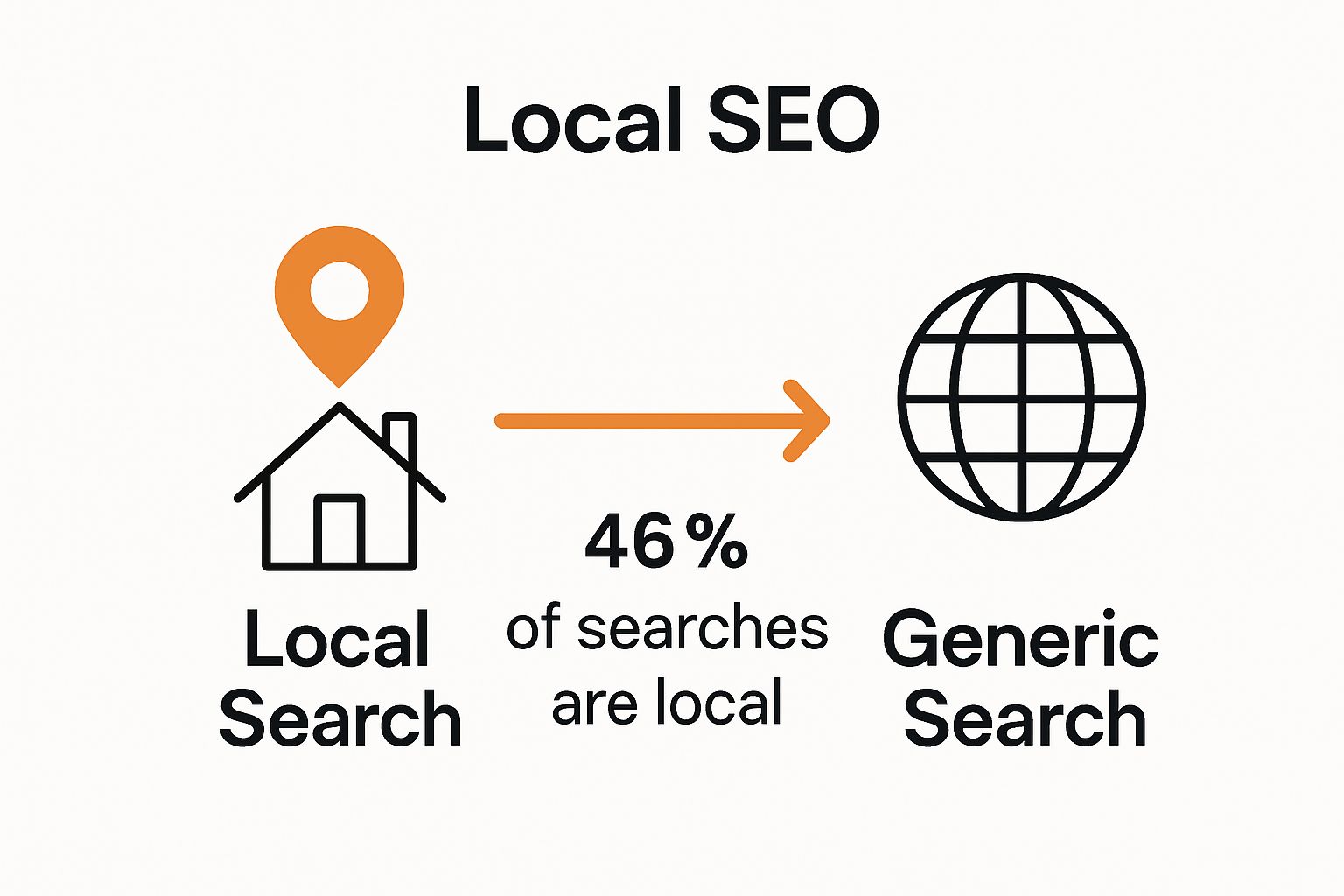
The Impact of Local Search on Consumer Behavior
Local search has fundamentally transformed how consumers discover, evaluate, and interact with businesses, particularly in service-oriented industries like real estate. The digital landscape has shifted consumer expectations, making immediate, geographically relevant information a critical factor in decision-making processes.
Understanding Consumer Search Patterns
Modern consumers have become increasingly sophisticated in their search behaviors, preferring hyper-targeted results that provide precise, localized information. In real estate, this means potential buyers and sellers are not just searching for generic property listings, but seeking agents, market insights, and property details specific to their immediate neighborhood or suburb.
Key characteristics of local search consumer behavior include:
- Preference for immediate, location-specific results
- High reliance on mobile devices for quick information retrieval
- Strong emphasis on user-generated content and local reviews
- Expectation of personalized, contextually relevant search experiences
Trust and Credibility in Local Searches
According to research from the National Association of Realtors, 97% of homebuyers use the internet during their property search, demonstrating the profound impact of digital platforms on real estate consumer behavior. Local search results play a crucial role in establishing trust and credibility.
Consumers view businesses with strong local search presence as more legitimate and trustworthy. For real estate professionals, this means that appearing in local search results is not just about visibility, but about creating a perception of local expertise and reliability. By consistently delivering accurate, location-specific information, agents can build digital credibility that translates into real-world client relationships.
The evolution of local search has fundamentally reshaped how consumers make purchasing decisions, turning geographical relevance into a key differentiator in competitive markets like real estate.
This table highlights research-backed statistics and their implications for local SEO and real estate agents, helping illustrate the importance and impact of local search strategies.
| Statistic | Source | Significance for Real Estate Agents |
|---|---|---|
| 46% of Google searches have local intent | BrightLocal, Moz | Indicates nearly half of searchers want local information. |
| 97% of homebuyers use the internet to search | National Association of Realtors | Confirms the digital-first behavior of today’s clients. |
| 44% of local pack results get click-throughs | Moz | Highlights the value of optimizing for Google’s local map pack. |
| 87% of consumers read reviews for local business | BrightLocal | Underscores the role of reviews in consumer trust decisions. |
How Local SEO Enhances Online Visibility for Agents
Local SEO serves as a powerful digital strategy that transforms how real estate professionals attract and engage potential clients in an increasingly competitive online marketplace. By strategically optimizing digital presence, agents can significantly amplify their visibility and reach within specific geographic territories.
Strategic Digital Positioning
Effective local SEO enables real estate agents to position themselves precisely where potential clients are searching. This means appearing prominently in local search results, map listings, and location-based queries that directly target individuals seeking property services in specific suburbs or neighborhoods.
Key strategic advantages of local SEO for real estate agents include:
- Targeting hyperlocal search queries with precision
- Increasing organic visibility in geographic-specific searches
- Building credibility through location-based content and reviews
- Competing effectively against larger real estate agencies
Maximizing Digital Real Estate
Real estate agent visibility depends on understanding and leveraging digital platforms strategically. According to Moz’s Local Search Ranking Factors, Google’s local pack results receive approximately 44% of all click-through traffic, making local SEO optimization crucial for capturing potential client attention.
Successful local SEO implementation goes beyond simple keyword optimization. It requires a comprehensive approach that includes consistent business information across online platforms, generating location-specific content, managing online reviews, and creating a robust Google Business Profile that accurately represents an agent’s local expertise and service areas.
By mastering local SEO techniques, real estate professionals can transform their digital presence from passive online listings to dynamic, engaging platforms that actively attract and convert potential clients in their target markets.

Key Components of Effective Local SEO Strategies
Local SEO demands a multifaceted approach that goes beyond simple keyword optimization. Real estate professionals must develop a comprehensive strategy that integrates multiple digital marketing elements to establish strong local online presence and credibility.
Foundational Local SEO Elements
Successful local SEO strategies for real estate agents require precise, strategic implementation across multiple digital platforms. This means creating a cohesive online ecosystem that signals local expertise and geographic relevance to both search engines and potential clients.
Critical foundational elements include:
- Consistent business name, address, and phone number across all online platforms
- Comprehensive and accurate Google Business Profile optimization
- Location-specific website content highlighting neighborhood expertise
- Strategic use of local keywords reflecting specific suburban markets
Technical and Content Optimization
Local real estate marketing requires careful attention to technical details and content quality. According to Ahrefs’ Local SEO Guide, successful strategies integrate precise technical optimization with high-quality, location-specific content that demonstrates deep understanding of local property markets.
Real estate professionals must focus on creating rich, informative content that addresses specific local market conditions, neighborhood insights, and hyperlocal property trends. This approach not only improves search engine rankings but also establishes the agent as a trusted local expert who understands the nuanced dynamics of specific geographic areas.
By implementing a holistic local SEO strategy, real estate agents can transform their digital presence from generic online listings to powerful, targeted marketing platforms that directly connect with potential clients in their specific service areas.
To clarify the foundational elements and technical strategies essential for effective local SEO in real estate, the table below breaks down the core components and their descriptions.
| Local SEO Component | Description |
|---|---|
| Consistent Business Information | Ensure name, address, and phone number are the same across all online platforms. |
| Google Business Profile Optimization | Keep your Google Business Profile accurate and complete to enhance local search visibility. |
| Location-Specific Website Content | Develop content focused on specific neighborhoods or suburbs to demonstrate local expertise. |
| Strategic Use of Local Keywords | Incorporate geographic keywords relevant to your service area for better targeted search results. |
| High-Quality Local Content | Publish in-depth, informative articles reflecting local market conditions and trends. |
| Online Review Management | Actively generate and manage reviews from local clients to build trust and authority. |
Real-World Examples of Local SEO Success in Real Estate
Local SEO represents more than a theoretical concept for real estate professionals. It is a practical strategy that can dramatically transform digital marketing effectiveness, enabling agents to capture targeted leads and establish neighborhood expertise through strategic online positioning.
Hyperlocal Content Strategies
Successful local SEO implementation requires agents to develop content that speaks directly to specific community needs and interests. This means creating detailed, location-specific resources that demonstrate deep understanding of particular suburbs, market trends, and neighborhood dynamics.
Key characteristics of successful hyperlocal content include:
- Detailed neighborhood guides with insider perspectives
- Market analysis specific to individual suburbs or districts
- Local market trend reports with current property insights
- Localized case studies highlighting recent property transactions
Measurable Impact and Conversion Potential
Location-based hashtags can play a significant role in amplifying local visibility. According to BrightLocal’s Local Consumer Review Survey, 87% of consumers read online reviews for local businesses in 2022, underscoring the critical importance of generating localized, trustworthy digital content.
Real estate agents who successfully implement local SEO strategies can experience remarkable outcomes. By developing targeted content that addresses specific community needs, agents transform their digital presence from generic listings to powerful, hyper-relevant marketing platforms that directly connect with potential clients in their precise service areas.
Through strategic local SEO approaches, real estate professionals can effectively differentiate themselves in competitive markets, demonstrating not just property expertise, but genuine community understanding and connection.
Take Control of Local Search and Become the Go-To Real Estate Expert
Are you struggling to stand out in your local market? The article made it clear: real estate clients are looking for agents who not only show up in suburb-level searches but also demonstrate true neighborhood expertise. With buyers relying on hyperlocal searches and online reviews, missing out on local SEO for real estate means leaving valuable opportunities on the table. It is time to stop feeling invisible or overwhelmed by the competition. Let the pain of low visibility propel you toward a better solution.
Let Content Charlie transform your online presence. Gain immediate traction with suburb-specific content, property descriptions, and Google Business Profile optimization that puts you in front of motivated buyers and sellers. Visit Content Charlie today and discover how our copywriting and proven real estate agent visibility strategies can help you dominate your market. Book your free discovery call now and make sure you are the agent local clients remember.
Frequently Asked Questions
What is local SEO and why is it important for real estate?
Local SEO is a digital marketing strategy that helps real estate professionals optimize their online presence for geographically targeted searches. It is important because it increases visibility among potential clients actively searching for property services in their area. Focus on optimizing your Google Business Profile and creating location-specific content to enhance your local search presence.
How can I improve my local search rankings as a real estate agent?
To improve your local search rankings, ensure that your business name, address, and phone number are consistent across all online platforms. Additionally, optimize your website with local keywords and generate positive reviews from satisfied clients. Take these actions to see improvements in local search visibility within 60 days.
What role does online reviews play in local SEO for real estate?
Online reviews significantly impact local SEO as they enhance credibility and trust among potential clients. Actively encourage satisfied clients to leave reviews on your Google Business Profile and other platforms to boost your visibility and attract more leads. Aim to gather at least five to ten new reviews each month.
Why should I create location-specific content for my real estate website?
Creating location-specific content helps demonstrate your expertise in specific neighborhoods or suburbs, making your services more relevant to potential clients. This targeted approach improves your local search rankings and attracts clients looking for detailed information about their desired area. Develop at least one piece of location-focused content each month to maintain relevance.
How can local SEO help me stand out from larger real estate agencies?
Local SEO can help you differentiate yourself by highlighting your specialized knowledge of local markets and community needs. By focusing on hyperlocal optimization strategies and personalized content, you can build stronger connections with potential clients. Implement tailored marketing strategies to position yourself as the go-to local expert and increase client engagement in your target market.
What should I monitor to measure the success of my local SEO efforts?
To measure the success of your local SEO efforts, monitor key metrics such as website traffic from local searches, the number of leads generated, and your rankings in local search results. Tools like Google Analytics can help you track these metrics over time. Review your progress every month to adjust your strategies effectively.
Recommended
- local SEO for real estate Archives – Content Charlie
- Local SEO Archives – Content Charlie
- real estate SEO Archives – Content Charlie
- SEO for realtors Archives – Content Charlie