
- You are here:
- Home »
- SEO mistakes
Tag Archives for " SEO mistakes "

SEO for Realtors Explained: Strategies for Dominance
Did you know that over 90 percent of home buyers begin their search online? With so much competition, showing up on the first page of search results can mean the difference between a steady stream of leads and missing out altogether. By understanding the core principles of SEO for realtors, you can reach more serious buyers and sellers right when they need expert guidance most.
Table of Contents
- SEO For Realtors: Essential Concepts Explained
- Types Of SEO For Real Estate Agents
- Local Keyword Strategies And Content Optimisation
- Optimising Google Business Profile Listings
- Common SEO Mistakes And Pitfalls To Avoid
Key Takeaways
| Point | Details |
|---|---|
| SEO Importance | Effective SEO enhances visibility, brand awareness, and marketing cost-effectiveness for realtors. |
| Local Optimization | Focus on local keyword strategies and create location-specific content to attract relevant leads. |
| Google Business Profile | Optimize your Google Business Profile with accurate information and engage with reviews to boost local search rankings. |
| Avoid Common Mistakes | Steer clear of vague titles, duplicate content, and neglecting mobile optimization to improve search visibility. |
SEO for Realtors: Essential Concepts Explained
Search engine optimization (SEO) is the strategic practice of enhancing your real estate website’s visibility in organic search results. According to dxstudio, effective SEO can dramatically boost brand awareness and improve the cost-effectiveness of marketing efforts by achieving higher search rankings.
For real estate professionals, SEO fundamentals involve several critical components. The Maine guidelines highlight key practices that translate directly to real estate websites:
- Create clear, descriptive page titles
- Generate original, high-quality content
- Use keywords strategically and appropriately
- Implement accessibility features like accurate image alt text
Successful real estate SEO requires understanding how potential clients search online. This means optimizing your website to appear when someone searches for terms like “homes in [your suburb]” or “real estate agents near me.” By focusing on local search optimization, you can attract more qualified leads directly through your website. To maximize your SEO strategy, learn more about real estate website essentials and how to build a site that both search engines and clients will love.
Types of SEO for Real Estate Agents
In the dynamic world of real estate digital marketing, understanding different SEO strategies is crucial for agents looking to stand out online. According to Coursera, SEO encompasses three primary approaches: on-page optimization, off-page optimization, and technical SEO, each playing a unique role in improving search engine rankings.
Here’s a summary of the main types of SEO for real estate agents:
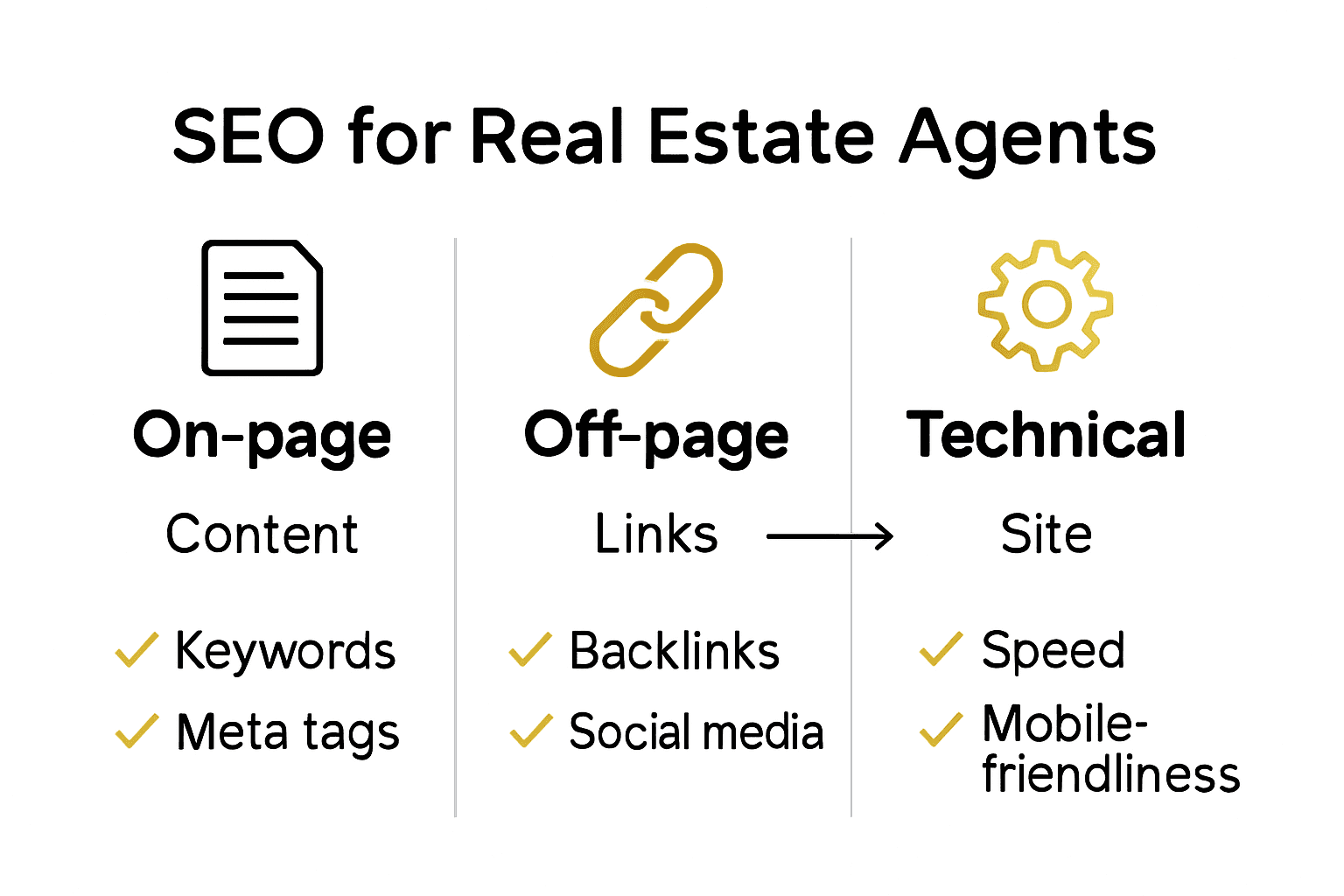
| SEO Type | Focus Area | Key Examples |
|---|---|---|
| On-Page SEO | Website content & structure | Keyword-rich property pages Optimized meta tags Local blog posts |
| Off-Page SEO | External reputation & authority | Backlinks from directories Realtor citations Community websites |
| Technical SEO | Website performance & search engine access | Fast loading speed Mobile responsiveness Secure HTTPS |
On-Page SEO focuses directly on your website’s content and structure. For real estate professionals, this means:
- Creating property descriptions with strategic keywords
- Developing suburb-specific landing pages
- Writing informative blog content about local real estate trends
- Optimizing meta titles and descriptions for each page
Off-Page SEO involves building your website’s credibility through external factors. This includes generating quality backlinks from local business directories, real estate platforms, and community websites. Coursera’s search engine optimization research emphasizes that off-page tactics signal to search engines that your website is a trusted resource in the real estate market.
Technical SEO ensures your website meets search engine infrastructure requirements. For real estate agents, this means creating a fast, mobile-responsive site with clean code, secure connections, and easy navigation. By understanding and implementing these SEO tips to boost agent visibility, you’ll dramatically improve your chances of ranking higher in local search results.

Local Keyword Strategies and Content Optimisation
Local keyword strategies are the backbone of successful real estate SEO, enabling agents to connect directly with potential clients searching in specific areas. According to Florida Realtors, creating location-specific content can significantly enhance search engine rankings by providing valuable community information including demographics, schools, amenities, and local points of interest.
Effective local keyword optimization involves multiple strategic approaches:
- Develop detailed suburb and neighborhood landing pages
- Incorporate hyperlocal keywords naturally into website content
- Use location-specific terms in headers, titles, and meta descriptions
- Create blog posts highlighting local market trends and community insights
The Splendour Group emphasizes the importance of hyperlocal content, recommending that real estate agents integrate location details throughout their digital presence. This means going beyond generic property listings to craft content that speaks directly to local buyers and sellers. By understanding the nuanced search behaviors of potential clients, you can create local SEO strategies that position you as the go-to real estate expert in your specific market.
To truly dominate local search results, real estate agents must think like their potential clients. This means anticipating the specific search terms people use when looking for properties, understanding local market dynamics, and creating content that answers their most pressing questions about neighborhoods, property values, and community living.
Optimising Google Business Profile Listings
A Google Business Profile is the digital storefront for real estate agents, serving as a critical first impression for potential clients searching online. According to Energy.gov, optimizing this profile requires providing accurate and comprehensive information, including your business name, address, phone number, and precise operating hours.
Key strategies for maximizing your Google Business Profile effectiveness include:
- Upload high-quality, professional photos of your team and properties
- Write a compelling business description that highlights your unique value
- Select the most relevant business categories
- Verify your business location to increase credibility
- Respond promptly to all customer reviews
The Splendour Group emphasizes that maintaining an up-to-date profile can dramatically improve local search rankings. Encouraging satisfied clients to leave positive reviews not only boosts your visibility but also builds trust with potential customers. By consistently updating your Google Business Profile, you signal to both Google and potential clients that you’re an active, engaged real estate professional.
Remember, your Google Business Profile is more than just a listing—it’s a powerful marketing tool that can significantly influence a potential client’s first impression. Regular maintenance, authentic engagement, and strategic optimization can transform this simple profile into a lead-generating machine for your real estate business.
Common SEO Mistakes and Pitfalls to Avoid
Real estate agents often stumble into SEO traps that can significantly undermine their online visibility. According to Maine, common mistakes include using vague page titles, neglecting comprehensive keyword research, and failing to produce original, high-quality content that truly serves potential clients.
Critical SEO pitfalls for real estate professionals include:
- Keyword stuffing that makes content unreadable
- Neglecting mobile optimization
- Using duplicate content across property listings
- Ignoring local search intent
- Failing to update website content regularly
DX Studio emphasizes the importance of understanding search intent and user behavior. For real estate agents, this means creating content that genuinely answers potential clients’ questions about properties, neighborhoods, and market trends. By exploring these nuanced search behaviors, you can craft SEO myths guide content that resonates with your target audience and improves your search rankings.
The most successful real estate SEO strategies require a holistic approach. Stop treating your website as a static brochure and start viewing it as a dynamic, interactive resource that adapts to potential clients’ evolving needs. Continuous learning, regular content updates, and a genuine commitment to providing value will set you apart in the competitive digital real estate landscape.
Take Control of Your Real Estate SEO Today
Struggling to break through the noise in local search results or frustrated that your property listings do not attract qualified leads? The challenges highlighted in “SEO for Realtors Explained” show how important it is to master local keyword strategies, create compelling Google Business Profile content, and avoid common SEO mistakes like duplicate and poorly optimized content. If you want to be the trusted local expert buyers and sellers find first, your website and content must truly stand out.
At Content Charlie, we specialize in crafting SEO-driven real estate copy that connects with your audience on a suburb level — from targeted property descriptions to engaging blog articles that boost your search rankings. Our tailored approach helps you capture the right traffic by focusing on the exact terms your customers use when searching for homes or agents nearby.

Ready to transform your online presence and dominate local searches? Visit Content Charlie now to explore how our local SEO and real estate copywriting services can turn your website into a lead-generating machine. Don’t let your competition outshine you—take action today and position your brand as the go-to real estate professional in your community.
Frequently Asked Questions
What is SEO for realtors?
Search engine optimization (SEO) for realtors is the practice of improving a real estate website’s visibility in search engine results. It involves various strategies aimed at attracting potential clients through organic search traffic.
What are the main types of SEO strategies for real estate agents?
The main types of SEO strategies for real estate agents include on-page SEO, off-page SEO, and technical SEO. On-page SEO focuses on website content and structure, off-page SEO builds external credibility through backlinks, and technical SEO ensures site performance and search engine accessibility.
How can local keyword strategies enhance my real estate SEO?
Local keyword strategies can enhance your real estate SEO by targeting specific community-related terms. Creating location-specific content helps your website appear in searches for properties in those areas, connecting you directly with potential clients.
What are common SEO mistakes real estate agents should avoid?
Common SEO mistakes to avoid include keyword stuffing, neglecting mobile optimization, using duplicate content, ignoring local search intent, and failing to update website content regularly. These errors can significantly reduce your online visibility and effectiveness.
Recommended

Real Estate SEO Myths: Complete Guide for Agents
Did you know that over 90 percent of property searches begin online? For real estate agents, showing up on the first page of search results can mean the difference between a flood of leads and an empty inbox. Misunderstandings about Search Engine Optimization often keep agents from realizing their digital potential. Understanding what truly drives real estate SEO gives you a real edge in connecting with tomorrow’s buyers and sellers.
Table of Contents
- Defining Real Estate SEO and Common Myths
- Debunking Popular Real Estate SEO Beliefs
- Local SEO Myths for Australian Agents
- Truths About Google Rankings and Content
- Real-World Impact of Following SEO Myths
Key Takeaways
| Point | Details |
|---|---|
| Continuous SEO Effort | Real estate SEO is an ongoing process requiring regular updates and strategic monitoring for effective results. |
| Quality Over Quantity | Focusing on high-quality, relevant content is essential for improving search engine rankings, rather than just increasing keyword usage. |
| Local Optimization is Crucial | Hyper-targeted local SEO strategies, including unique content and optimized listings, significantly enhance visibility in competitive markets. |
| Understanding Realistic Expectations | SEO should not be viewed as a quick fix; agents must commit to long-term strategies to improve online visibility and client acquisition. |
Defining Real Estate SEO and Common Myths
Real estate Search Engine Optimization (SEO) is the strategic process of enhancing your online visibility to attract potential property buyers and sellers through organic search results. According to research from Zillow, SEO involves optimizing your website to improve its ranking in search engine results, ultimately driving more targeted traffic to your real estate business.
Many agents misunderstand SEO, believing it’s a simple one-time task with guaranteed immediate results. As insights from Breakthrough Broker reveal, SEO is actually a continuous process requiring regular updates and strategic monitoring. Common myths that can derail an agent’s digital strategy include:
- Believing more keywords automatically mean better rankings
- Assuming social media directly impacts search engine rankings
- Thinking SEO is a quick fix rather than an ongoing effort
Successful real estate SEO requires understanding that search engines prioritize high-quality, relevant content that genuinely helps potential clients. This means creating suburb guides, property market insights, and targeted local content that answers specific questions your audience might have. By focusing on providing value and maintaining consistent website optimization, you’ll gradually improve your online visibility and attract more qualified leads.
For a comprehensive breakdown of real estate SEO terminology, check out our guide on real estate SEO jargon to help you navigate this complex digital landscape.
Debunking Popular Real Estate SEO Beliefs
Real estate agents often fall prey to common misconceptions about Search Engine Optimization (SEO) that can significantly hinder their online marketing efforts. According to insights from Realty Ninja, one critical mistake is using identical listing descriptions across multiple platforms, which creates duplicate content and negatively impacts search rankings.
Beyond content uniqueness, many agents misunderstand the fundamental nature of SEO. As Breakthrough Broker explains, SEO is not a one-time task but a continuous process requiring consistent effort and strategic updates. Common myths that can derail your digital strategy include:
Here’s a breakdown of top real estate SEO myths versus the reality:
| SEO Myth | The Reality | Impact if Believed |
|---|---|---|
| More keywords mean better rankings | Quality and relevance matter more | Poor search performance |
| Social media directly improves rankings | Social signals have indirect effect only | Misallocated marketing focus |
| SEO is a quick, one-time fix | SEO is ongoing and requires updates | Loss of long-term visibility |
| Duplicate listings are harmless | Unique content is critical | Lowered search ranking |
| Location-specific keywords are unnecessary | Hyper-local terms boost local results | Missed local opportunities |
- Believing you can achieve instant search ranking improvements
- Assuming more keywords automatically mean better search results
- Thinking SEO is a set-it-and-forget-it marketing approach
To truly enhance your online visibility, you must develop a dynamic SEO strategy that focuses on creating unique, valuable content tailored to your local market. This means crafting original property descriptions, developing suburb-specific guides, and regularly updating your website with fresh, relevant information. By understanding how blogging can boost your real estate SEO, you’ll create a more robust and effective digital marketing approach that attracts potential clients and improves your search rankings over time.
Local SEO Myths for Australian Agents
Local Search Engine Optimization (SEO) is a critical strategy for real estate agents looking to dominate suburb-specific markets across Australia. According to Web Globals, many agents mistakenly believe that a generic online presence is sufficient to attract local clients. In reality, hyper-local optimization is key to standing out in competitive real estate markets.
Common misconceptions about local SEO can significantly hinder an agent’s digital marketing efforts. Locally.net.au highlights the importance of creating targeted local landing pages and maintaining consistent business listings across different platforms. Myths that can derail your local search strategy include:
- Assuming all online listings are equally effective
- Believing location-specific keywords are unnecessary
- Thinking social media followers automatically translate to local visibility
To truly excel in local SEO, agents must develop a hyper-targeted digital presence that speaks directly to specific suburbs and local communities. This means creating unique content for each area you serve, optimizing Google Business Profile listings, and understanding local market differentiation strategies that set you apart from competitors. By focusing on authentic, locally-relevant content and precise geographic targeting, you’ll improve your chances of appearing in crucial suburb-level searches and attracting potential clients in your specific real estate market.

Truths About Google Rankings and Content
Google Rankings are far more nuanced than most real estate agents realize. According to Realty Ninja, one critical mistake that can torpedo your search visibility is using duplicate content, such as recycling identical listing descriptions across multiple platforms. Search engines penalize websites that don’t offer unique, valuable information.
Breakthrough Broker emphasizes that SEO is a long-term strategy, not an overnight miracle. Agents often harbor unrealistic expectations about search rankings, believing they can achieve top positions through quick tricks. The truth is more complex:
- Rankings improve through consistent, high-quality content
- Unique property descriptions matter more than keyword stuffing
- Patience and strategic effort are essential for SEO success
To truly understand how to improve your digital presence, dive into the role of content in SEO and recognize that Google rewards websites providing genuine value to potential clients. This means crafting original suburb guides, detailed property insights, and locally targeted content that answers real questions your audience is asking. Your goal isn’t just to rank, but to become a trusted local authority that search engines and clients both respect.
Real-World Impact of Following SEO Myths
Believing in SEO misconceptions can have devastating consequences for real estate agents’ digital marketing efforts. According to Realty Ninja, minimal content is a critical error that directly impacts search engine visibility. Agents who skimp on comprehensive, unique content essentially render themselves invisible in the digital marketplace.
Breakthrough Broker highlights the long-term repercussions of treating SEO as a one-time task. The real-world consequences of following outdated SEO myths include:
- Dramatically reduced online visibility
- Lower client acquisition rates
- Missed opportunities in competitive markets
- Potential loss of potential commission income
To understand the true financial impact of SEO strategies, real estate professionals must recognize that digital marketing is an ongoing investment. Poor SEO practices don’t just limit your online presence they directly translate to fewer leads, fewer property viewings, and ultimately, less revenue. Your digital strategy needs to be as dynamic and adaptable as the real estate market itself – constantly evolving, always engaging, and strategically positioned to capture potential clients’ attention.
Break Free from Real Estate SEO Myths and Get Found Locally
If you are struggling with common SEO misconceptions like quick fixes or copy-pasting listing descriptions, you are not alone. The article highlights how ongoing, strategic local SEO and unique, relevant content make the difference between invisibility and becoming a trusted market leader. Without a clear, focused approach, your online presence will remain buried beneath competitors who understand how to win suburb-level searches.
Content Charlie specializes in crafting exactly the kind of high-quality, localized copy that Google and your clients crave. From detailed suburb guides to engaging property descriptions and optimized Google Business Profile content, we help real estate agents rise above SEO myths and shine in their communities.
Take control of your digital future today by partnering with Content Charlie. Visit us at Content Charlie now to unlock local SEO strategies that deliver real results and make your brand the first choice for buyers and sellers in your market.
Frequently Asked Questions
What is real estate SEO?
Real estate SEO is the process of optimizing a real estate website to improve its visibility in search engine results, attracting potential buyers and sellers through organic search traffic.
Is SEO a one-time task for real estate agents?
No, SEO is an ongoing process that requires continuous updates and regular monitoring to maintain and improve search rankings over time.
How important is unique content for real estate websites?
Unique content is critical as it helps avoid duplicate content penalties from search engines, improves search rankings, and provides genuine value to potential clients.
Can social media presence improve my real estate SEO results?
Social media can indirectly impact SEO results by driving traffic to your website and increasing brand visibility, but it does not directly influence search engine rankings.
Recommended
- Real Estate SEO Jargon Explained: Essential Guide – Content Charlie
- Real Estate Website Essentials: Complete Guide for Agents – Content Charlie
- Complete Guide to Copywriting in Real Estate – Content Charlie
- SEO for Real Estate Agencies: Simple Strategies to Grow Your Business
- Understanding SEO Best Practices for Your Business – My Blog

Real Estate SEO Jargon Explained: Essential Guide
Real Estate SEO Jargon can be confusing. In this article we’ll explain the basics to get you sorted.
Only about 5.7 percent of websites reach Google’s top 10 rankings within their first year, which leaves many real estate agents wondering how to stand out online. Understanding the world of real estate SEO can make the difference between languishing on page five or popping up when local clients search for listings. Grasping the true meaning behind common SEO terms helps agents sidestep costly mistakes and build digital strategies that actually connect with buyers and sellers.
Table of Contents
- Defining Real Estate SEO Jargon And Misconceptions
- Key Categories Of SEO Terms In Property Marketing
- Essential On-Page And Off-Page SEO Vocabulary
- How Agents Apply SEO Jargon In Practice
- Common Jargon Mistakes And What To Avoid
Key Takeaways
| Point | Details |
|---|---|
| Understanding SEO’s Importance | Real estate SEO is critical for enhancing online visibility, with only 5.7% of websites achieving top Google rankings in a year. |
| Implementing Key Strategies | Effective SEO requires targeted actions such as location-specific content, mobile optimization, and consistent content updates. |
| Mastering On-Page and Off-Page SEO | Both on-page and off-page SEO strategies are essential for improving search rankings and establishing credibility. |
| Avoiding Common Mistakes | Agents should ensure accuracy in Google Business Profile management and select a balanced domain name to enhance online presence. |
Defining Real Estate SEO Jargon and Misconceptions
Search Engine Optimization (SEO) represents the strategic process of enhancing website visibility and ranking within search engine results. Real estate SEO focuses specifically on helping property professionals increase their online presence and attract potential clients through targeted digital strategies. According to research from Kent University, only 5.7% of websites successfully reach top 10 Google rankings within a year, highlighting the critical importance of understanding SEO fundamentals.
In the competitive real estate landscape, SEO isn’t just about keywords – it’s about creating a comprehensive digital strategy that connects agents with potential buyers and sellers. Strategic domain name selection plays a crucial role in this process, making websites more discoverable and memorable. Understanding Real Estate SEO Metrics Explained can provide deeper insights into measuring and improving your online performance.
Common SEO misconceptions can significantly hinder a real estate professional’s online marketing efforts. Many agents mistakenly believe that simply having a website guarantees visibility, when in reality, targeted optimization is required. Key SEO strategies for real estate professionals include:
- Creating location-specific content
- Optimizing website loading speeds
- Developing mobile-responsive designs
- Generating high-quality, relevant backlinks
- Consistently updating website content
By demystifying SEO jargon and implementing strategic techniques, real estate agents can transform their digital presence and attract more potential clients through improved search engine rankings.
Key Categories of SEO Terms in Property Marketing
Keyword optimization is the foundational pillar of effective real estate digital marketing strategies. According to research from Kent University, SEO success hinges on making content as relevant as possible, which includes strategic use of tags, page titles, categories, and carefully selected keywords. In the competitive real estate landscape, understanding these critical SEO categories can dramatically improve online visibility.
The primary categories of SEO terms in property marketing can be broken down into several key areas. Keyword optimization techniques play a crucial role in helping real estate professionals target specific search queries. These categories typically include:
- Domain Keywords: Incorporating location-specific or property-type terms
- On-Page SEO: Optimizing page titles, meta descriptions, and content
- Local SEO: Targeting geographically relevant search terms
- Technical SEO: Improving website performance and crawlability
- Content SEO: Creating valuable, search-engine-friendly property descriptions
Research indicates that strategic keyword incorporation can be particularly powerful in real estate digital marketing. As noted in domain name optimization studies, keywords like ‘homes’, ‘realty’, ‘properties’, or location-specific terms can directly target common search queries, making your online presence more discoverable and attractive to potential clients. By mastering these SEO categories, real estate professionals can significantly enhance their digital marketing effectiveness and attract more qualified leads.

Essential On-Page and Off-Page SEO Vocabulary
Understanding the critical vocabulary of Search Engine Optimization (SEO) is fundamental for real estate professionals seeking to enhance their digital marketing strategies. According to research from Kent University, SEO optimization involves making content as relevant as possible through strategic use of tags, page titles, categories, and carefully selected keywords.
On-Page SEO terminology focuses on elements directly within your website that can be optimized. On-page optimization techniques encompass critical elements such as:
- Meta Descriptions: Concise page summaries
- Title Tags: Webpage headline text
- Header Tags (H1, H2): Content structure indicators
- Internal Linking: Connecting related website pages
- Keyword Density: Frequency of target search terms
Off-Page SEO terminology, conversely, refers to external factors that influence your website’s search rankings. These include backlink quality, social media mentions, and domain authority. Just as domain name optimization studies suggest using keywords like ‘homes’ or ‘properties’ to target specific search queries, off-page strategies help establish your website’s credibility and relevance in the broader digital ecosystem.
By mastering both on-page and off-page SEO vocabularies, real estate professionals can create a comprehensive digital strategy that improves search engine visibility and attracts more potential clients.
Here’s a summary of essential on-page vs. off-page SEO terms in real estate:
| SEO Aspect | On-Page SEO | Off-Page SEO |
|---|---|---|
| Focus Areas | Content quality Meta tags Internal linking |
Backlinks Social mentions Domain authority |
| Key Elements | Title tags Header tags Keyword density |
Referring domains Google My Business Online reviews |
| Primary Goal | Improve website relevance | Build website credibility |
| Control Level | Full (by website owner) | Partial (influenced by others) |
How Agents Apply SEO Jargon in Practice
In the competitive real estate market, digital marketing strategies have become essential for agents looking to stand out. According to digital marketing research, strategic online presence can dramatically improve an agent’s ability to attract potential clients and close sales. Digital marketing insights reveal that successful real estate professionals leverage SEO techniques to increase their visibility and credibility.
Practical application of SEO jargon requires a strategic approach to online presence. Agents must pay careful attention to critical elements like:
- Google Business Profile (GBP) Optimization: Ensuring 100% consistency in Name, Address, and Phone (NAP) details
- Local Keyword Targeting: Using location-specific search terms
- Content Localization: Creating neighborhood-specific property descriptions
- Backlink Building: Establishing credibility through quality external references
- Mobile-Friendly Website Design: Ensuring seamless user experience across devices
One of the most crucial practical applications involves domain name strategy. As research indicates, a strategic domain name can significantly boost a real estate business’s online presence, making it easier for potential buyers and sellers to find and trust an agent. By understanding and implementing these SEO techniques, real estate professionals can transform their digital marketing approach from generic to highly targeted, ultimately increasing their chances of connecting with potential clients in an increasingly competitive market.
Common Jargon Mistakes and What to Avoid
In the intricate world of real estate digital marketing, SEO terminology can become a minefield of potential missteps. Keyword research strategies reveal that agents often fall into common traps that can significantly diminish their online visibility and credibility.
One of the most critical areas for avoiding mistakes is Google Business Profile (GBP) management. According to digital marketing research, common GBP errors can substantially impact an agent’s online reputation. These mistakes include:
- Using a P.O. box instead of a physical address
- Leaving business hours incomplete or inaccurate
- Uploading low-resolution or generic stock photos
- Neglecting to respond to customer reviews
- Skipping the Q&A section entirely
Another significant pitfall involves domain name selection. Experts caution that agents must strike a delicate balance between keyword relevance and brand identity. A domain name that’s too generic risks blending into the background, while an overly specific name can artificially limit business potential. By carefully navigating these linguistic nuances, real estate professionals can create a robust online presence that speaks directly to potential clients while maintaining a strong, distinctive brand identity.
Master Real Estate SEO Jargon with Content Charlie
Struggling to turn confusing real estate SEO jargon into actionable results for your business Is your goal to attract more local clients and boost your Google rankings with clear and effective digital marketing strategies The article highlights key challenges like optimizing your Google Business Profile and selecting the right domain keywords all crucial for standing out online
At Content Charlie, we specialize in crafting SEO-driven copy that speaks directly to local buyers and sellers. From creating compelling Google Business Profile content to writing suburb guides and property descriptions focused on keyword optimization, we turn complex SEO concepts into real results for your agency. Take control of your online presence now and avoid common pitfalls that hold agents back.
Ready to rise above the competition and dominate local search Results Visit Content Charlie today for tailored real estate SEO solutions designed to get you found and chosen by clients actively looking in your market. Don’t let SEO jargon keep you stuck when expert help is just a click away.
Frequently Asked Questions
What is Real Estate SEO?
Real Estate SEO refers to the strategic process of enhancing the online visibility and ranking of real estate websites within search engine results. It focuses on attracting potential clients through targeted digital strategies.
Why is keyword optimization important in real estate SEO?
Keyword optimization is critical because it helps real estate professionals target specific search queries relevant to their services. Incorporating location-specific or property-type keywords can make your online presence more discoverable to potential clients.
What are some essential on-page SEO techniques for real estate professionals?
Essential on-page SEO techniques include optimizing meta descriptions, title tags, header tags, internal linking, and maintaining an appropriate keyword density throughout the website content.
How can agents improve their Google Business Profile for better SEO?
Agents can improve their Google Business Profile by ensuring consistency in their Name, Address, and Phone (NAP) details, providing accurate business hours, uploading high-quality images, responding to customer reviews, and using the Q&A section to engage with potential clients.