
- You are here:
- Home »
- real estate agents
Tag Archives for " real estate agents "

Understanding Why Blogging Boosts SEO for Real Estate
SEO can feel overwhelming for real estate agents who want their websites to attract real clients. Most believe you have to master every algorithm and tech trick out there. We need to understand why blogging boosts seo.
Yet the surprising truth is that consistent blogging alone can make your website up to 4 times more effective at reaching qualified leads. That flips the script on what really drives online success.
Table of Contents
- The Basics Of Seo And Blogging
- How Blogging Improves Website Authority
- The Role Of Keywords And Content Strategy
- Engagement And Audience Connection Through Blogging
- Long-Term Benefits Of Consistent Blogging
Quick Summary
| Takeaway | Explanation |
|---|---|
| Create relevant content consistently | Regularly publishing blogs increases website visibility and attracts qualified leads. |
| Focus on strategic keyword integration | Use long-tail keywords tailored to specific client needs to enhance searchability. |
| Build website authority through quality | High-quality, informative content establishes trust and credibility with search engines and clients. |
| Engage with your audience genuinely | Personal insights and addressing client concerns help build a loyal readership and community trust. |
| Invest in long-term blogging | A consistent blogging strategy creates lasting digital resources that continue to attract traffic over time. |
The Basics of SEO and Blogging
Search Engine Optimization (SEO) represents a strategic approach that helps websites become more visible and attractive to search engines like Google.
For real estate professionals, blogging serves as a powerful mechanism to enhance online presence and attract potential clients through targeted content.
Google’s search documentation emphasizes that quality content helps search engines discover, crawl, and understand website information effectively.
Understanding SEO Fundamentals
At its core, SEO involves optimizing digital content to rank higher in search engine results pages (SERPs). For real estate agents, this means creating content that answers potential clients’ questions about property markets, neighborhoods, buying strategies, and local real estate trends.
The goal is not just attracting website visitors but drawing qualified leads who are genuinely interested in real estate services.
How Blogging Supports SEO Strategy
Blogs provide multiple advantages for SEO performance. They allow real estate professionals to:
- Generate fresh, relevant content consistently
- Target specific keywords related to local property markets
- Demonstrate professional expertise and market knowledge
- Create opportunities for internal and external linking
By publishing regular, high-quality content that addresses client interests and local real estate dynamics, agents can signal to search engines that their website is an authoritative and valuable resource. Learn more about content marketing strategies that can elevate your real estate business’s online visibility.
Successful SEO through blogging requires understanding audience needs, researching relevant keywords, and delivering informative content that provides genuine value to potential property buyers and sellers.
How Blogging Improves Website Authority
Website authority represents a critical metric determining how search engines perceive the credibility and relevance of a digital platform.
For real estate professionals, building this authority through strategic blogging can significantly enhance online visibility and attract potential clients. Moz’s Domain Authority research highlights that websites with consistent, high-quality content tend to rank higher in search engine results.
The Role of Content Quality and Consistency
Blogs serve as a powerful mechanism for establishing expertise and trustworthiness in the real estate market. By producing informative, original content that addresses specific client questions and concerns, agents can demonstrate deep understanding of local property landscapes.
Consistent publishing signals to search engines that a website is active, relevant, and committed to providing valuable insights.
Building Credibility Through Strategic Content
Website authority is not just about quantity but the strategic depth of content. Real estate professionals can enhance their digital credibility by:
- Creating in-depth neighborhood guides
- Analyzing local market trends
- Sharing expert insights on property investment
- Addressing common client questions and challenges
These approaches transform a blog from a simple webpage into a comprehensive resource that search engines recognize as authoritative.
Explore strategies for boosting Google rankings to further understand how strategic content can elevate your online presence.
By consistently delivering valuable, targeted content, real estate agents can systematically build website authority that attracts both search engine algorithms and potential clients seeking genuine expertise.
To clarify how strategic blogging impacts website authority in real estate, the table below breaks down the key characteristics of quality content versus consistency and explains how each contributes to higher search engine rankings.
| Characteristic | Impact on SEO | How It Builds Authority |
|---|---|---|
| Content Quality | Elevates site in search rankings | Signals expertise and trustworthiness |
| Content Consistency | Encourages regular site crawling by search engines | Shows site is active and relevant |
| In-depth Market Analysis | Targets client needs and search intent | Demonstrates knowledge of local trends |
| Addressing Client Questions | Attracts targeted traffic | Builds reputation as a resource |
| Originality | Reduces competition with duplicate content | Distinguishes the agent |
| s voice |

The Role of Keywords and Content Strategy
Keywords represent the critical bridge connecting potential real estate clients with relevant online content.
Developing a sophisticated content strategy that integrates targeted keywords naturally can transform a blog from a simple collection of posts into a powerful lead generation tool.
Moz’s SEO guide emphasizes that strategic keyword selection enables websites to appear precisely where potential clients are searching.
Understanding Keyword Relevance in Real Estate
For real estate professionals, keyword strategy goes beyond generic terms like “houses for sale.” Successful content marketing requires understanding the nuanced search behaviors of local property seekers.
This means identifying long-tail keywords that reflect specific client intentions, such as “three-bedroom homes in Brisbane waterfront” or “investment properties near Gold Coast beaches.”
Crafting a Strategic Content Approach
Effective keyword integration demands a comprehensive approach that considers multiple factors:
- Identifying local search patterns
- Matching keywords with specific client needs
- Creating content that genuinely answers user questions
- Balancing keyword density with natural, engaging writing
Real estate agents must think beyond simple keyword placement and focus on developing content that provides genuine value and directly addresses potential client queries. Learn more about content marketing strategies that can help refine your approach to digital visibility.
By understanding and implementing a sophisticated keyword strategy, real estate professionals can create content that not only ranks well in search results but also meaningfully connects with potential buyers and sellers seeking expert guidance.
Engagement and Audience Connection Through Blogging
Blogging transcends traditional marketing by creating meaningful connections between real estate professionals and potential clients. Authentic, valuable content transforms a website from a mere digital brochure into an interactive platform for community engagement.
Sprout Social’s research on social media engagement highlights how consistent, relevant content encourages deeper audience interactions.
Building Trust Through Personalized Content
Successful real estate blogs go beyond property listings by sharing insights that demonstrate genuine understanding of client needs. This approach involves crafting narratives that speak directly to potential buyers’ and sellers’ challenges, fears, and aspirations.
By addressing specific local market nuances, real estate agents can position themselves as trusted neighborhood experts rather than simply transactional service providers.
Strategies for Meaningful Audience Interaction
Engagement requires a multifaceted approach that encourages reader participation and builds community trust:
- Creating content that answers specific client questions
- Sharing personal insights about local neighborhood developments
- Providing actionable advice for property investors
- Responding promptly to comments and reader inquiries
Learn more about building writing connections to enhance your digital communication strategy. Real estate professionals who consistently deliver value through their blogs can transform casual website visitors into loyal followers and potential long-term clients, ultimately driving both SEO performance and business growth.
This table summarizes various approaches real estate professionals can use to foster engagement and build audience connection through blogging, highlighting the focus of each strategy and the main benefit it delivers.
| Engagement Strategy | Focus | Main Benefit |
|---|---|---|
| Answering Client Questions | Addressing specific local concerns | Builds trust and authority |
| Sharing Neighborhood Insights | Providing personal perspectives | Demonstrates local expertise |
| Offering Actionable Advice | Giving investment or buying tips | Positions agent as a problem-solver |
| Responding to Comments/Inquiries | Interactive communication | Encourages repeat visits and loyalty |
| Sharing Market Developments | Real-time updates and market trends | Keeps content fresh and relevant |
Long-Term Benefits of Consistent Blogging
Consistent blogging represents a strategic investment in digital marketing that compounds value over time for real estate professionals.
Unlike traditional advertising that provides temporary visibility, blog content creates a lasting digital footprint that continually attracts potential clients.
HubSpot research demonstrates that companies prioritizing blogging experience significantly higher return on investment through sustained web traffic and lead generation.
Compounding Content Value
Each blog post functions as a permanent asset in a real estate agent’s digital portfolio.
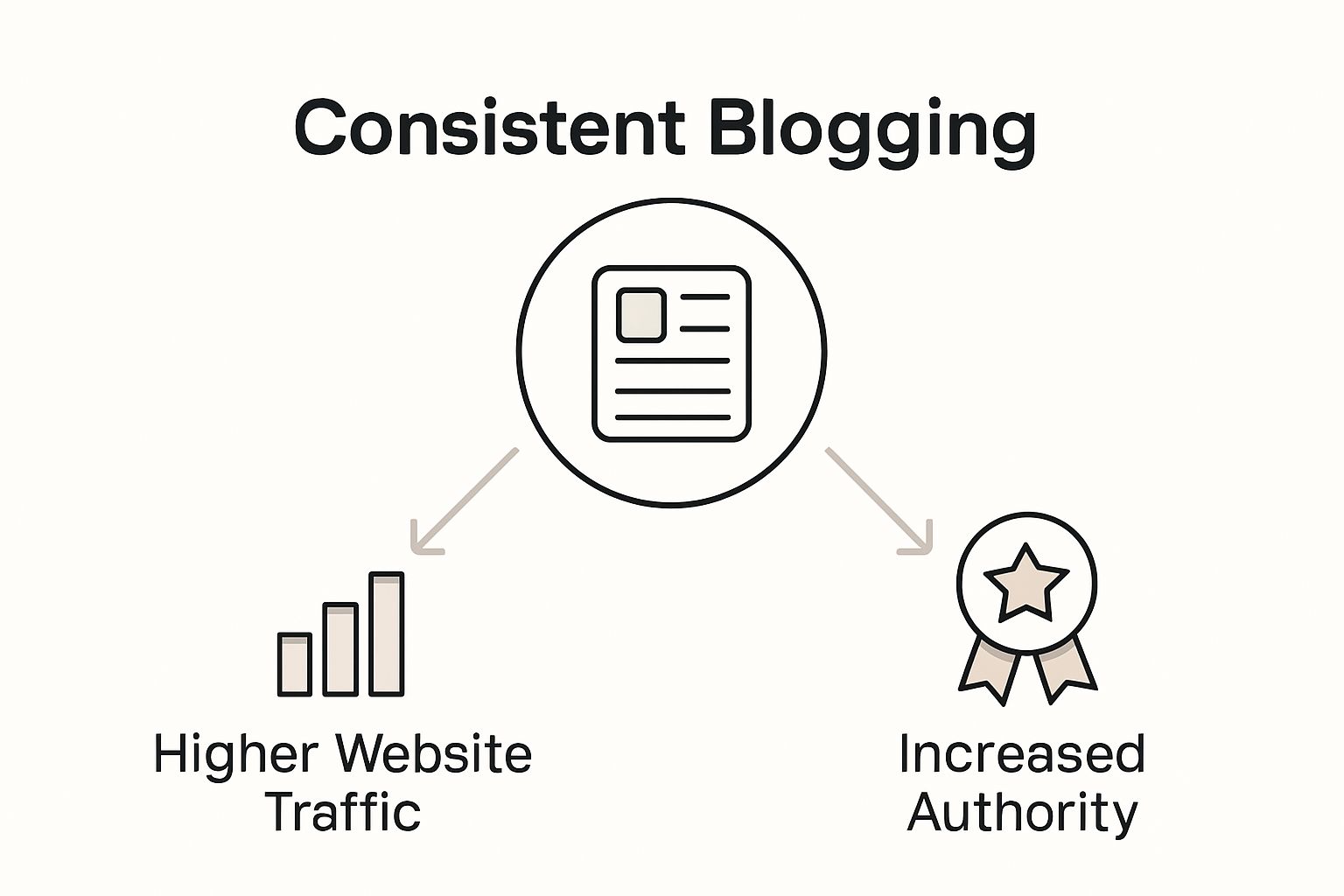 Evergreen content addressing timeless topics like first-time homebuyer guidance, neighborhood insights, or investment strategies continues generating organic traffic months and even years after initial publication.
This approach transforms blogs from ephemeral marketing materials into enduring resources that consistently showcase professional expertise.
Strategic Long-Term Positioning
Consistent blogging offers multiple strategic advantages for real estate professionals:
- Building a comprehensive digital knowledge base
- Establishing credibility as a local market expert
- Creating searchable content that attracts targeted leads
- Developing a repository of shareable professional insights
Explore strategies for professional branding to understand how consistent content creation elevates your digital presence.
By treating blogging as a long-term commitment rather than a sporadic marketing tactic, real estate agents can systematically build an authoritative online platform that attracts and retains potential client interest.
Ready to See Your Real Estate Brand Rise Above the Competition?
Feeling frustrated because your blog posts are not attracting serious home buyers or sellers? You invest time creating content but struggle to stand out in suburb-level searches.
As this article explains, consistent, SEO-focused blogging builds website authority, fuels Google rankings, and keeps your audience coming back for up-to-date real estate insights.
But crafting this kind of content takes expertise, strategy, and a deep understanding of what local clients are searching for.

At Content Charlie, we transform your real estate marketing with copywriting that gets you found by your ideal clients. Discover how our proven content marketing strategies and focus on local SEO turn your blog into a powerful lead magnet. Stop letting your competitors win those clicks. Reach out now to start building trust, capturing suburb searches, and growing your authority in every neighborhood you serve. Visit Content Charlie today and make your next move the one that dominates your market.
Frequently Asked Questions
How does blogging improve SEO for real estate websites?
Blogging improves SEO for real estate websites by generating fresh, relevant content that search engines prioritize. To enhance your SEO, publish at least one high-quality blog post each week that addresses local market trends or client questions.
What types of content should real estate blogs include to boost SEO?
Real estate blogs should include in-depth neighborhood guides, market analyses, and expert insights to engage potential clients. Aim to create content that directly addresses common client concerns, ensuring each piece has targeted keywords relevant to your audience.
How often should I publish blog posts to see SEO results?
To see noticeable improvements in SEO, aim to publish blog posts consistently, ideally once a week or every two weeks. Regular updates signal to search engines that your site is active, which can lead to higher rankings.
What are long-tail keywords, and why are they important for real estate blogging?
Long-tail keywords are specific phrases that potential clients use when searching online, like “investment properties near beaches.” Integrate these into your blog content to attract highly targeted traffic and meet the specific needs of your audience.
How can I measure the impact of my blogging on SEO performance?
You can measure the impact of blogging on SEO performance through metrics like organic traffic, keyword rankings, and engagement rates. Track these metrics monthly to evaluate the effectiveness of your blog content and adjust your strategy accordingly.
What actions can I take to ensure my blog content is valuable to clients?
To ensure your blog content is valuable, focus on addressing client questions and providing solutions based on local market insights. Engage with your audience by inviting comments and responding promptly to create a sense of community.
Recommended
- real estate marketing Archives – Content Charlie
- real estate SEO Archives – Content Charlie
- social media tips for real estate Archives – Content Charlie
- real estate social media strategy Archives – Content Charlie
- SEO for Real Estate Agencies: Simple Strategies to Grow Your Business
- Understanding SEO Best Practices for Your Business – My Blog

Understanding Real Estate SEO Metrics Explained
Real estate agents used to rely mostly on personal networks and open houses to woo buyers. Now everything happens online and a staggering 97 percent of home buyers start their search on the internet. Most people think it all comes down to having a flashy website or posting listings every day. But it turns out the real secret is hiding in your SEO metrics and these numbers can reveal exactly how to win the digital battle for new clients.
Table of Contents
- What Are Real Estate SEO Metrics?
- Why Real Estate SEO Metrics Matter For Agents
- Key Components Of Real Estate SEO Metrics
- How Real Estate SEO Metrics Inform Online Strategies
Quick Summary
| Takeaway | Explanation |
|---|---|
| Real estate SEO metrics enhance visibility | Measuring these metrics helps agents improve their online presence and attract more potential clients. |
| Track organic search rankings for success | Keeping an eye on search rankings for keywords is essential to ensure effective property listing visibility. |
| Focus on high-performing content | Identify which content attracts the most clients to optimize future marketing strategies. |
| Analyze geographical search behavior | Understanding where clients search helps tailor marketing efforts to specific locations effectively. |
| Allocate resources to top channels | Direct marketing budgets toward effective strategies based on performance data to maximize return on investment. |
What Are Real Estate SEO Metrics?
Real estate SEO metrics are quantitative measurements that help agents and marketers understand how their online content performs in search engine rankings and digital visibility. These specialized metrics go beyond traditional website analytics by providing targeted insights specific to real estate digital marketing strategies.
Understanding Core SEO Performance Indicators
At their fundamental level, real estate SEO metrics track how effectively your digital content attracts potential property buyers and sellers through search engines. Explore our guide on local SEO for real estate to understand the broader context of these performance indicators.
Key performance indicators in real estate SEO typically include:
- Organic Search Rankings: Your website’s position for specific property-related keywords
- Website Traffic Volume: Number of visitors arriving through search engines
- Click Through Rate (CTR): Percentage of searchers who click on your website link
- Bounce Rate: Percentage of visitors who leave your site quickly after arriving
Why Real Estate SEO Metrics Matter
Measuring these metrics provides critical intelligence about your digital marketing strategy. Moz’s SEO research demonstrates that understanding these metrics helps real estate professionals optimize their online presence and attract more potential clients.
By tracking these metrics, real estate agents can:
- Identify which content attracts the most potential clients
- Understand geographical search behavior
- Optimize website content for better search engine performance
- Make data driven decisions about digital marketing investments
Successful real estate professionals recognize that SEO metrics are not just numbers but strategic tools that illuminate the path to digital marketing excellence. They transform raw data into actionable insights that can significantly improve online visibility and client acquisition strategies.
Why Real Estate SEO Metrics Matter for Agents
Real estate SEO metrics transform raw data into strategic insights, enabling agents to navigate the complex digital landscape of property marketing with precision and effectiveness. Learn about our SEO strategies for real estate agents to understand how these metrics drive business growth.
Digital Visibility and Competitive Advantage
In a market where online presence determines client acquisition, SEO metrics provide agents with critical competitive intelligence. National Association of Realtors research reveals that over 97% of home buyers now use online resources during their property search, making digital visibility crucial.
Key competitive advantages of tracking SEO metrics include:
- Targeted Marketing: Understanding which keywords attract potential clients
- Performance Tracking: Measuring the effectiveness of digital marketing strategies
- Client Acquisition Optimization: Identifying most successful content and search channels
- Resource Allocation: Directing marketing investments toward high-performing strategies
Financial Impact and Business Growth
SEO metrics are not just technical measurements but direct indicators of potential revenue. By analyzing these metrics, real estate agents can:
- Reduce marketing expenditure by focusing on proven effective channels
- Increase conversion rates through targeted content strategy
- Build a robust online reputation that attracts high-quality leads
- Understand local market search behaviors and preferences
Successful real estate professionals recognize that SEO metrics provide more than analytics. They offer a roadmap for digital marketing success, transforming complex data into actionable strategies that drive business growth and client engagement.

Key Components of Real Estate SEO Metrics
Real estate SEO metrics encompass a complex ecosystem of performance indicators that provide comprehensive insights into digital marketing effectiveness. Learn more about our real estate SEO strategies to understand how these components work together.
Fundamental Performance Indicators
Organic search metrics form the foundation of real estate digital marketing analysis. Ahrefs SEO research highlights that these indicators reveal critical information about website visibility and user engagement.
Key fundamental performance indicators include:
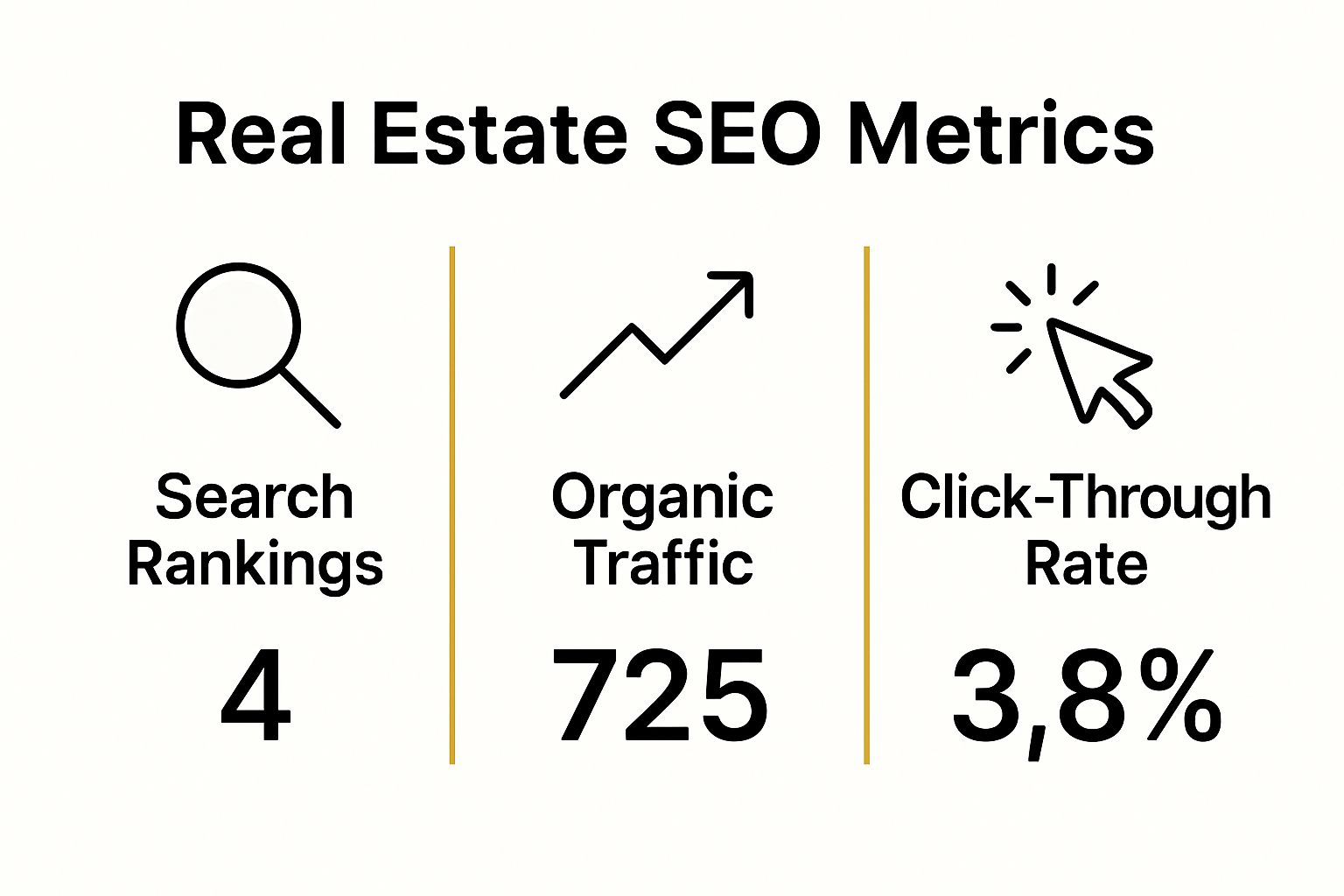
- Search Rankings: Position of property listings and content in search results
- Organic Traffic: Number of visitors arriving through search engines
- Click Through Rate (CTR): Percentage of searchers clicking on your website links
- Bounce Rate: Proportion of visitors leaving your site quickly
Advanced Analytical Components
Beyond basic metrics, sophisticated real estate SEO analysis requires deeper examination of user behavior and content performance. Advanced metrics help agents understand not just how many people visit their site, but how effectively those visits translate into potential client interactions.
Critical advanced metrics encompass:
- Conversion Rate: Percentage of website visitors who take desired actions
- Time on Site: Average duration visitors spend exploring property content
- Geographical Search Data: Understanding location based search patterns
- Mobile Performance: Website effectiveness across different device types
Successful real estate professionals recognize that these metrics are interconnected signals that provide a holistic view of digital marketing performance. By comprehensively analyzing these components, agents can develop targeted strategies that improve online visibility, attract qualified leads, and ultimately drive business growth.
To clarify the fundamental and advanced metrics used in real estate SEO, the following table summarizes each key component and its purpose.
| SEO Metric | Description |
|---|---|
| Organic Search Rankings | Position your website holds for property-related keywords |
| Website Traffic Volume | Number of visitors arriving via search engines |
| Click Through Rate (CTR) | Percentage of searchers who click on your website link |
| Bounce Rate | Percentage of visitors who leave quickly after arriving |
| Conversion Rate | Percentage of visitors taking a desired action |
| Time on Site | Average duration visitors spend exploring property content |
| Geographical Search Data | Information about where website traffic originates |
| Mobile Performance | Effectiveness of the website across different device types |
How Real Estate SEO Metrics Inform Online Strategies
Real estate SEO metrics transform raw data into strategic roadmaps for digital marketing success, enabling agents to make precision driven decisions about their online presence. Explore our guide to enhancing real estate online strategies to understand how metrics drive strategic planning.
Strategic Content Development
Content optimization emerges as a critical outcome of comprehensive SEO metric analysis. Google Search Central emphasizes that understanding user behavior through metrics allows agents to create more targeted, relevant content that resonates with potential clients.
Key strategic content development insights include:
- Identifying most engaging property topics
- Understanding user search intent
- Determining optimal content length and format
- Recognizing geographical search preferences
Targeted Marketing Resource Allocation
SEO metrics provide a sophisticated framework for intelligent marketing resource allocation. By analyzing performance data, real estate professionals can:
- Prioritize high performing marketing channels
- Redirect budget from underperforming strategies
- Develop hyper targeted audience segments
- Create personalized content experiences
Successful digital marketing in real estate requires continuous adaptation. SEO metrics offer real time feedback, allowing agents to pivot strategies quickly, ensuring their online presence remains dynamic, responsive, and aligned with evolving market demands and client expectations.
Ready to Turn Real Estate SEO Metrics Into Measurable Results?
Are you feeling overwhelmed by raw numbers and complex metrics, but hungry for real progress in your property marketing? The article explained how real estate SEO metrics reveal where your website attracts buyers and sellers, which content truly engages your local market, and how you can make smarter marketing decisions that move the needle.
At Content Charlie, we transform insights into action. Let us help you capture suburb-level searches and convert traffic into ready-to-act clients. Discover how our SEO-driven copywriting and tailored local strategies boost your digital visibility and generate leads that count.
Stop guessing and start growing. Visit Content Charlie now and see how better metrics lead to real results for your real estate business.
Frequently Asked Questions
What are the key real estate SEO metrics I should track?
To optimize your online presence, focus on key real estate SEO metrics such as organic search rankings, website traffic volume, click-through rate (CTR), and bounce rate. Start by monitoring these metrics regularly to gain insights into your digital marketing performance and identify areas for improvement.
How can I improve my website’s organic search rankings?
To enhance your organic search rankings, optimize your website content by incorporating relevant property keywords, improving page load speed, and ensuring mobile responsiveness. Regularly update your content and track changes over a 30–60 day period to gauge the impact of your efforts.
What role do SEO metrics play in client acquisition for real estate agents?
SEO metrics are essential for client acquisition as they help identify which content attracts potential clients and the effectiveness of your marketing strategies. Analyze data on visitor behavior and adjust your content to improve engagement and conversion rates.
How can I leverage geographical search data to improve my real estate SEO strategy?
To use geographical search data effectively, analyze where your website traffic comes from and tailor your content to local market interests. Implement targeted local keyword strategies and update your content based on findings to enhance local search visibility.
What actions can I take if my bounce rate is high?
If your bounce rate is high, focus on improving user experience by optimizing website loading times and providing engaging, relevant content that meets visitor expectations. Consider conducting an analysis of your top landing pages and making adjustments to encourage longer site engagement and lower the bounce rate.
Recommended
- real estate SEO Archives – Content Charlie
- SEO for realtors Archives – Content Charlie
- local SEO for real estate Archives – Content Charlie
- real estate agent visibility Archives – Content Charlie

Understanding Why Local SEO Matters for Real Estate
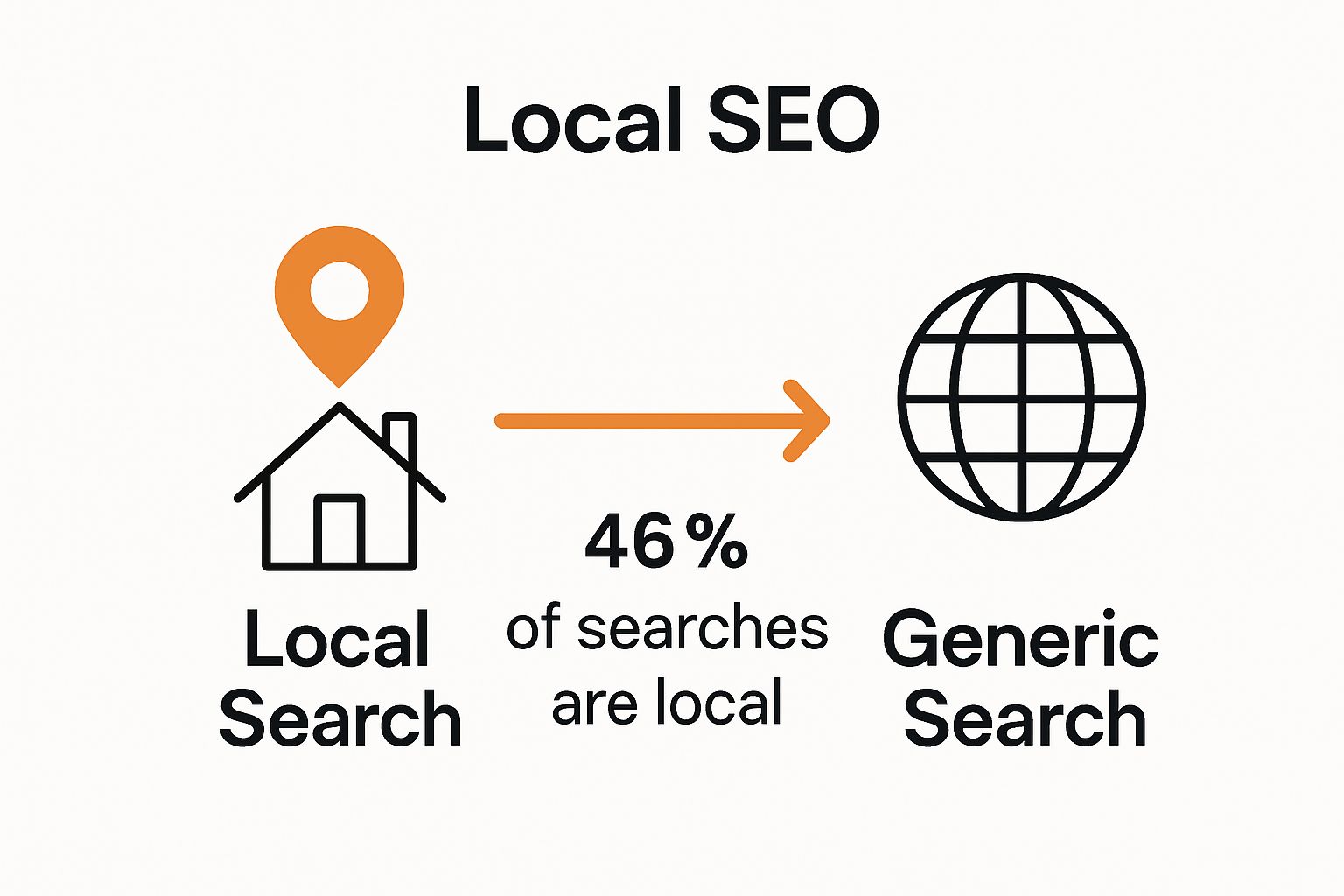
Local SEO is changing the way home buyers and sellers connect with real estate agents in their own neighborhoods. And get this. 46% of all Google searches now have local intent, which means nearly half of online house-hunters are searching for answers right where they live. Most agents still focus only on broad search terms, but the agents who win clients today are the ones who master hyperlocal visibility and become the top choice just down the street.
Table of Contents
- Defining Local Seo And Its Importance In Real Estate
- The Impact Of Local Search On Consumer Behavior
- How Local Seo Enhances Online Visibility For Agents
- Key Components Of Effective Local Seo Strategies
- Real-World Examples Of Local Seo Success In Real Estate
Quick Summary
| Takeaway | Explanation |
|---|---|
| Optimize Your Google Business Profile | Ensure your profile has accurate information to improve local visibility. |
| Focus on Hyperlocal Content Creation | Develop content tailored to specific neighborhoods to engage local clients effectively. |
| Leverage Online Reviews for Credibility | Encourage clients to leave positive reviews to build trust in your services. |
| Use Location-Specific Keywords | Incorporate local keywords to enhance search rankings in targeted areas. |
| Maintain Consistency Across Platforms | Keep business information uniform on all online platforms to boost local SEO success. |
Defining Local SEO and Its Importance in Real Estate
Local SEO represents a strategic digital marketing approach specifically designed to help businesses increase their visibility in geographically targeted search results. For real estate professionals, this means optimizing online presence to attract potential clients within specific neighborhoods, suburbs, or regional areas.
What Exactly is Local SEO?
Local SEO goes beyond traditional search engine optimization by focusing on location-specific search signals. In real estate, this translates to helping potential buyers and sellers find your services when searching for property-related information in their immediate geographic area. Local SEO for real estate involves multiple tactics designed to improve your visibility in local search results.
Key components of local SEO for real estate include:
- Optimizing Google Business Profile with accurate business information
- Creating location-specific content targeting particular suburbs or neighborhoods
- Building local citations and consistent business information across online platforms
- Generating location-based reviews from satisfied clients
Why Local SEO Matters for Real Estate Professionals
According to Google’s Local Search Ranking Factors Study, 46% of all Google searches have local intent, making local SEO critical for real estate agents seeking to capture targeted leads. By implementing strategic local SEO practices, agents can significantly improve their chances of appearing in “near me” searches and map pack results.
For real estate professionals, local SEO is not just about ranking higher in search results. It’s about establishing credibility, demonstrating local expertise, and connecting with potential clients who are actively searching for property services in specific areas. By focusing on hyperlocal optimization strategies, agents can differentiate themselves from competitors and become the go-to real estate expert in their target market.
The Impact of Local Search on Consumer Behavior
Local search has fundamentally transformed how consumers discover, evaluate, and interact with businesses, particularly in service-oriented industries like real estate. The digital landscape has shifted consumer expectations, making immediate, geographically relevant information a critical factor in decision-making processes.
Understanding Consumer Search Patterns
Modern consumers have become increasingly sophisticated in their search behaviors, preferring hyper-targeted results that provide precise, localized information. In real estate, this means potential buyers and sellers are not just searching for generic property listings, but seeking agents, market insights, and property details specific to their immediate neighborhood or suburb.
Key characteristics of local search consumer behavior include:
- Preference for immediate, location-specific results
- High reliance on mobile devices for quick information retrieval
- Strong emphasis on user-generated content and local reviews
- Expectation of personalized, contextually relevant search experiences
Trust and Credibility in Local Searches
According to research from the National Association of Realtors, 97% of homebuyers use the internet during their property search, demonstrating the profound impact of digital platforms on real estate consumer behavior. Local search results play a crucial role in establishing trust and credibility.
Consumers view businesses with strong local search presence as more legitimate and trustworthy. For real estate professionals, this means that appearing in local search results is not just about visibility, but about creating a perception of local expertise and reliability. By consistently delivering accurate, location-specific information, agents can build digital credibility that translates into real-world client relationships.
The evolution of local search has fundamentally reshaped how consumers make purchasing decisions, turning geographical relevance into a key differentiator in competitive markets like real estate.
This table highlights research-backed statistics and their implications for local SEO and real estate agents, helping illustrate the importance and impact of local search strategies.
| Statistic | Source | Significance for Real Estate Agents |
|---|---|---|
| 46% of Google searches have local intent | BrightLocal, Moz | Indicates nearly half of searchers want local information. |
| 97% of homebuyers use the internet to search | National Association of Realtors | Confirms the digital-first behavior of today’s clients. |
| 44% of local pack results get click-throughs | Moz | Highlights the value of optimizing for Google’s local map pack. |
| 87% of consumers read reviews for local business | BrightLocal | Underscores the role of reviews in consumer trust decisions. |
How Local SEO Enhances Online Visibility for Agents
Local SEO serves as a powerful digital strategy that transforms how real estate professionals attract and engage potential clients in an increasingly competitive online marketplace. By strategically optimizing digital presence, agents can significantly amplify their visibility and reach within specific geographic territories.
Strategic Digital Positioning
Effective local SEO enables real estate agents to position themselves precisely where potential clients are searching. This means appearing prominently in local search results, map listings, and location-based queries that directly target individuals seeking property services in specific suburbs or neighborhoods.
Key strategic advantages of local SEO for real estate agents include:
- Targeting hyperlocal search queries with precision
- Increasing organic visibility in geographic-specific searches
- Building credibility through location-based content and reviews
- Competing effectively against larger real estate agencies
Maximizing Digital Real Estate
Real estate agent visibility depends on understanding and leveraging digital platforms strategically. According to Moz’s Local Search Ranking Factors, Google’s local pack results receive approximately 44% of all click-through traffic, making local SEO optimization crucial for capturing potential client attention.
Successful local SEO implementation goes beyond simple keyword optimization. It requires a comprehensive approach that includes consistent business information across online platforms, generating location-specific content, managing online reviews, and creating a robust Google Business Profile that accurately represents an agent’s local expertise and service areas.
By mastering local SEO techniques, real estate professionals can transform their digital presence from passive online listings to dynamic, engaging platforms that actively attract and convert potential clients in their target markets.

Key Components of Effective Local SEO Strategies
Local SEO demands a multifaceted approach that goes beyond simple keyword optimization. Real estate professionals must develop a comprehensive strategy that integrates multiple digital marketing elements to establish strong local online presence and credibility.
Foundational Local SEO Elements
Successful local SEO strategies for real estate agents require precise, strategic implementation across multiple digital platforms. This means creating a cohesive online ecosystem that signals local expertise and geographic relevance to both search engines and potential clients.
Critical foundational elements include:
- Consistent business name, address, and phone number across all online platforms
- Comprehensive and accurate Google Business Profile optimization
- Location-specific website content highlighting neighborhood expertise
- Strategic use of local keywords reflecting specific suburban markets
Technical and Content Optimization
Local real estate marketing requires careful attention to technical details and content quality. According to Ahrefs’ Local SEO Guide, successful strategies integrate precise technical optimization with high-quality, location-specific content that demonstrates deep understanding of local property markets.
Real estate professionals must focus on creating rich, informative content that addresses specific local market conditions, neighborhood insights, and hyperlocal property trends. This approach not only improves search engine rankings but also establishes the agent as a trusted local expert who understands the nuanced dynamics of specific geographic areas.
By implementing a holistic local SEO strategy, real estate agents can transform their digital presence from generic online listings to powerful, targeted marketing platforms that directly connect with potential clients in their specific service areas.
To clarify the foundational elements and technical strategies essential for effective local SEO in real estate, the table below breaks down the core components and their descriptions.
| Local SEO Component | Description |
|---|---|
| Consistent Business Information | Ensure name, address, and phone number are the same across all online platforms. |
| Google Business Profile Optimization | Keep your Google Business Profile accurate and complete to enhance local search visibility. |
| Location-Specific Website Content | Develop content focused on specific neighborhoods or suburbs to demonstrate local expertise. |
| Strategic Use of Local Keywords | Incorporate geographic keywords relevant to your service area for better targeted search results. |
| High-Quality Local Content | Publish in-depth, informative articles reflecting local market conditions and trends. |
| Online Review Management | Actively generate and manage reviews from local clients to build trust and authority. |
Real-World Examples of Local SEO Success in Real Estate
Local SEO represents more than a theoretical concept for real estate professionals. It is a practical strategy that can dramatically transform digital marketing effectiveness, enabling agents to capture targeted leads and establish neighborhood expertise through strategic online positioning.
Hyperlocal Content Strategies
Successful local SEO implementation requires agents to develop content that speaks directly to specific community needs and interests. This means creating detailed, location-specific resources that demonstrate deep understanding of particular suburbs, market trends, and neighborhood dynamics.
Key characteristics of successful hyperlocal content include:
- Detailed neighborhood guides with insider perspectives
- Market analysis specific to individual suburbs or districts
- Local market trend reports with current property insights
- Localized case studies highlighting recent property transactions
Measurable Impact and Conversion Potential
Location-based hashtags can play a significant role in amplifying local visibility. According to BrightLocal’s Local Consumer Review Survey, 87% of consumers read online reviews for local businesses in 2022, underscoring the critical importance of generating localized, trustworthy digital content.
Real estate agents who successfully implement local SEO strategies can experience remarkable outcomes. By developing targeted content that addresses specific community needs, agents transform their digital presence from generic listings to powerful, hyper-relevant marketing platforms that directly connect with potential clients in their precise service areas.
Through strategic local SEO approaches, real estate professionals can effectively differentiate themselves in competitive markets, demonstrating not just property expertise, but genuine community understanding and connection.
Take Control of Local Search and Become the Go-To Real Estate Expert
Are you struggling to stand out in your local market? The article made it clear: real estate clients are looking for agents who not only show up in suburb-level searches but also demonstrate true neighborhood expertise. With buyers relying on hyperlocal searches and online reviews, missing out on local SEO for real estate means leaving valuable opportunities on the table. It is time to stop feeling invisible or overwhelmed by the competition. Let the pain of low visibility propel you toward a better solution.
Let Content Charlie transform your online presence. Gain immediate traction with suburb-specific content, property descriptions, and Google Business Profile optimization that puts you in front of motivated buyers and sellers. Visit Content Charlie today and discover how our copywriting and proven real estate agent visibility strategies can help you dominate your market. Book your free discovery call now and make sure you are the agent local clients remember.
Frequently Asked Questions
What is local SEO and why is it important for real estate?
Local SEO is a digital marketing strategy that helps real estate professionals optimize their online presence for geographically targeted searches. It is important because it increases visibility among potential clients actively searching for property services in their area. Focus on optimizing your Google Business Profile and creating location-specific content to enhance your local search presence.
How can I improve my local search rankings as a real estate agent?
To improve your local search rankings, ensure that your business name, address, and phone number are consistent across all online platforms. Additionally, optimize your website with local keywords and generate positive reviews from satisfied clients. Take these actions to see improvements in local search visibility within 60 days.
What role does online reviews play in local SEO for real estate?
Online reviews significantly impact local SEO as they enhance credibility and trust among potential clients. Actively encourage satisfied clients to leave reviews on your Google Business Profile and other platforms to boost your visibility and attract more leads. Aim to gather at least five to ten new reviews each month.
Why should I create location-specific content for my real estate website?
Creating location-specific content helps demonstrate your expertise in specific neighborhoods or suburbs, making your services more relevant to potential clients. This targeted approach improves your local search rankings and attracts clients looking for detailed information about their desired area. Develop at least one piece of location-focused content each month to maintain relevance.
How can local SEO help me stand out from larger real estate agencies?
Local SEO can help you differentiate yourself by highlighting your specialized knowledge of local markets and community needs. By focusing on hyperlocal optimization strategies and personalized content, you can build stronger connections with potential clients. Implement tailored marketing strategies to position yourself as the go-to local expert and increase client engagement in your target market.
What should I monitor to measure the success of my local SEO efforts?
To measure the success of your local SEO efforts, monitor key metrics such as website traffic from local searches, the number of leads generated, and your rankings in local search results. Tools like Google Analytics can help you track these metrics over time. Review your progress every month to adjust your strategies effectively.
Recommended
- local SEO for real estate Archives – Content Charlie
- Local SEO Archives – Content Charlie
- real estate SEO Archives – Content Charlie
- SEO for realtors Archives – Content Charlie

Market Fluctuation Problems For Brisbane Real Estate Agents Solved
10 Market Fluctuation Issues Solved By Brisbane Real Estate Agents [2023]
The world of real estate is a dynamic and ever-changing landscape. Real estate agents often find themselves riding the waves of market fluctuations, facing both the highs of a seller’s market and the lows of a buyer’s market. These fluctuations can present significant challenges to real estate professionals, impacting their income, job security, and overall success in the industry. In this article, we will explore the problem of market fluctuations faced by real estate agents and investigate whether working with a big-brand real estate agency can provide a solution to help smooth out this issue.
Understanding Market Fluctuations
Market fluctuations are a natural part of the real estate industry, driven by various factors such as economic conditions, interest rates, demographics, and local supply and demand. Real estate agents, who act as intermediaries between buyers and sellers, are directly affected by these fluctuations.
In a seller’s market, where demand for properties exceeds supply, real estate agents may find it easier to sell homes quickly and at higher prices. Conversely, in a buyer’s market, where there is an abundance of properties and fewer buyers, agents may struggle to close deals and may need to lower prices to attract buyers. These market shifts can result in significant income variations for real estate professionals.
Challenges Faced by Brisbane Real Estate Agents
Real estate agents often encounter several challenges due to market fluctuations:
- Inconsistent Income: The unpredictability of market conditions can lead to inconsistent income for agents. During a seller’s market, they may earn substantial commissions, but in a buyer’s market, their earnings can plummet.
- Increased Competition: In a competitive market, agents must work harder to stand out and secure listings. When the market is flooded with properties, they may face difficulties finding buyers.
- Longer Sales Cycles: In a slow market, properties may take longer to sell, leading to extended sales cycles and reduced turnover for agents.
- Stress and Uncertainty: The constant ups and downs of the real estate market can create stress and uncertainty for agents, impacting their job satisfaction and overall well-being.
Big-Brand Real Estate Agencies: A Potential Solution?
Many real estate agents consider affiliating with big-brand real estate agencies in the hopes of mitigating the challenges posed by market fluctuations. These large, well-established firms often tout several advantages that may help agents weather market ups and downs:
- Brand Recognition: Big-brand agencies have established names and reputations in the industry, which can attract clients even during slower market periods. Clients may trust these agencies more, making it easier for agents to secure listings.
- Marketing Resources: Larger agencies typically have more substantial marketing budgets, enabling them to promote properties effectively and reach a wider audience. This can be especially beneficial when the market is competitive and requires creative marketing strategies.
- Training and Support: Big-brand agencies often offer comprehensive training programs and ongoing support for their agents. This can help agents adapt to changing market conditions and develop their skills to excel in any environment.
- Network and Referrals: A vast network of agents within a big-brand agency can lead to more referrals and collaborative opportunities, increasing an agent’s chances of closing deals in any market.
- Stability and Resources: These agencies typically have financial stability and access to resources that smaller agencies may lack. This stability can provide agents with a safety net during challenging market periods.
Case Studies: Real-World Experiences
To understand the impact of working with big-brand real estate agencies on navigating market fluctuations, let’s explore a couple of real-world case studies.
Case Study 1: The Independent Agent
Jane, an independent real estate agent, has been in the business for several years. She enjoys the flexibility of working independently but struggles when the market takes a downturn. During a particularly slow market phase, she experiences a significant drop in income, and her stress levels rise as she faces uncertainty about her future in the industry.
After much consideration, Jane decides to join a well-known big-brand real estate agency. With access to the agency’s marketing resources and a network of experienced agents, she begins to see improvements in her business. The agency’s reputation attracts more clients, and Jane benefits from ongoing training and support. During the next market downturn, she finds herself better equipped to weather the storm, thanks to the stability and resources provided by the big-brand agency.
This is something that won’t happen if Jane stays independent or joins another independent agency.
Case Study 2: The Agent Already with a Big-Brand Agency
John has been with a big-brand real estate agency for several years. While he appreciates the brand recognition and resources the agency provides, he still faces challenges during market fluctuations. When the market is booming, he enjoys significant success and commissions. However, during a buyer’s market, he struggles to secure listings and close deals.
John decides to leverage the resources of his big-brand agency even further during the challenging market conditions. He takes advantage of additional training opportunities and taps into the agency’s vast network to find potential buyers and sellers. By adapting his strategies and capitalizing on the agency’s support, he manages to maintain a steady income and reputation, even when the market is less favorable.
Century 21: A Legacy of Excellence in Real Estate
When it comes to real estate, the name Century 21 is synonymous with excellence, innovation, and a legacy that spans several decades. Founded in 1971 by Art Bartlett and Marsh Fisher in Orange County, California, Century 21 has grown to become one of the world’s most recognizable and respected real estate brands. With a commitment to providing top-notch service, empowering agents, and embracing technological advancements, Century 21 has played a pivotal role in shaping the modern real estate landscape.
The Birth of Century 21
Century 21 was founded on the principle of combining the local expertise of individual real estate agents with the strength of a global brand. The idea was to create a network of real estate professionals who could provide clients with unparalleled service, whether they were buying or selling property in their hometown or across the world.
From its inception, Century 21 focused on fostering a culture of excellence, professionalism, and continuous learning among its agents. This commitment to education and training quickly set the brand apart in the real estate industry.
Global Expansion and Market Presence
One of Century 21’s key strengths is its global reach. With thousands of offices in over 80 countries and territories, Century 21 boasts an extensive international network. This global presence has been a significant advantage for clients looking to buy or sell properties in foreign markets or for agents seeking cross-border opportunities.
The brand’s commitment to excellence has made it a trusted name for clients worldwide. The distinctive gold jacket worn by Century 21 agents has become a symbol of professionalism and expertise in real estate, and it’s a sight recognized in communities around the globe.
Technology and Innovation
Century 21 has consistently been at the forefront of technological innovation in the real estate industry. The brand has embraced advancements in digital marketing, data analytics, and customer relationship management tools to empower its agents and provide clients with a seamless and efficient experience.
In recent years, Century 21 has invested heavily in cutting-edge technology to streamline the homebuying and selling processes. These innovations include immersive virtual tours, augmented reality apps, and artificial intelligence-driven data analysis. Such tools not only make transactions more efficient but also enhance the overall customer experience.
Support and Training
One of the cornerstones of Century 21’s success has been its commitment to agent training and support. The brand offers comprehensive training programs designed to equip its agents with the knowledge and skills necessary to excel in the competitive real estate market. Whether it’s marketing strategies, negotiation skills, or the latest industry trends, Century 21 ensures that its agents are well-prepared to meet their clients’ needs.
Additionally, the brand provides ongoing support through mentoring programs, coaching, and a vast network of experienced professionals. This support system helps new agents build their careers and allows seasoned agents to stay ahead in a constantly evolving industry.
Community Involvement
Beyond its business success, Century 21 has a strong tradition of community involvement and philanthropy. Many local Century 21 offices are actively engaged in charitable activities and support causes that matter to their communities. This commitment to giving back reflects the brand’s values and its desire to make a positive impact beyond real estate transactions.
Century 21 has earned its reputation as a real estate powerhouse through a combination of innovation, a commitment to excellence, global reach, and a dedication to agent success. For decades, it has remained a trusted name for clients seeking expert guidance in buying or selling real estate. As the real estate industry continues to evolve, Century 21 stands ready to adapt and lead the way, ensuring that its legacy of excellence endures for generations to come.
Conclusion
Navigating market fluctuations is an enduring challenge for real estate agents. While working with a big-brand real estate agency can offer various advantages, it’s essential to remember that success ultimately depends on the agent’s adaptability, skills, and willingness to leverage the resources available to them.
Big-brand agencies provide brand recognition, marketing resources, training, and a network that can help agents withstand market fluctuations. However, agents must actively engage with these benefits to maximize their impact. Additionally, some independent agents may prefer the freedom and autonomy of working on their own terms, even if it means facing more significant challenges during market downturns.
In the end, the decision to work with a big-brand real estate agency should be based on a thorough assessment of an agent’s individual goals, strengths, and preferences. While such agencies can certainly help smooth out some of the issues caused by market fluctuations, success in the real estate industry ultimately comes down to the agent’s ability to adapt and thrive in any market conditions.