
- You are here:
- Home »
- neighborhood landing pages
Tag Archives for " neighborhood landing pages "

The Ultimate Guide to Real Estate Agent Lead Generation: Everything You Need to Succeed in 2026
Real estate agent lead generation has fundamentally changed. 28% of agents prioritize selling more homes, 19% focus on increasing referrals, and 14% want to generate more leads: but most are using outdated strategies that worked five years ago.
The agents crushing it in 2026 aren’t relying on a single magic bullet. They’re building integrated systems that combine digital presence, personal relationships, and AI efficiency to create consistent lead flow month after month.
Whether you’re a new agent struggling to get your first listing or a veteran looking to scale, this guide breaks down exactly what’s working right now.
Digital Real Estate Agent Lead Generation: Your 24/7 Sales Machine
Website & SEO Optimization
Your website needs to work harder than ever. Neighborhood-specific landing pages are absolutely crushing it right now. Create dedicated pages for each area you serve, packed with local market data, school information, and community highlights.
Here’s what converts:
• Weekly market update blogs featuring price trends and neighborhood spotlights
• IDX-integrated home search that captures visitor information before showing full details
• Downloadable buyer/seller guides in exchange for email addresses
• Live chat functionality for real-time engagement
• Virtual tour galleries of past listings to showcase your marketing skills

Optimize for “near me” searches by including service areas prominently throughout your site. Retargeting pixels keep you top-of-mind with visitors who didn’t convert immediately.
Social Media Marketing That Actually Converts
Stop posting random listing photos and start building a content system. High-quality photos and virtual tours are just the baseline: you need strategic variety.
Content that generates leads:
• Speed tours of new listings (60-second Instagram Reels)
• Before-and-after transformation stories
• Client testimonial videos
• Live Q&A sessions about buying/selling processes
• Behind-the-scenes content that builds personal connection
Targeted Facebook and Instagram ads reach people actively searching for homes in specific areas. But here’s the key: don’t just promote listings. Promote your expertise with market reports, neighborhood guides, and first-time buyer workshops.
Email & CRM Automation
Automated drip campaigns are non-negotiable in 2026. Set up sequences based on specific interests: buyers get different content than sellers or investors.
High-performing email campaigns:
• Segmentation by life stage: downsizing, first-time buying, investment opportunities
• Lead scoring that prioritizes follow-up with most engaged prospects
• Anniversary emails on past clients’ home purchase dates
• Personalized video greetings for birthdays and holidays
• Market condition alerts when prices drop in their areas of interest
Your CRM should automatically track engagement and trigger the next touchpoint. If someone opens three emails about investment properties, they get added to your investor nurture sequence.

Paid Advertising: High-Intent Prospects
Google Ads capture prospects at the exact moment they express interest. These high-intent keywords reach potential clients actively searching for solutions, making them incredibly valuable leads with measurable ROI; essential in real estate agent lead generation 2026.
Focus on:
• Local buying/selling keywords (“homes for sale in [city]”)
• Problem-solving searches (“how to sell house fast”)
• Neighborhood-specific queries (“[neighborhood] real estate agent”)
Facebook lead generation ads work best when targeting specific demographics in your farm area with compelling property showcases or exclusive market reports.
AI-Enhanced Real Estate Lead Generation: The Competitive Advantage
AI predictive analytics identify homeowners most likely to sell based on life events, equity position, expired listings, and current market conditions. This isn’t science fiction: it’s happening right now.
AI tools that generate real leads:
• 24/7 chatbots that qualify leads, answer questions, and schedule appointments
• AI-powered content creation for personalized property descriptions and social media posts
• Voice assistants for follow-up calls that handle initial qualification
• Predictive lead scoring analyzing behavioral patterns across your database
• AI-generated virtual staging transforming empty rooms into furnished showcases
AI-powered video personalization automatically inserts prospect names and property details into marketing videos. Imagine sending a personalized video tour of a property with the prospect’s name in the opening frame.

Traditional Networking: Still Essential in 2026
Digital doesn’t replace relationships: it amplifies them. In-person events where agents, investors, and wholesalers connect remain gold mines for quality leads.
High-ROI networking opportunities:
• Local meetups and conferences (Inman Connect, NAR Conference)
• Community events like home expos and charity fundraisers
• Neighborhood coffee meetups discussing market trends
• Builder partnerships for new construction referrals
• Facebook and LinkedIn groups where agents share leads and insights
Even with digital advancement, offline networking builds genuine relationships that lead to consistent referrals. The key is strategic follow-up that moves online connections into real business.
Direct Outreach: Proactive Real EstateLead Generation
With accurate contact data, you can reach potential sellers before they list their homes. This proactive approach consistently generates exclusive leads that competitors never see.
Effective outreach strategies:
• Calling or texting homeowners in high-activity neighborhoods
• Personalized emails to owners thinking about selling
• Direct mail campaigns to areas with recent sale activity
• Social media messaging to expired listing owners
• Video messages for warm introductions
The key is providing immediate value: market updates, neighborhood insights, or exclusive off-market opportunities: rather than generic sales pitches.

Follow-Up: Converting Contacts to Clients
Meeting people is step one. Following up turns connections into actual business. Most agents fail here because they lack a systematic approach to nurturing relationships over time.
High-converting follow-up tactics:
• Quick texts or emails within 24 hours of meeting someone
• Value-driven content sharing useful resources and market updates
• Scheduled check-ins that can lead to deals, partnerships, or referrals
• CRM-based automation maintaining consistent touchpoints
• Engagement-based prioritization focusing energy on most responsive prospects
Pro tip: Track every interaction in your CRM and set automatic reminders for follow-up. The fortune is in the follow-up, but only if you actually do it consistently.
Your 2026 Action Plan
Start with one strategy from each category rather than trying to implement everything at once. Pick the tactics that align with your strengths and market conditions.
Week 1-2: Set up basic CRM automation and create neighborhood-specific landing pages
Week 3-4: Launch one social media campaign and implement website chat functionality
Week 5-6: Begin direct outreach in your target neighborhoods
Week 7-8: Add AI tools for lead qualification and content creation
Track everything. What gets measured gets improved. Your lead generation system should produce predictable results that you can scale month after month.
The agents dominating 2026 aren’t using secret tactics: they’re executing proven strategies with systematic consistency. Your competition is still posting random listing photos on social media while you’re building a lead generation machine that works around the clock.


SEO for Realtors Explained: Strategies for Dominance
Did you know that over 90 percent of home buyers begin their search online? With so much competition, showing up on the first page of search results can mean the difference between a steady stream of leads and missing out altogether. By understanding the core principles of SEO for realtors, you can reach more serious buyers and sellers right when they need expert guidance most.
Table of Contents
- SEO For Realtors: Essential Concepts Explained
- Types Of SEO For Real Estate Agents
- Local Keyword Strategies And Content Optimisation
- Optimising Google Business Profile Listings
- Common SEO Mistakes And Pitfalls To Avoid
Key Takeaways
| Point | Details |
|---|---|
| SEO Importance | Effective SEO enhances visibility, brand awareness, and marketing cost-effectiveness for realtors. |
| Local Optimization | Focus on local keyword strategies and create location-specific content to attract relevant leads. |
| Google Business Profile | Optimize your Google Business Profile with accurate information and engage with reviews to boost local search rankings. |
| Avoid Common Mistakes | Steer clear of vague titles, duplicate content, and neglecting mobile optimization to improve search visibility. |
SEO for Realtors: Essential Concepts Explained
Search engine optimization (SEO) is the strategic practice of enhancing your real estate website’s visibility in organic search results. According to dxstudio, effective SEO can dramatically boost brand awareness and improve the cost-effectiveness of marketing efforts by achieving higher search rankings.
For real estate professionals, SEO fundamentals involve several critical components. The Maine guidelines highlight key practices that translate directly to real estate websites:
- Create clear, descriptive page titles
- Generate original, high-quality content
- Use keywords strategically and appropriately
- Implement accessibility features like accurate image alt text
Successful real estate SEO requires understanding how potential clients search online. This means optimizing your website to appear when someone searches for terms like “homes in [your suburb]” or “real estate agents near me.” By focusing on local search optimization, you can attract more qualified leads directly through your website. To maximize your SEO strategy, learn more about real estate website essentials and how to build a site that both search engines and clients will love.
Types of SEO for Real Estate Agents
In the dynamic world of real estate digital marketing, understanding different SEO strategies is crucial for agents looking to stand out online. According to Coursera, SEO encompasses three primary approaches: on-page optimization, off-page optimization, and technical SEO, each playing a unique role in improving search engine rankings.
Here’s a summary of the main types of SEO for real estate agents:
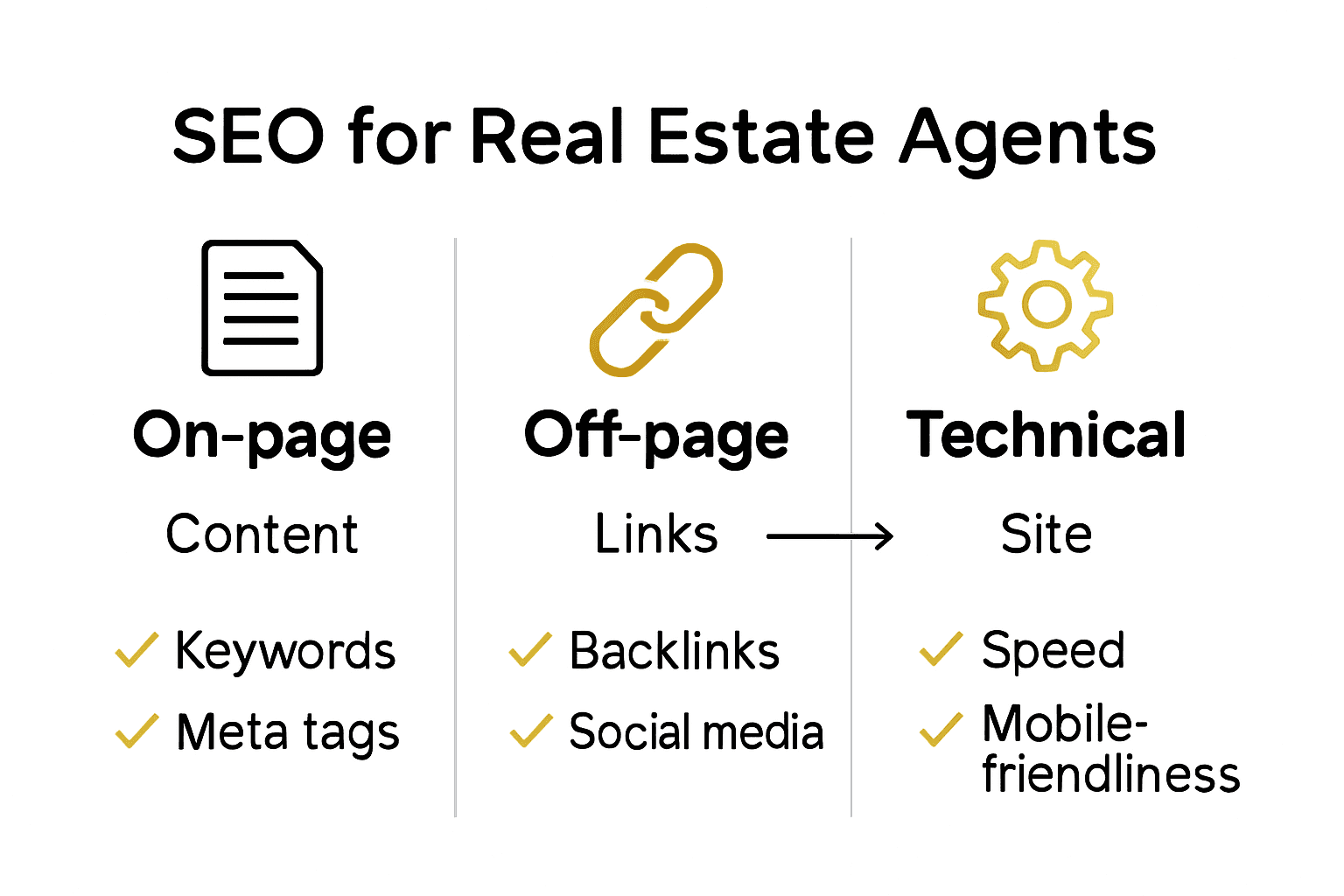
| SEO Type | Focus Area | Key Examples |
|---|---|---|
| On-Page SEO | Website content & structure | Keyword-rich property pages Optimized meta tags Local blog posts |
| Off-Page SEO | External reputation & authority | Backlinks from directories Realtor citations Community websites |
| Technical SEO | Website performance & search engine access | Fast loading speed Mobile responsiveness Secure HTTPS |
On-Page SEO focuses directly on your website’s content and structure. For real estate professionals, this means:
- Creating property descriptions with strategic keywords
- Developing suburb-specific landing pages
- Writing informative blog content about local real estate trends
- Optimizing meta titles and descriptions for each page
Off-Page SEO involves building your website’s credibility through external factors. This includes generating quality backlinks from local business directories, real estate platforms, and community websites. Coursera’s search engine optimization research emphasizes that off-page tactics signal to search engines that your website is a trusted resource in the real estate market.
Technical SEO ensures your website meets search engine infrastructure requirements. For real estate agents, this means creating a fast, mobile-responsive site with clean code, secure connections, and easy navigation. By understanding and implementing these SEO tips to boost agent visibility, you’ll dramatically improve your chances of ranking higher in local search results.

Local Keyword Strategies and Content Optimisation
Local keyword strategies are the backbone of successful real estate SEO, enabling agents to connect directly with potential clients searching in specific areas. According to Florida Realtors, creating location-specific content can significantly enhance search engine rankings by providing valuable community information including demographics, schools, amenities, and local points of interest.
Effective local keyword optimization involves multiple strategic approaches:
- Develop detailed suburb and neighborhood landing pages
- Incorporate hyperlocal keywords naturally into website content
- Use location-specific terms in headers, titles, and meta descriptions
- Create blog posts highlighting local market trends and community insights
The Splendour Group emphasizes the importance of hyperlocal content, recommending that real estate agents integrate location details throughout their digital presence. This means going beyond generic property listings to craft content that speaks directly to local buyers and sellers. By understanding the nuanced search behaviors of potential clients, you can create local SEO strategies that position you as the go-to real estate expert in your specific market.
To truly dominate local search results, real estate agents must think like their potential clients. This means anticipating the specific search terms people use when looking for properties, understanding local market dynamics, and creating content that answers their most pressing questions about neighborhoods, property values, and community living.
Optimising Google Business Profile Listings
A Google Business Profile is the digital storefront for real estate agents, serving as a critical first impression for potential clients searching online. According to Energy.gov, optimizing this profile requires providing accurate and comprehensive information, including your business name, address, phone number, and precise operating hours.
Key strategies for maximizing your Google Business Profile effectiveness include:
- Upload high-quality, professional photos of your team and properties
- Write a compelling business description that highlights your unique value
- Select the most relevant business categories
- Verify your business location to increase credibility
- Respond promptly to all customer reviews
The Splendour Group emphasizes that maintaining an up-to-date profile can dramatically improve local search rankings. Encouraging satisfied clients to leave positive reviews not only boosts your visibility but also builds trust with potential customers. By consistently updating your Google Business Profile, you signal to both Google and potential clients that you’re an active, engaged real estate professional.
Remember, your Google Business Profile is more than just a listing—it’s a powerful marketing tool that can significantly influence a potential client’s first impression. Regular maintenance, authentic engagement, and strategic optimization can transform this simple profile into a lead-generating machine for your real estate business.
Common SEO Mistakes and Pitfalls to Avoid
Real estate agents often stumble into SEO traps that can significantly undermine their online visibility. According to Maine, common mistakes include using vague page titles, neglecting comprehensive keyword research, and failing to produce original, high-quality content that truly serves potential clients.
Critical SEO pitfalls for real estate professionals include:
- Keyword stuffing that makes content unreadable
- Neglecting mobile optimization
- Using duplicate content across property listings
- Ignoring local search intent
- Failing to update website content regularly
DX Studio emphasizes the importance of understanding search intent and user behavior. For real estate agents, this means creating content that genuinely answers potential clients’ questions about properties, neighborhoods, and market trends. By exploring these nuanced search behaviors, you can craft SEO myths guide content that resonates with your target audience and improves your search rankings.
The most successful real estate SEO strategies require a holistic approach. Stop treating your website as a static brochure and start viewing it as a dynamic, interactive resource that adapts to potential clients’ evolving needs. Continuous learning, regular content updates, and a genuine commitment to providing value will set you apart in the competitive digital real estate landscape.
Take Control of Your Real Estate SEO Today
Struggling to break through the noise in local search results or frustrated that your property listings do not attract qualified leads? The challenges highlighted in “SEO for Realtors Explained” show how important it is to master local keyword strategies, create compelling Google Business Profile content, and avoid common SEO mistakes like duplicate and poorly optimized content. If you want to be the trusted local expert buyers and sellers find first, your website and content must truly stand out.
At Content Charlie, we specialize in crafting SEO-driven real estate copy that connects with your audience on a suburb level — from targeted property descriptions to engaging blog articles that boost your search rankings. Our tailored approach helps you capture the right traffic by focusing on the exact terms your customers use when searching for homes or agents nearby.

Ready to transform your online presence and dominate local searches? Visit Content Charlie now to explore how our local SEO and real estate copywriting services can turn your website into a lead-generating machine. Don’t let your competition outshine you—take action today and position your brand as the go-to real estate professional in your community.
Frequently Asked Questions
What is SEO for realtors?
Search engine optimization (SEO) for realtors is the practice of improving a real estate website’s visibility in search engine results. It involves various strategies aimed at attracting potential clients through organic search traffic.
What are the main types of SEO strategies for real estate agents?
The main types of SEO strategies for real estate agents include on-page SEO, off-page SEO, and technical SEO. On-page SEO focuses on website content and structure, off-page SEO builds external credibility through backlinks, and technical SEO ensures site performance and search engine accessibility.
How can local keyword strategies enhance my real estate SEO?
Local keyword strategies can enhance your real estate SEO by targeting specific community-related terms. Creating location-specific content helps your website appear in searches for properties in those areas, connecting you directly with potential clients.
What are common SEO mistakes real estate agents should avoid?
Common SEO mistakes to avoid include keyword stuffing, neglecting mobile optimization, using duplicate content, ignoring local search intent, and failing to update website content regularly. These errors can significantly reduce your online visibility and effectiveness.
Recommended

Role of Content in SEO: Everything You Need to Know
Did you know that over 70 percent of people start their property search online? Today, the Role of Content in SEO shapes more than just first impressions. It decides how visible and credible you are in the eyes of both clients and search engines. Understanding how content shapes modern SEO can put you ahead of your competition and ensure your expertise gets noticed where it matters most.
Key Takeaways
| Point | Details |
|---|---|
| Content Quality is Essential | High-quality content drives SEO rankings by demonstrating expertise and meeting user needs. |
| Diversify Content Types | Utilizing various content types, like suburb guides and market reports, enhances SEO and engages potential clients. |
| Focus on Local SEO | Developing hyperlocal content tailored to specific communities improves visibility and attracts relevant clients. |
| Avoid Common Pitfalls | Steer clear of mistakes like keyword stuffing and outdated information to maintain credibility and effectiveness in content marketing. |
Table of Contents
- Defining Content’s Role In Modern SEO
- Types Of SEO Content For Real Estate
- How Content Drives Search Rankings
- Local SEO: Content Strategies That Work
- Common Content Mistakes To Avoid
Defining Content’s Role in Modern SEO
In the rapidly evolving digital landscape, content is no longer just words on a page—it’s the strategic engine driving search engine optimization (SEO). Our comprehensive content marketing guide reveals how modern search algorithms prioritize content that genuinely serves user needs and demonstrates expertise.
According to research from Search Engine Journal, Google now considers content quality as a core ranking factor. The 2024 study highlights critical attributes that elevate content’s SEO performance:
- Relevance to user search intent
- Depth of information provided
- Semantic clarity and topical comprehensiveness
- User engagement signals
Recent academic research on Generative Search Engine Optimization reveals an even more sophisticated evaluation framework. This multi-dimensional approach moves beyond traditional metrics, analyzing content’s substantive impact through semantic influence. For real estate agents, this means creating hyperlocal, expertise-driven content that doesn’t just include keywords, but provides genuine value to potential property buyers and sellers.
The message is clear: exceptional content isn’t just recommended—it’s essential. Search engines now reward content that demonstrates authentic expertise, answers user questions comprehensively, and creates meaningful connections with the target audience.
Types of SEO Content for Real Estate
In the competitive world of real estate digital marketing, content diversity is your secret weapon for attracting potential buyers and sellers. Learn more about effective content strategies that can transform your online presence and drive targeted traffic.
Real estate professionals have several powerful content types at their disposal to boost SEO and engage potential clients:
- Suburb Guides: Comprehensive neighborhood profiles
- Property Market Reports: Local market trend analysis
- Client Success Stories: Testimonial and case study content
- Buyer and Seller Advice Blogs: Educational content addressing common questions
- Local Area Listings: Hyperlocal property insights
- Virtual Property Tours: Multimedia content with descriptive narratives
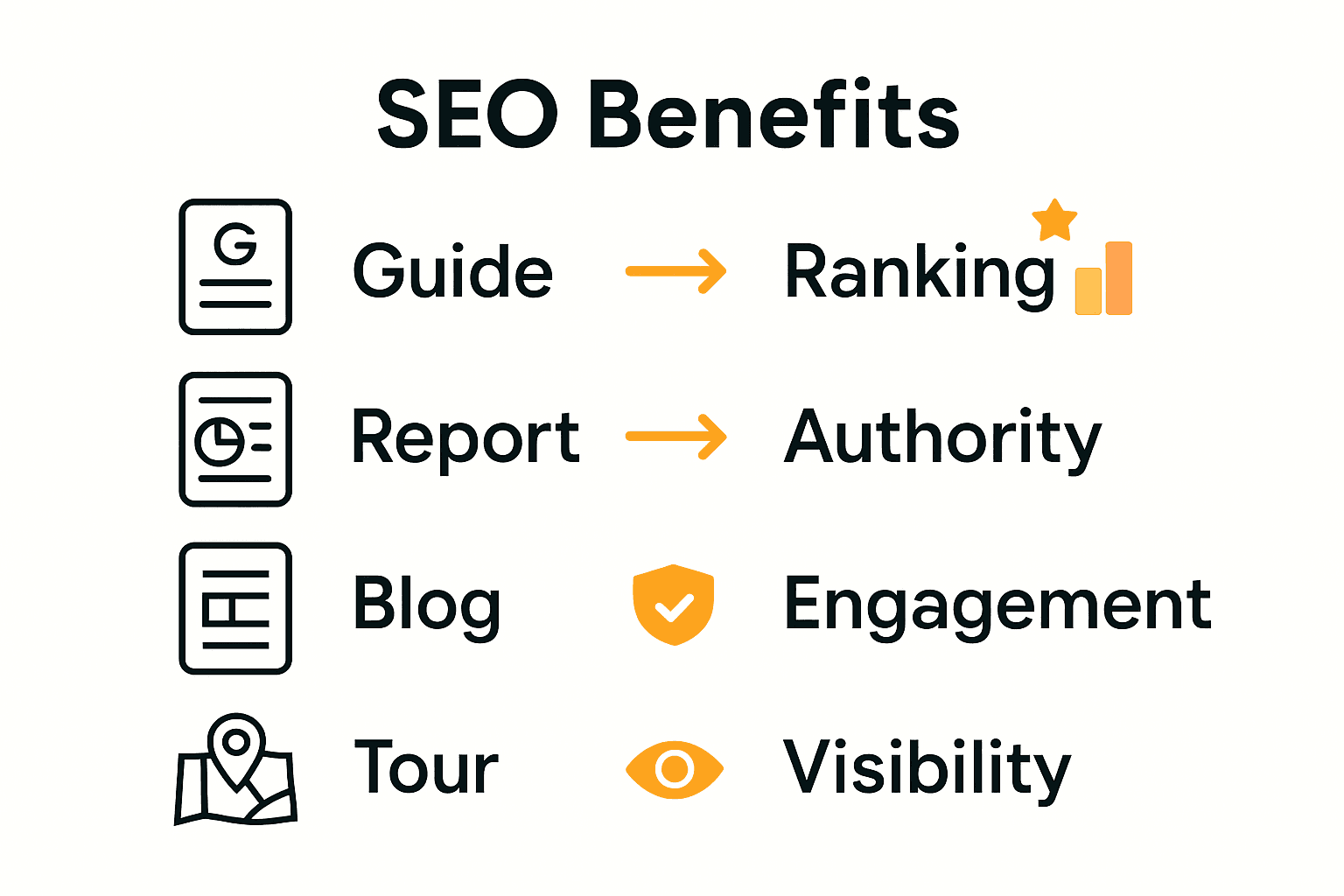
Each content type serves a unique purpose in your SEO strategy. Suburb guides, for instance, help you rank for hyperlocal search terms while providing immense value to potential clients researching specific areas. Property market reports establish you as a local market expert, attracting both search engine algorithms and potential clients seeking knowledgeable guidance.
Here’s a summary of key real estate content types and their SEO advantages:
| Content Type | Main Purpose | SEO Benefit |
|---|---|---|
| Suburb Guides | Neighborhood profiles | Ranks for hyperlocal keywords |
| Property Market Reports | Market trend analysis | Boosts authority & trust |
| Client Success Stories | Showcase expertise | Enhances credibility & engagement |
| Buyer/Seller Advice Blogs | Inform & educate clients | Targets long-tail search queries |
| Local Area Listings | Property details by area | Improves local search visibility |
| Virtual Property Tours | Visual property showcasing | Increases time on site |
The key is creating content that balances informational depth with strategic keyword targeting. By diversifying your content approach, you’re not just improving SEO—you’re building a comprehensive digital resource that positions you as the go-to real estate authority in your local market.

How Content Drives Search Rankings
In the intricate world of search engine optimization, content quality is the ultimate determining factor for ranking success. Our comprehensive content marketing insights reveal the complex mechanisms by which exceptional content propels websites up search result pages.
According to research from Search Engine Journal, Google’s algorithms assess content through multiple critical lenses:
- Relevance to user search intent
- Comprehensiveness of information
- Semantic depth of topic coverage
- User engagement metrics
Recent academic findings highlight a sophisticated, multi-agent framework for evaluating content. This approach goes beyond traditional keyword matching, analyzing content’s substantive influence through semantic complexity. For real estate professionals, this means creating content that doesn’t just include keywords, but provides genuine, in-depth insights that demonstrate true expertise.
The search ranking process is now more nuanced than ever. Search engines prioritize content that not only answers user questions but does so with authority, clarity, and comprehensive understanding. By crafting content that truly serves user needs—whether it’s a detailed suburb guide, a market trend analysis, or a comprehensive property buying walkthrough—real estate agents can significantly improve their visibility and credibility in search results.
Local SEO: Content Strategies That Work
For real estate agents, local SEO is the lifeline of digital marketing success. Our comprehensive link building strategies can help you transform hyperlocal content into a powerful ranking tool that attracts potential clients right in your neighborhood.
According to research from Search Engine Journal, strategic content approaches can dramatically improve local visibility:
- Structured data markup for property listings
- Localized social media content with targeted hashtags
- Neighborhood-specific landing pages
- Google Business Profile optimization
- Geo-targeted blog content
The key to effective local SEO lies in creating content that speaks directly to your community’s unique characteristics. This means developing suburb guides that go beyond generic descriptions, sharing market insights specific to local neighborhoods, and demonstrating deep understanding of micro-market trends that matter to potential buyers and sellers.
Successful local content strategies aren’t about keyword stuffing—they’re about genuine connection. By crafting content that provides real value to your local audience, you’re not just improving search rankings, you’re establishing yourself as the go-to real estate expert in your specific market. Think hyperlocal, write with authenticity, and watch your local search visibility soar.
Common Content Mistakes to Avoid
In the competitive realm of real estate digital marketing, content missteps can dramatically undermine your SEO efforts. Learn about strategic content approaches that help you sidestep common pitfalls and maintain a strong online presence.
Real estate professionals frequently encounter content challenges that can hurt their search rankings and audience engagement:
- Keyword Stuffing: Overloading content with repetitive keywords
- Generic Content: Using bland, non-specific property descriptions
- Outdated Information: Failing to update market data and listings
- Inconsistent Publishing: Irregular content creation schedules
- Ignoring Local Context: Writing without hyperlocal insights
One of the most critical mistakes is treating content as a mere SEO checkbox rather than a genuine communication tool. Real estate content should tell a story, provide meaningful insights, and address potential clients’ specific needs and questions. This means moving beyond surface-level property descriptions to create narratives that showcase neighborhood character, market trends, and the unique value you bring as a local expert.
Successful content strategy requires consistent, thoughtful execution. By avoiding these common pitfalls and focusing on creating authentic, valuable content, real estate agents can transform their digital presence from forgettable to remarkable. Remember: great content isn’t just about ranking—it’s about building trust, demonstrating expertise, and connecting with your local community.
Transform Your SEO Content Into Real Results With Content Charlie
Are you frustrated that your efforts with suburb guides or market reports are not turning into higher local rankings or more real estate clients? This article makes it clear that in today’s market, generic or keyword-stuffed content will only hold you back. You need tailored writing that demonstrates authority, connects with your local audience, and keeps you ahead in suburb-level searches. At Content Charlie, we know your challenges and we solve them by crafting SEO-driven copy and engaging blog articles that give your business lasting visibility.
It is time to stop guessing and start attracting clients who are ready to take action. Work with specialists who help real estate agents and local businesses master local SEO and content strategy every single day. Visit Content Charlie now to discover how we can turn your content into the secret weapon for ranking, engagement, and trust. Start seeing more leads from Broadbeach to Burleigh today. Book a strategy call and get your business found before your competition does.
Frequently Asked Questions
What is the role of content in modern SEO?
Content plays a crucial role in modern SEO as it serves as the strategic engine driving search engine rankings. High-quality, relevant content that addresses user needs is prioritized by search algorithms, enhancing visibility and user engagement.
How can real estate professionals use content to improve their local SEO?
Real estate professionals can enhance their local SEO by creating hyperlocal content, such as suburb guides, neighborhood-specific landing pages, and localized blog posts. This approach ensures that content resonates with local audiences and ranks well in search results.
What types of content are effective for enhancing SEO in real estate marketing?
Effective content types for real estate marketing include suburb guides, property market reports, buyer and seller advice blogs, client success stories, local area listings, and virtual property tours. Each type serves distinct purposes, from providing local insights to establishing authority in the market.
What common mistakes should real estate professionals avoid when creating content for SEO?
Common mistakes to avoid include keyword stuffing, using generic or outdated content, having inconsistent publishing schedules, and ignoring local context. Instead, focus on creating authentic, insightful narratives that connect with your target audience.