
- You are here:
- Home »
- local credibility
Tag Archives for " local credibility "

7 Powerful Real Estate Content Strategies for Local Agents
Over 90 percent of homebuyers start their property search online, putting digital strategies at the heart of real estate success. Standing out means more than just having listings—it requires skillful use of local SEO, eye catching visuals, and authentic client stories. By focusing on proven tactics that connect with local buyers, you can grow your reputation and attract the right clients in a crowded market.
Table of Contents
- 1. Identify Local SEO Keywords That Attract Homebuyers
- 2. Craft Suburb Guides to Build Trust and Visibility
- 3. Write Compelling Property Descriptions That Convert
- 4. Optimize Google Business Profile Content for Searches
- 5. Publish Consistent Blog Articles to Show Expertise
- 6. Leverage Client Testimonials for Local Credibility
- 7. Use Visual Content to Make Listings Stand Out
Quick Summary
| Takeaway | Explanation |
|---|---|
| 1. Focus on Local SEO Keywords | Identify specific search terms like neighborhood names to attract homebuyers actively searching online. |
| 2. Create Detailed Suburb Guides | Develop comprehensive guides about neighborhoods to establish trust and position yourself as a local expert. |
| 3. Write Engaging Property Descriptions | Use storytelling and emotional language in property descriptions to create connections with potential buyers. |
| 4. Optimize Google Business Profile | Fill out and regularly update your Google Business Profile to enhance your visibility in local searches. |
| 5. Publish Consistent Blog Content | Regularly post relevant blogs to showcase expertise and connect with potential clients in your market. |
1. Identify Local SEO Keywords That Attract Homebuyers
Successful real estate marketing starts with understanding what potential homebuyers are actually searching for online. Local SEO keywords are your secret weapon to connecting with ready buyers in specific neighborhoods and markets.
When researching keywords, think like a homebuyer searching for properties. Understanding why local SEO matters begins with mapping out precise location based search terms that reflect genuine buyer intent. According to research, location specific keywords like “homes for sale in [City]” can dramatically improve your search visibility.
Strategic Keyword Research Approach:
- Focus on neighborhood specific searches
- Include city and suburb names
- Incorporate property type descriptors
- Add transactional search terms
For instance, instead of generic terms like “real estate,” target phrases such as “3 bedroom homes in Broadbeach” or “waterfront properties Gold Coast.” These specific keywords signal exactly what potential buyers want and help search engines match your content with relevant searches.
To implement this strategy, use free tools like Google Keyword Planner or SEMrush to discover search volume and competition for local real estate keywords. Track which terms potential buyers use most frequently and integrate them naturally into your website content, blog posts, and property descriptions.
Remember that local keyword optimization is not about stuffing terms randomly. The goal is creating authentic, valuable content that genuinely answers homebuyers questions while strategically incorporating location based search terms.
2. Craft Suburb Guides to Build Trust and Visibility
Potential homebuyers are hungry for insider knowledge about neighborhoods where they might invest their future. Creating comprehensive suburb guides transforms you from a simple real estate agent into a local market expert.
Local neighborhood spotlights are powerful tools for establishing your credibility and attracting targeted traffic. According to research, writing detailed neighborhood breakdowns and answering local questions can significantly enhance your reputation within a geographical area.
Key Elements of Compelling Suburb Guides:
- Detailed neighbourhood demographic information
- Local amenities and infrastructure
- Property value trends
- School district ratings
- Community lifestyle insights
Your suburb guide should read like an insider’s manual for potential homebuyers. Go beyond basic statistics and create narrative rich content that helps people imagine living in the area. Discuss local coffee shops, upcoming development projects, community events, and unique neighborhood characteristics that make each suburb special.
To maximize impact, update these guides regularly with fresh market insights, seasonal real estate trends, and emerging local developments. This approach not only improves your SEO but positions you as the go to local real estate expert who truly understands the nuanced character of each neighborhood.
Remember that authentic, valuable content speaks directly to your audience’s curiosity and need for local understanding. Your suburb guides are more than marketing materials they are community resources that build genuine trust.
3. Write Compelling Property Descriptions That Convert
Your property description is more than just a list of features it is your digital sales pitch that can transform casual browsers into serious buyers. Crafting descriptions that spark imagination and emotional connection requires strategic storytelling.
Complete guide to copywriting in real estate reveals that successful property descriptions go beyond basic specifications. According to research, incorporating location specific keywords naturally within your content can significantly improve search engine rankings and attract potential clients.
Key Components of Magnetic Property Descriptions:
- Create a narrative that sells a lifestyle
- Highlight unique property features
- Use sensory and emotional language
- Include specific neighborhood context
- Optimize for local search keywords
Instead of writing dry statements like “3 bedroom house with garage,” paint a vivid picture. For example: “Imagine morning coffee on your sun drenched balcony overlooking Broadbeach parklands the perfect sanctuary for professionals seeking coastal tranquility.”
When writing descriptions, think about what makes a property special. Does it have a stunning view? Proximity to top schools? Recent renovations? These details transform generic listings into compelling stories that resonate with potential buyers.
Remember that great property descriptions are a blend of strategic SEO and emotional storytelling. Your goal is to help potential buyers visualize themselves living in the space not just reading about its technical specifications.
4. Optimize Google Business Profile Content for Searches
Your Google Business Profile is the digital front door to your real estate brand a powerful tool that can attract or repel potential clients within seconds. Mastering this platform is not just about filling out basic information it is about creating a compelling digital presence that stands out in local searches.
Google Business Profile optimization requires strategic thinking and consistent effort. According to research, regularly posting and adding high quality visual content can dramatically improve your visibility in Google Search and Maps.
Strategic Profile Optimization Tactics:
- Complete every profile section thoroughly
- Add professional headshots and team photos
- Include recent property listing images
- Update business hours and contact information
- Respond to all client reviews promptly
Think of your Google Business Profile as a 24/7 digital marketing representative. Professional photos showing your team, office environment, and recent successful property sales create trust and credibility. Potential clients want to see the human side of your real estate business.
Consistent updates are crucial. Share recent property achievements, local market insights, and community events. Each post increases your chances of appearing in local search results and demonstrates your active engagement with the local real estate market.
Remember that authenticity wins. Your profile should reflect your unique brand personality while providing clear, valuable information that helps potential clients understand why they should choose you as their real estate agent.
5. Publish Consistent Blog Articles to Show Expertise
Blogs are not just content they are your digital megaphone for establishing credibility and attracting potential clients. Consistent publishing transforms you from a simple real estate agent into a trusted local market expert.
Consistent blogging requires strategic planning and genuine insights. According to research, publishing local content like neighborhood guides and market updates helps build audience connection and demonstrates deep understanding of your real estate landscape.
Strategic Blog Content Approaches:
- Create hyper local market analysis
- Share seasonal real estate trends
- Offer neighborhood buying guides
- Highlight community development stories
- Answer common buyer questions
Your blog should feel like a conversation with potential clients. Instead of generic market reports, craft narratives that help readers visualize living in specific neighborhoods. For example, write articles like “Top 5 Family Friendly Suburbs in Gold Coast” or “What First Time Buyers Need to Know About Broadbeach Real Estate”.
Consistency matters more than perfection. Aim to publish 1 2 high quality articles monthly that provide genuine value. Track which topics generate the most engagement and double down on content that resonates with your audience.
Remember that your blog is a living portfolio showcasing your local expertise. Each article is an opportunity to build trust and position yourself as the go to real estate professional in your market.
6. Leverage Client Testimonials for Local Credibility
Testimonials are the secret weapon of successful real estate agents transforming satisfied clients into powerful marketing advocates. These personal stories can speak volumes about your expertise in ways no traditional advertisement ever could.
Real estate client engagement requires strategic approach to gathering and showcasing client experiences. According to research, proactively soliciting reviews and displaying positive testimonials can significantly build trust and credibility in your local market.
Strategic Testimonial Collection Tactics:
- Request feedback immediately after successful transactions
- Create multiple testimonial collection channels
- Feature diverse client stories
- Include specific transaction details
- Display testimonials across multiple platforms
When collecting testimonials, go beyond generic praise. Encourage clients to share specific details about their experience working with you. A testimonial like “John helped us find our dream home in Broadbeach within our budget” is far more compelling than “John is a great agent.”
Spread your testimonials strategically across your website, Google Business Profile, social media platforms and printed marketing materials. Video testimonials can be especially powerful providing authentic visual proof of your professional success.
Remember that potential clients want social proof. Your testimonials are not just reviews they are powerful narratives that demonstrate your ability to deliver exceptional real estate experiences.
7. Use Visual Content to Make Listings Stand Out
Visual storytelling transforms ordinary property listings into compelling narratives that capture potential buyers imagination. In a digital world saturated with real estate content, high quality visual assets are your secret weapon for standing out.
Types of real estate content every agent should use reveals the power of strategic visual marketing. According to research, incorporating videos like virtual tours and lifestyle showcases can significantly boost engagement and help potential clients connect emotionally with properties.
Powerful Visual Content Strategies:
- Produce professional property photography
- Create immersive video property tours
- Share lifestyle neighborhood context videos
- Design visually appealing market update graphics
- Highlight unique property features through visual storytelling
Think beyond standard listing photos. A walkthrough video showing morning light streaming through kitchen windows or a drone shot capturing a homes proximity to local parks can transform a simple listing into an experience. Professional photography that captures a propertys best angles tells a story far more effectively than text descriptions.
Consider creating diverse visual content that goes beyond individual listings. Market trend infographics, neighborhood lifestyle reels, and behind the scenes glimpses of your real estate process can build trust and showcase your expertise.
Remember that great visual content does more than display a property it invites potential buyers to imagine their future life in that space.
Below is a comprehensive table summarizing the strategies discussed in the article for enhancing real estate marketing using Local SEO, content creation, and client engagement.
| Strategy | Implementation | Expected Results |
|---|---|---|
| Local SEO Keyword Identification | Focus on neighborhood-specific searches, city names, property types, and transactional terms. Use tools like Google Keyword Planner. | Improved search visibility and increased webpage relevance for potential buyers. |
| Crafting Suburb Guides | Include demographics, amenities, property trends, and lifestyle insights. Regularly update guides. | Enhanced local credibility and attraction of targeted traffic. |
| Property Descriptions | Use storytelling, highlight unique features, and include sensory and emotional language. Optimize with local keywords. | Conversion of casual browsers to serious buyers. |
| Google Business Profile Optimization | Complete profile details, add high-quality images, update frequently, and respond to reviews. | Increased visibility in searches and stronger client engagement. |
| Consistent Blogging | Publish regular articles on local market analysis, trends, and buying guides. | Establishment as a local expert and stronger connection with potential clients. |
| Leveraging Client Testimonials | Collect detailed feedback, feature diverse stories, and display across platforms. | Increased trustworthiness and credibility in the local market. |
| Visual Content Usage | Incorporate professional photos, videos, and infographics. Highlight property features. | Enhanced listing appeal and emotional connection with potential buyers. |
Unlock the Full Potential of Your Local Real Estate Content
Struggling to stand out in a crowded market and connect with local homebuyers can be frustrating. This article highlights crucial strategies like targeted local SEO keywords, compelling suburb guides, and authentic property descriptions that resonate with buyers. If you want to overcome challenges such as low search visibility and weak buyer engagement, focusing on authentic content tailored to your neighborhood is key. Content Charlie specializes in creating SEO-driven real estate copy that ranks highly for specific locality searches and builds trust through valuable insights.
Elevate your listings and neighborhood expertise with our help. From crafting engaging suburb guides to writing magnetic property descriptions and optimizing your Google Business Profile content, we make sure your brand connects with ready-to-act buyers in your area. Don’t let your marketing fall flat when you can dominate your local market and become the trusted agent buyers choose.
Ready to transform your real estate content into a powerful client magnet now
Visit Content Charlie to discover how our tailored local SEO strategies and high-converting copywriting can put you ahead of competitors in neighborhoods like Broadbeach and beyond. Take the first step to getting found and closing more deals today.
Frequently Asked Questions
How can I identify local SEO keywords that attract homebuyers?
To identify local SEO keywords, focus on neighborhood-specific searches and include city names, property types, and transactional terms. Conduct keyword research using free tools to discover popular local search phrases and integrate them naturally into your website and listings.
What should I include in suburb guides to engage potential homebuyers?
Suburb guides should include detailed demographics, local amenities, property value trends, and community lifestyle insights. Create engaging content that helps buyers visualize life in the area to build trust and position yourself as a local expert.
How can I write compelling property descriptions that convert?
Write property descriptions that tell a story, highlighting unique features and using sensory language to evoke emotions. Aim to incorporate localized keywords and provide specific neighborhood context to enhance search visibility and buyer connection.
What are effective strategies for optimizing my Google Business Profile?
Optimize your Google Business Profile by completing all sections thoroughly, adding professional photos, and posting updates regularly. Engage with client reviews to improve visibility and showcase your real estate brand’s personality.
How often should I publish blog articles to establish expertise in my local market?
Aim to publish 1-2 high-quality blog articles each month to showcase your local knowledge and market insights. Consistency helps engage your audience and positions you as a trusted professional in your field.
How can I use visual content to enhance my property listings?
Util high-quality visuals such as professional photography and immersive video tours to create compelling property listings. Highlight unique features and the surrounding neighborhood through varied visual content, helping potential buyers imagine themselves in the space.
Recommended
- 7 Types of Real Estate Content Every Agent Should Use – Content Charlie
- 7 Best Real Estate Blog Ideas for Local Agents – Content Charlie
- 7 Essential Types of Real Estate Leads Agents Must Know – Content Charlie
- Why Use Blog Content: Essential Guide for Real Estate – Content Charlie
- SEO for Real Estate Agencies: Simple Strategies to Grow Your Business

SEO for Realtors Explained: Strategies for Dominance
Did you know that over 90 percent of home buyers begin their search online? With so much competition, showing up on the first page of search results can mean the difference between a steady stream of leads and missing out altogether. By understanding the core principles of SEO for realtors, you can reach more serious buyers and sellers right when they need expert guidance most.
Table of Contents
- SEO For Realtors: Essential Concepts Explained
- Types Of SEO For Real Estate Agents
- Local Keyword Strategies And Content Optimisation
- Optimising Google Business Profile Listings
- Common SEO Mistakes And Pitfalls To Avoid
Key Takeaways
| Point | Details |
|---|---|
| SEO Importance | Effective SEO enhances visibility, brand awareness, and marketing cost-effectiveness for realtors. |
| Local Optimization | Focus on local keyword strategies and create location-specific content to attract relevant leads. |
| Google Business Profile | Optimize your Google Business Profile with accurate information and engage with reviews to boost local search rankings. |
| Avoid Common Mistakes | Steer clear of vague titles, duplicate content, and neglecting mobile optimization to improve search visibility. |
SEO for Realtors: Essential Concepts Explained
Search engine optimization (SEO) is the strategic practice of enhancing your real estate website’s visibility in organic search results. According to dxstudio, effective SEO can dramatically boost brand awareness and improve the cost-effectiveness of marketing efforts by achieving higher search rankings.
For real estate professionals, SEO fundamentals involve several critical components. The Maine guidelines highlight key practices that translate directly to real estate websites:
- Create clear, descriptive page titles
- Generate original, high-quality content
- Use keywords strategically and appropriately
- Implement accessibility features like accurate image alt text
Successful real estate SEO requires understanding how potential clients search online. This means optimizing your website to appear when someone searches for terms like “homes in [your suburb]” or “real estate agents near me.” By focusing on local search optimization, you can attract more qualified leads directly through your website. To maximize your SEO strategy, learn more about real estate website essentials and how to build a site that both search engines and clients will love.
Types of SEO for Real Estate Agents
In the dynamic world of real estate digital marketing, understanding different SEO strategies is crucial for agents looking to stand out online. According to Coursera, SEO encompasses three primary approaches: on-page optimization, off-page optimization, and technical SEO, each playing a unique role in improving search engine rankings.
Here’s a summary of the main types of SEO for real estate agents:
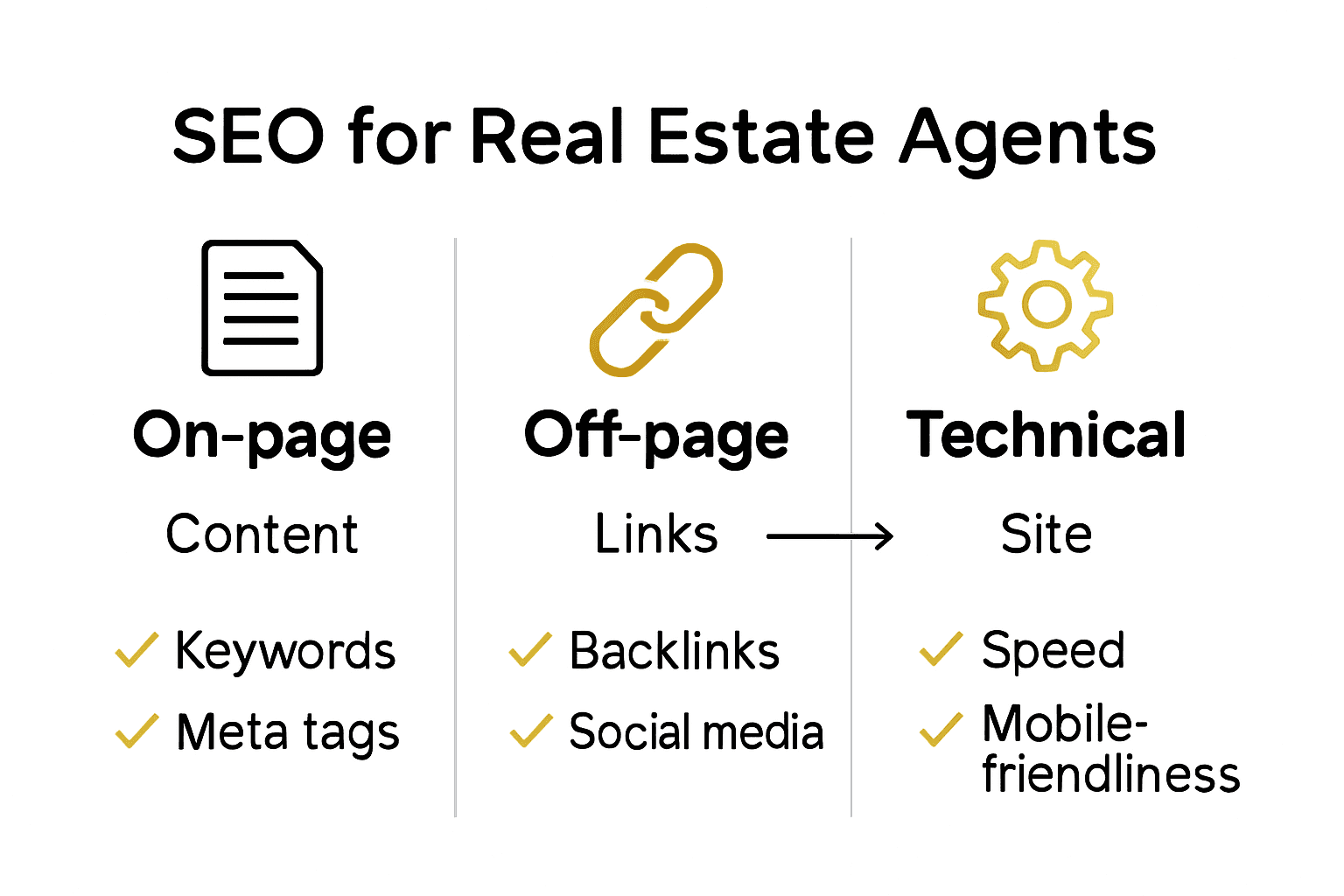
| SEO Type | Focus Area | Key Examples |
|---|---|---|
| On-Page SEO | Website content & structure | Keyword-rich property pages Optimized meta tags Local blog posts |
| Off-Page SEO | External reputation & authority | Backlinks from directories Realtor citations Community websites |
| Technical SEO | Website performance & search engine access | Fast loading speed Mobile responsiveness Secure HTTPS |
On-Page SEO focuses directly on your website’s content and structure. For real estate professionals, this means:
- Creating property descriptions with strategic keywords
- Developing suburb-specific landing pages
- Writing informative blog content about local real estate trends
- Optimizing meta titles and descriptions for each page
Off-Page SEO involves building your website’s credibility through external factors. This includes generating quality backlinks from local business directories, real estate platforms, and community websites. Coursera’s search engine optimization research emphasizes that off-page tactics signal to search engines that your website is a trusted resource in the real estate market.
Technical SEO ensures your website meets search engine infrastructure requirements. For real estate agents, this means creating a fast, mobile-responsive site with clean code, secure connections, and easy navigation. By understanding and implementing these SEO tips to boost agent visibility, you’ll dramatically improve your chances of ranking higher in local search results.

Local Keyword Strategies and Content Optimisation
Local keyword strategies are the backbone of successful real estate SEO, enabling agents to connect directly with potential clients searching in specific areas. According to Florida Realtors, creating location-specific content can significantly enhance search engine rankings by providing valuable community information including demographics, schools, amenities, and local points of interest.
Effective local keyword optimization involves multiple strategic approaches:
- Develop detailed suburb and neighborhood landing pages
- Incorporate hyperlocal keywords naturally into website content
- Use location-specific terms in headers, titles, and meta descriptions
- Create blog posts highlighting local market trends and community insights
The Splendour Group emphasizes the importance of hyperlocal content, recommending that real estate agents integrate location details throughout their digital presence. This means going beyond generic property listings to craft content that speaks directly to local buyers and sellers. By understanding the nuanced search behaviors of potential clients, you can create local SEO strategies that position you as the go-to real estate expert in your specific market.
To truly dominate local search results, real estate agents must think like their potential clients. This means anticipating the specific search terms people use when looking for properties, understanding local market dynamics, and creating content that answers their most pressing questions about neighborhoods, property values, and community living.
Optimising Google Business Profile Listings
A Google Business Profile is the digital storefront for real estate agents, serving as a critical first impression for potential clients searching online. According to Energy.gov, optimizing this profile requires providing accurate and comprehensive information, including your business name, address, phone number, and precise operating hours.
Key strategies for maximizing your Google Business Profile effectiveness include:
- Upload high-quality, professional photos of your team and properties
- Write a compelling business description that highlights your unique value
- Select the most relevant business categories
- Verify your business location to increase credibility
- Respond promptly to all customer reviews
The Splendour Group emphasizes that maintaining an up-to-date profile can dramatically improve local search rankings. Encouraging satisfied clients to leave positive reviews not only boosts your visibility but also builds trust with potential customers. By consistently updating your Google Business Profile, you signal to both Google and potential clients that you’re an active, engaged real estate professional.
Remember, your Google Business Profile is more than just a listing—it’s a powerful marketing tool that can significantly influence a potential client’s first impression. Regular maintenance, authentic engagement, and strategic optimization can transform this simple profile into a lead-generating machine for your real estate business.
Common SEO Mistakes and Pitfalls to Avoid
Real estate agents often stumble into SEO traps that can significantly undermine their online visibility. According to Maine, common mistakes include using vague page titles, neglecting comprehensive keyword research, and failing to produce original, high-quality content that truly serves potential clients.
Critical SEO pitfalls for real estate professionals include:
- Keyword stuffing that makes content unreadable
- Neglecting mobile optimization
- Using duplicate content across property listings
- Ignoring local search intent
- Failing to update website content regularly
DX Studio emphasizes the importance of understanding search intent and user behavior. For real estate agents, this means creating content that genuinely answers potential clients’ questions about properties, neighborhoods, and market trends. By exploring these nuanced search behaviors, you can craft SEO myths guide content that resonates with your target audience and improves your search rankings.
The most successful real estate SEO strategies require a holistic approach. Stop treating your website as a static brochure and start viewing it as a dynamic, interactive resource that adapts to potential clients’ evolving needs. Continuous learning, regular content updates, and a genuine commitment to providing value will set you apart in the competitive digital real estate landscape.
Take Control of Your Real Estate SEO Today
Struggling to break through the noise in local search results or frustrated that your property listings do not attract qualified leads? The challenges highlighted in “SEO for Realtors Explained” show how important it is to master local keyword strategies, create compelling Google Business Profile content, and avoid common SEO mistakes like duplicate and poorly optimized content. If you want to be the trusted local expert buyers and sellers find first, your website and content must truly stand out.
At Content Charlie, we specialize in crafting SEO-driven real estate copy that connects with your audience on a suburb level — from targeted property descriptions to engaging blog articles that boost your search rankings. Our tailored approach helps you capture the right traffic by focusing on the exact terms your customers use when searching for homes or agents nearby.
Ready to transform your online presence and dominate local searches? Visit Content Charlie now to explore how our local SEO and real estate copywriting services can turn your website into a lead-generating machine. Don’t let your competition outshine you—take action today and position your brand as the go-to real estate professional in your community.
Frequently Asked Questions
What is SEO for realtors?
Search engine optimization (SEO) for realtors is the practice of improving a real estate website’s visibility in search engine results. It involves various strategies aimed at attracting potential clients through organic search traffic.
What are the main types of SEO strategies for real estate agents?
The main types of SEO strategies for real estate agents include on-page SEO, off-page SEO, and technical SEO. On-page SEO focuses on website content and structure, off-page SEO builds external credibility through backlinks, and technical SEO ensures site performance and search engine accessibility.
How can local keyword strategies enhance my real estate SEO?
Local keyword strategies can enhance your real estate SEO by targeting specific community-related terms. Creating location-specific content helps your website appear in searches for properties in those areas, connecting you directly with potential clients.
What are common SEO mistakes real estate agents should avoid?
Common SEO mistakes to avoid include keyword stuffing, neglecting mobile optimization, using duplicate content, ignoring local search intent, and failing to update website content regularly. These errors can significantly reduce your online visibility and effectiveness.