
- You are here:
- Home »
- email open rates
Tag Archives for " email open rates "

Lead Generation Workflow Real Estate: Step-by-Step Success
Lead Generation Workflow Real Estate is necessary for all real estate agents to understand.
Did you know that over 90 percent of home buyers begin their search online? In a crowded real estate market, getting high quality leads makes all the difference for agents who want lasting success. Understanding who your ideal client is and how to reach them not only shapes your strategy but also determines how much value you deliver. Discover the steps to turn curiosity into solid connections and grow your business.
Table of Contents
- Step 1: Define Your Ideal Client And Market Focus
- Step 2: Set Up Essential Lead Capture Channels
- Step 3: Develop Compelling Lead Magnets And Offers
- Step 4: Implement Automation For Lead Nurturing
- Step 5: Track Results And Optimise Your Workflow
Quick Summary
| Key Point | Explanation |
|---|---|
| 1. Define Your Ideal Client | Understand your target audience and their specific needs to tailor your marketing strategies effectively. |
| 2. Set Up Lead Capture Channels | Create multiple engagement points like a professional website and optimize Google Business Profile for better visibility. |
| 3. Develop Compelling Lead Magnets | Design valuable offers that address specific problems of your target market to increase lead capture rates. |
| 4. Implement Automated Lead Nurturing | Use segmented email campaigns to provide personalized communication, enhancing client engagement throughout their journey. |
| 5. Track Performance and Optimize | Regularly analyze KPIs to refine your lead generation strategies and improve overall effectiveness in conversions. |
Step 1: Define your ideal client and market focus
Successful real estate lead generation starts with knowing exactly who you want to serve. According to Dataconomy, building trust through targeted content marketing requires a crystal clear understanding of your target audience and locality.
Begin by mapping out your specific market segment. Are you focusing on first time homebuyers in suburban areas? Luxury property investors? Retirees looking to downsize? Your target client profile determines everything from your marketing strategy to the properties you showcase.
Create a detailed client persona that goes beyond basic demographics. Think about their motivations, challenges, and aspirations. A young professional might prioritize proximity to public transport and modern amenities. A growing family will likely want school districts and spacious layouts. Understanding these nuanced preferences helps you craft more compelling communications.
Here’s a comparison of common real estate client personas and their unique needs:
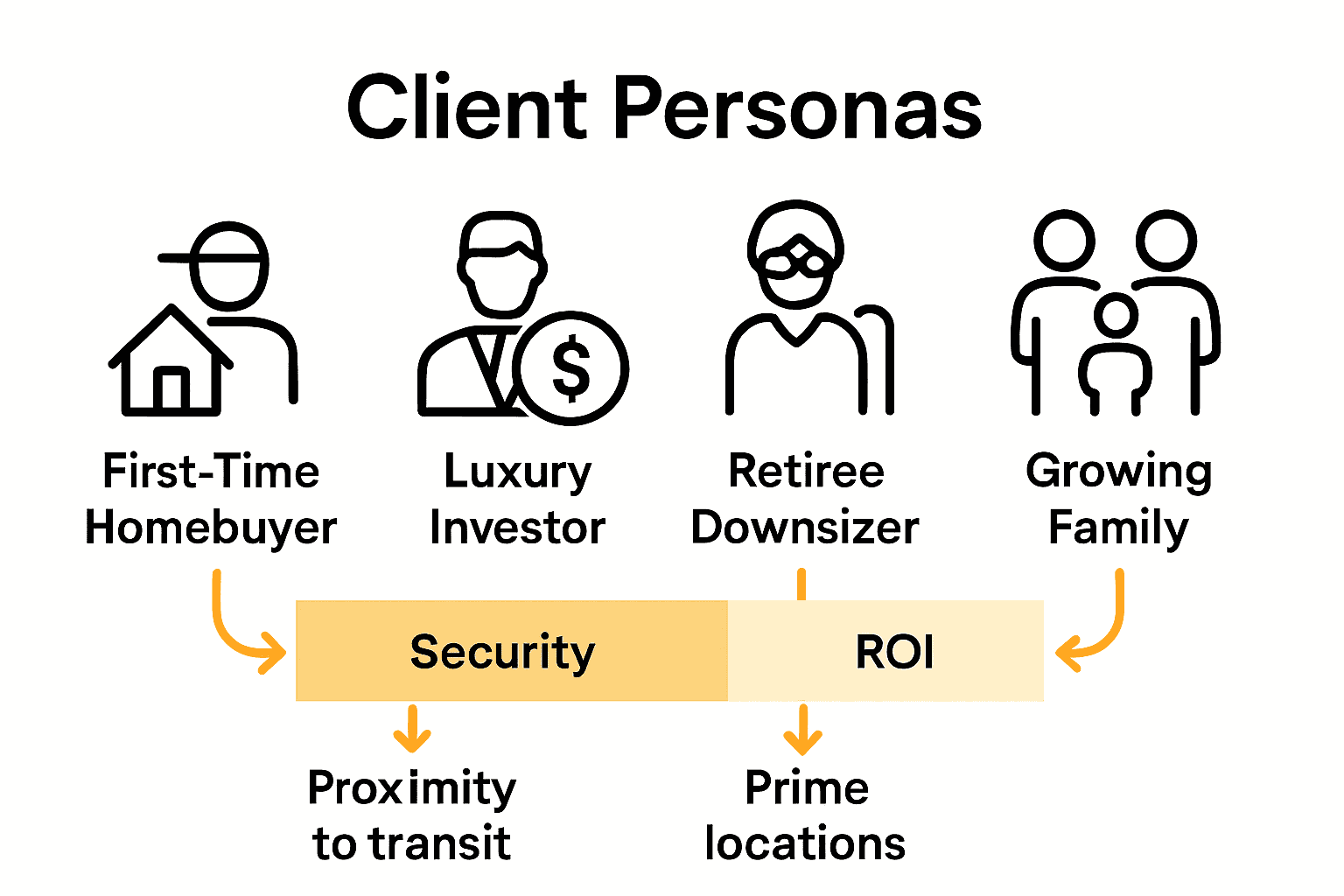
| Client Persona | Key Motivations | Top Priorities |
|---|---|---|
| First-Time Homebuyer | Security Affordability |
Proximity to transit Modern amenities |
| Luxury Investor | ROI Status |
Prime locations Exclusive properties |
| Retiree Downsizer | Simplicity Accessibility |
Walkability Low maintenance |
| Growing Family | Space Stability |
Schools Safe neighborhoods |
Research your local market thoroughly. Examine recent sales data, neighborhood trends, and economic indicators. This helps you identify not just who your ideal clients are but where they are most likely to be searching for properties.
Pro Tip: Use local real estate data platforms and government statistics to build a comprehensive market understanding.
Once you have defined your ideal client, everything from your website copy to your social media content can be strategically tailored to speak directly to their needs and desires. Your marketing becomes more precise powerful and effective.
Ready to move to the next step? You will now develop a targeted content strategy that speaks directly to your defined market segment.
Step 2: Set up essential lead capture channels
Your lead generation strategy hinges on creating multiple touchpoints where potential clients can discover and engage with your real estate services. According to Dataconomy, successful real estate agents integrate diverse channels like CRM systems email platforms and social media to maximize lead capture opportunities.
Start by establishing a robust online presence through a professional website with clear contact forms. Your website should not just showcase properties but actively invite interaction. Implement strategic call to action buttons that make it easy for visitors to request more information schedule viewings or download market reports.
Expand your digital reach by optimizing your Google Business Profile. Inman highlights the importance of creating a searchable profile that appears in local searches. Include high quality property images comprehensive business information and encourage client reviews to boost your credibility.
Consider innovative capture methods beyond traditional websites. QR codes on property signage mailers or business cards can instantly connect potential clients to your landing pages. Create engaging YouTube videos about local property markets neighborhood guides and client testimonials that provide value while subtly capturing viewer contact details.
Pro Tip: Always offer something of genuine value in exchange for contact information such as a free market analysis report or exclusive property listing guide.
Develop a comprehensive CRM system that tracks interactions across all channels. This allows you to nurture leads systematically and personalize your communication based on their specific interests and interactions.
Ready for the next step? You will now learn how to craft compelling content that attracts and converts these captured leads into potential clients.
Step 3: Develop compelling lead magnets and offers
Lead magnets are your secret weapon for transforming casual website visitors into potential clients. According to LinkedIn, high converting lead magnets in real estate include homebuyer guides free property valuation PDFs and local moving resources that provide genuine value to potential clients.
Design your lead magnets with laser focus on solving specific problems your target market experiences. A first time homebuyer might appreciate a comprehensive guide walking them through the purchasing process. Investors could be drawn to a detailed market analysis report showcasing neighborhood property value trends. The key is creating content so useful that people willingly exchange their contact information to access it.
Inman suggests innovative approaches like QR code mailers linking to exclusive reports such as “7 Secrets That Make Owning a Home Easier” or unsolicited video comparative market analyses. These unexpected value offerings can dramatically increase your lead capture rates.
Consider multiple formats for your lead magnets digital PDFs video walkthroughs webinar recordings interactive property valuation tools. Diversifying your offerings increases the likelihood of attracting different types of potential clients with varying content preferences.
Pro Tip: Ensure your lead magnet directly relates to the specific needs of your ideal client persona you developed in the previous step.
Track the performance of each lead magnet.
 Some will resonate more strongly than others and understanding these nuances helps you refine your approach continuously.
Ready for the next step? You will now learn how to create a systematic follow up process that converts these captured leads into actual clients.
Step 4: Implement automation for lead nurturing
Automation transforms how real estate agents manage and engage potential clients. According to Fran Funnel, effective lead nurturing requires strategic drip email campaigns precisely segmented by buyer personas ensuring consistent personalized communication throughout the client journey.
Start by designing targeted email workflows for different client segments. First time homebuyers will need educational content about purchasing processes. Investors require market trend analyses and investment property insights. Retirees might appreciate neighborhood lifestyle guides. Your automation should feel like a personalized conversation not a generic broadcast.
Zavops highlights the importance of multichannel automation beyond traditional email. Consider integrating SMS marketing which boasts significantly higher open rates and implementing click to call features on your website for immediate engagement.
Create a logical sequence of touchpoints that gradually build trust. Your first email might offer the free guide they downloaded. Follow ups could include neighborhood market reports community event invitations or personalized property recommendations based on their initial interaction.
Pro Tip: Set up triggered emails that respond instantly to specific lead actions like downloading a resource or clicking a particular link.
Track engagement metrics closely. Which emails get opened? What content generates the most clicks? Use these insights to continuously refine your automation strategy making each interaction more compelling than the last.
Ready for the next step? You will now learn how to convert these nurtured leads into actual client meetings and property transactions.
Step 5: Track results and optimise your workflow
Data drives success in real estate lead generation. According to Dataconomy, integrating comprehensive CRM systems allows agents to monitor lead interactions across multiple channels enabling precise performance tracking and strategic optimization.
Start by establishing key performance indicators specific to your lead generation workflow. Conversion rates cost per lead engagement levels and client acquisition metrics will be your north star. Track how many website visitors transform into actual leads and what percentage of those leads convert into signed clients.
ShareLoApp recommends analyzing performance across diverse channels. Examine metrics from content marketing social media advertising virtual tours and blog engagement. Which platforms generate the most qualified leads? Where are you seeing the highest return on investment?
Implement monthly review sessions where you deep dive into your analytics. Look beyond surface level numbers and understand the story behind the data. Are certain lead magnets performing better than others? Do specific email sequences generate more responses? Your workflow should be a living document constantly refined by real world performance.
Pro Tip: Create a dashboard that consolidates all your key metrics making it easy to spot trends and make rapid strategic adjustments.
Remember that optimization is an ongoing process. What works today might change tomorrow. Stay curious experiment regularly and be willing to pivot your approach based on solid data insights.
Ready for the final step? You will now learn how to continuously improve and scale your real estate lead generation strategy.
Elevate Your Real Estate Lead Generation with Content Charlie
The challenge of crafting a precise lead generation workflow that truly connects with your ideal client can feel overwhelming. This article highlights how defining client personas, creating compelling lead magnets, and automating nurturing processes are essential steps. Yet, without the right content strategy focused on local SEO and persuasive copywriting, even the best workflows may fail to capture and convert leads effectively.
At Content Charlie, we understand that your success depends on being discovered by motivated buyers and sellers right in your neighborhood. Our expertise lies in producing targeted real estate copy, suburb guides, and Google Business Profile content that ranks on Google and speaks directly to your defined market segment. Combine your strategic workflow with our high-converting content solutions to build trust, boost engagement, and turn prospects into clients.
Don’t let your leads slip away due to unclear messaging or poor local visibility. Visit Content Charlie now to start transforming your real estate marketing strategy with SEO-driven copy that gets found and brings results. Explore our services to find out how suburb-specific content and consistent blog articles can complement your lead generation pipeline. Take the next step toward dominating your market today.
Frequently Asked Questions
How can I define my ideal client in real estate lead generation?
To define your ideal client, create a detailed client persona that includes their motivations, challenges, and aspirations. Start by identifying specific segments like first-time homebuyers or luxury investors to tailor your marketing strategy effectively.
What are effective lead capture channels for real estate agents?
Effective lead capture channels include a professional website with clear contact forms and optimized Google Business Profiles. Ensure your website invites interaction, such as scheduling viewings, and utilize social media platforms for broader reach.
What types of lead magnets should I create for my real estate business?
Create lead magnets that address specific problems faced by your target market, like homebuyer guides or market analysis reports. Aim to make these resources so valuable that potential clients are willing to exchange their contact information for access.
How can I implement automation to nurture my real estate leads?
Implement automation by setting up targeted email workflows based on client segments, ensuring that each email delivers personalized content. Design touchpoints that gradually build trust and track engagement metrics to refine your approach continuously.
What key performance indicators should I track in my lead generation workflow?
Key performance indicators to track include conversion rates, cost per lead, and engagement levels. Regularly analyze these metrics to identify areas for improvement and refine your workflow based on real-world performance.
How often should I review my lead generation strategy for optimal results?
Conduct monthly review sessions to analyze your lead generation performance and uncover trends. By frequently evaluating your strategy, you can make timely adjustments, potentially improving efficiency and results by up to 30%.
Get the book that explains it all How To Generate Leads
Recommended

7 Innovative Real Estate Newsletter Ideas for Agents
Real estate newsletter ideas are packed with tips and data but not every agent knows how to make them truly irresistible. Most send out general updates that subscribers barely skim. Yet when you reveal that properties with virtual tours get 87 percent more views than standard listings, it shows how one simple change can captivate your audience and turn routine emails into something everyone wants to open.
Table of Contents
- Highlight Current Market Trends And Insights
- Share Case Studies And Success Stories
- Provide Tips For Home Buyers And Sellers
- Feature Local Community News And Events
- Offer Seasonal Maintenance And Home Improvement Advice
- Include Interactive Content Like Polls Or Surveys
- Showcase Properties With Virtual Tours And Listings
Quick Summary
| Takeaway | Explanation |
|---|---|
| Share local market insights | Provide specific data about trends and prices to position yourself as a knowledgeable expert. |
| Include authentic case studies | Highlight success stories that showcase your expertise and build trust with potential clients. |
| Offer actionable tips for clients | Provide targeted advice to help buyers and sellers make informed decisions throughout the real estate process. |
| Highlight community news and events | Showcase local happenings to engage readers and demonstrate your connection to the community. |
| Incorporate interactive content | Use polls and surveys to engage subscribers, gather insights, and foster client relationships. |
1: Highlight Current Market Trends and Insights
Your real estate newsletter can become a powerful communication tool when you consistently share market trends and insights. By transforming complex market data into digestible, engaging content, you position yourself as a knowledgeable local expert that clients trust.
Translating raw market statistics into compelling narratives helps your audience understand the broader real estate landscape. When potential buyers and sellers receive timely, accurate market information directly from you, they perceive added value beyond traditional transactional relationships.
Our local SEO guide suggests creating content that resonates with your specific community’s real estate interests. This means going beyond generic national trends and focusing on hyperlocal market dynamics.
Effective market trend newsletters typically include key insights such as:
- Average home sale prices in specific neighborhoods
- Days on market for different property types
- Median listing prices compared to previous quarters
- Inventory levels and what they mean for buyers and sellers
To make your newsletter truly compelling, contextualize these statistics. Explain what falling inventory might mean for first-time homebuyers or how increasing median prices impact investment strategies. According to National Association of Realtors research, providing interpretation alongside raw data significantly increases reader engagement.
Remember that transparency builds trust. Be honest about market challenges and opportunities. Clients appreciate agents who provide balanced, nuanced perspectives rather than overly optimistic or pessimistic narratives.
Professional real estate newsletters transform complex market data into stories that help clients make informed decisions. By consistently delivering valuable insights, you demonstrate expertise and build long-term relationships that extend far beyond individual transactions.
2: Share Case Studies and Success Stories for Real Estate Newsletter Ideas
Real estate newsletters become infinitely more compelling when they showcase authentic client success stories. These narratives transform abstract marketing materials into powerful, relatable experiences that potential clients can connect with emotionally.
Successful case studies demonstrate your professional expertise while humanizing your brand. They provide concrete evidence of your problem-solving skills and commitment to client satisfaction. Our local SEO guide recommends crafting stories that highlight unique challenges and innovative solutions.
According to Nielsen Norman Group research, narratives with specific details are 22 times more memorable than plain facts. When constructing your case studies, focus on elements that showcase your professional approach:
- Client background and initial real estate challenges
- Strategic approach you implemented
- Measurable outcomes and client satisfaction
Consider anonymizing client details to protect privacy while maintaining the story’s authenticity. Effective case studies might highlight scenarios like helping first-time homebuyers secure their dream property, assisting investors in finding profitable opportunities, or guiding sellers through complex market transitions.
Your success stories should demonstrate tangible value. Numbers and specific outcomes matter. Did you help a client sell their home 20% faster than the local average? Did you negotiate a purchase price significantly below market value? These concrete details transform generic narratives into powerful testimonials.
Additionally, varied case studies can appeal to different client segments. A mix of stories involving different property types, buyer demographics, and transaction complexities shows your versatility and comprehensive market understanding.
Ultimately, well-crafted case studies in your newsletter do more than showcase past achievements. They build trust, illustrate your professional capabilities, and provide potential clients with a clear vision of the exceptional service you provide.
3: Provide Real Estate Newsletter Ideas Tips for Home Buyers and Sellers
Transforming your real estate newsletter into a valuable resource means offering practical, actionable advice that helps clients navigate complex property transactions. By sharing targeted tips for both buyers and sellers, you establish yourself as a trusted advisor who goes beyond traditional transactional services.
Our real estate marketing guide emphasizes the importance of providing clear, strategic guidance that addresses common pain points in the real estate process.
According to National Association of Realtors research, clients value agents who provide comprehensive education about the buying and selling landscape. Your newsletter can become an essential tool for demystifying complex real estate processes.
For home buyers, consider including tips such as:
- Understanding mortgage pre-approval before house hunting
- Budgeting for hidden costs beyond the purchase price
- Importance of home inspections and what to look for
For sellers, focus on strategies that maximize property value and streamline the selling process:
- Cost-effective home improvement projects
- Staging techniques that attract potential buyers
- Pricing strategies aligned with current market conditions
The most effective tips blend practical advice with local market insights. Discuss how neighborhood-specific trends might impact buying or selling strategies. For instance, highlight upcoming infrastructure projects, school district changes, or emerging local development that could influence property values.
Remember that educational content builds trust. By consistently providing valuable information, you position yourself as a knowledgeable professional who genuinely wants to help clients make informed decisions. Your newsletter becomes more than a marketing tool – it transforms into a valuable resource clients will eagerly anticipate and share with their networks.
4: Feature Local Community News and Events
Highlighting local community news and events transforms your real estate newsletter from a marketing tool into a valuable neighborhood resource. By showcasing the vibrant local landscape, you demonstrate deep community connection and provide subscribers with engaging, relevant content.
Our neighborhood spotlights guide suggests creating content that goes beyond traditional real estate information. Local events and news create meaningful context for potential buyers and sellers understanding the true essence of a neighborhood.
According to Nextdoor’s Community Impact Report, 87% of residents are more likely to engage with local businesses that demonstrate genuine community involvement. Your newsletter can become a critical communication bridge between real estate services and local community dynamics.
Consider featuring content such as:
- Upcoming community festivals and cultural events
- Local infrastructure and development projects
- School district updates and educational initiatives
Effective community news coverage requires a strategic approach. Highlight events that showcase the neighborhood’s unique character. Are there new restaurants opening? Community improvement projects? Local business success stories? These narratives provide potential buyers with insights beyond property listings.
Remember to balance information with storytelling. Include personal perspectives, interview local business owners, or share community achievements. This approach transforms your newsletter from a transactional document into a compelling neighborhood narrative.
By consistently delivering rich, locally focused content, you position yourself as more than a real estate agent. You become a community connector, trusted advisor, and local expert who understands the intricate dynamics that make a neighborhood truly special.
5: Offer Seasonal Maintenance and Home Improvement Advice in Real Estate Newsletter Ideas
Providing seasonal maintenance and home improvement advice in your real estate newsletter positions you as a proactive, knowledgeable resource for current and potential clients. These practical tips demonstrate your commitment to helping homeowners protect and enhance their property investments.
Our real estate marketing guide emphasizes the importance of delivering actionable, timely information that adds genuine value to your clients’ lives.
According to HomeAdvisor’s State of Home Spending report, homeowners spend an average of $7,560 annually on home maintenance and improvement projects. Your newsletter can help them make informed, strategic decisions about these investments.
Consider offering advice tailored to different seasons:
- Summer preparation tips like air conditioning maintenance
- Winter weatherproofing strategies to prevent home damage
- Spring landscaping recommendations for curb appeal
Key maintenance advice should address both preventative care and value-adding improvements. This might include cost-effective projects that can increase home value, such as:
- Minor kitchen updates
- Energy-efficient upgrades
- Landscaping improvements
Your maintenance advice should blend practical guidance with potential financial benefits. Explain how regular maintenance can prevent costly repairs and how strategic improvements can boost property value. For instance, discuss how a $500 investment in fresh paint might yield a significant return during a future sale.
By consistently providing expert maintenance insights, you transform your newsletter from a marketing tool into a valuable homeowner resource. Clients will appreciate receiving timely, actionable advice that helps them protect and improve their most significant asset. This approach builds trust, positions you as an authority, and keeps your audience engaged beyond traditional real estate transactions.
6: Include Interactive Content Like Polls or Surveys
Interactive content transforms your real estate newsletter from a passive communication tool into an engaging, two-way conversation. Polls and surveys invite subscribers to actively participate, providing valuable insights while simultaneously increasing reader engagement and connection.
Our email marketing strategies guide highlights the critical role of interactive elements in maintaining subscriber interest and improving overall communication effectiveness.
According to HubSpot’s Marketing Research, interactive content generates 2x more conversions compared to passive content. By incorporating strategic polls and surveys, you create opportunities for meaningful client interactions.
Consider implementing interactive elements that provide mutual benefits:
- Market sentiment polls about local real estate trends
- Neighborhood preference surveys
- Home improvement idea collections
Effective interactive content should be:
- Concise and easy to complete
- Relevant to your audience’s interests
- Visually appealing
Designing compelling interactive content requires understanding your audience’s motivations. Ask questions that reveal client preferences, challenges, and aspirations. For instance, a survey about preferred home features can provide insights into market demands while making subscribers feel valued.
The data collected through these interactive elements serves multiple purposes. Beyond engagement, you gain actionable market intelligence that can inform your service offerings, marketing strategies, and client communication approaches.
By regularly featuring interactive content, you demonstrate that your newsletter is not just about broadcasting information, but about creating a collaborative, responsive community where client perspectives are genuinely heard and respected.
7: Showcase Properties with Virtual Tours and Listings
Virtual tours and property listings have revolutionized how real estate agents present properties in their newsletters. Digital showcasing allows potential buyers to explore homes remotely, providing an immersive experience that traditional photography cannot match.
Our virtual tours guide emphasizes creating engaging, high-quality digital property presentations that capture potential buyers’ imaginations.
According to Matterport’s Real Estate Visualization Report, properties with virtual tours receive 87% more views compared to traditional listings, dramatically increasing potential buyer engagement.
When incorporating property showcases in your newsletter, consider these strategic approaches:
- High-resolution property images
- 360-degree virtual tour links
- Detailed property description highlighting unique features
Key elements that make property listings compelling include:
- Clear, professional photography
- Accurate, concise property descriptions
- Transparent pricing information
Digital property presentation requires more than just uploading images. Craft narratives that help potential buyers visualize living in the space. Describe not just the physical attributes, but the lifestyle each property offers. A modern kitchen isn’t just about appliances – it’s about family gatherings, culinary adventures, and creating memories.
Technology has transformed property marketing. By integrating sophisticated virtual tour technologies and thoughtful storytelling, your newsletter becomes a powerful tool that doesn’t just show properties, but sells compelling living experiences. Your goal is to help subscribers imagine themselves walking through these spaces, turning passive viewing into active interest.
Below is a comprehensive table summarizing the seven innovative real estate newsletter ideas for agents, including their key focus, main benefits, and practical implementation tips.
| Newsletter Idea | Key Focus | Main Benefit | Practical Example/Tip |
|---|---|---|---|
| Highlight Market Trends and Insights | Share neighborhood-specific data and analysis | Establish authority, build trust | Explain what statistics mean for buyers/sellers |
| Share Case Studies and Success Stories | Feature authentic client journeys and outcomes | Build credibility and emotional connection | Include measurable results and detailed narratives |
| Provide Tips for Home Buyers and Sellers | Offer actionable advice and local market strategies | Empower clients to make informed decisions | Give seasonal tips, explain processes for buyers and sellers |
| Feature Local Community News and Events | Cover events, development, and neighborhood updates | Engage audience; show community expertise | Highlight festivals, infrastructure projects, and spotlights |
| Offer Seasonal Maintenance and Improvement Advice | Advise on timely home care and value-boosting upgrades | Demonstrate proactivity, foster long-term relationships | Suggest cost-effective projects for different seasons |
| Include Interactive Content like Polls or Surveys | Engage readers with polls and gather feedback | Increase engagement, gain market insights | Ask about market sentiment or home feature preferences |
| Showcase Properties with Virtual Tours and Listings | Present listings using immersive digital experiences | Capture interest, increase views, stand out | Use 360-degree tours, quality images, lifestyle-focused descriptions |
Ready to Transform Your Real Estate Newsletter Ideas Into Game-Changing Marketing Tools?
Standing out in your local market is tough when every agent is fighting for attention. Does your newsletter truly offer value beyond basic listings? If you recognize yourself struggling to deliver market trends, engaging case studies or actionable homeowner tips as outlined in our article, it is time to level up. Imagine sending emails packed with hyperlocal insights, strong storytelling and expert-driven tips—making your brand the resource that buyers and sellers trust and remember. See how our real estate marketing strategies can help your content resonate with the local audience you want to reach.
Stop your email marketing from blending into the crowd. Let Content Charlie craft SEO-smart, trust-building newsletters and digital content that set you apart as the local expert. Visit Content Charlie now for proven solutions designed specifically for real estate. Book your free consult today—you deserve newsletters that get read, shared and drive results.
Frequently Asked Questions
How can I highlight current market trends in my real estate newsletter?
To highlight current market trends, focus on local statistics like average home sale prices and inventory levels. Break down these numbers in simple terms and explain their implications for buyers and sellers in your community.
What type of client success stories should I include in my newsletter?
Include diverse client success stories that demonstrate your problem-solving skills and professional expertise. Showcase detailed narratives about unique challenges you faced and the measurable outcomes of your efforts to resonate with potential clients.
What practical tips should I share for home buyers in my newsletter?
For home buyers, share actionable tips such as understanding mortgage pre-approval processes and budgeting for hidden costs. Provide information that helps them feel informed and prepared for their purchasing journey.
How can I feature local community news effectively in my newsletter?
Feature local community news by including updates on upcoming events and developments that highlight the neighborhood’s appeal. Focus on stories that connect potential buyers to the community, showcasing its character and unique features.
What seasonal maintenance tips can I offer to homeowners in my newsletter?
Offer seasonal maintenance tips that guide homeowners on tasks such as weatherproofing in winter or landscaping in spring. Provide clear, actionable steps that help them maintain their property and enhance its value over time.
How can I incorporate interactive content like polls in my real estate newsletter?
Incorporate polls by creating simple, relevant questions related to your audience’s interests, such as market trends or home preferences. This invites engagement and provides you with valuable insights from your subscribers.
Recommended
- email marketing tactics Archives – Content Charlie
- real estate email marketing Archives – Content Charlie
- real estate emails Archives – Content Charlie
- email marketing strategies Archives – Content Charlie
- SEO for Real Estate Agencies: Simple Strategies to Grow Your Business
- Why Use Independent Real Estate Agent for Luxury Homes – ULI & LISA Mallorca Property Blog

27 Email Open Rate Tips To Get Your Emails Opened Faster
Email Open Rate: How To Get Your Emails Opened All The Time
A good email open rate are vital for your business if it relies on sales. Having your customers read an email and act upon it can improve dramatically if you adopt these 27 hacks that are evergreen in 2019.
Email still offers the best opportunity to create sales way beyond social media. But there are some key important ingredients to boost your email open rates, especially in 2019.
Let’s check out these ‘insider hacks’ now.
-
Let’s get personal
We all love hearing our name being called or seeing it in print. It screams “I am important” and we all love the recognition.
Include the recipient’s name in the subject line.
My email supplier GetResponse reported a 42% increase in email open rates just by putting somebody’s name in the subject line.
I’m all in “George, Tom, Sally, Bianca.
-
Go short with your subject line
It’s a fast world. We are a growing bunch of scanners.
We often view our emails off mobile devices. So it’s important that our subject lines are short and catch our readers attention.
Around 50-65 characters is ideal. Use this email open rate tip for maximum benefit.
-
Drop the money, free and get rich words from your subject line
Spam filters love these types of words and will gobble your email up in a flash.
And that means your recipient won’t see your email. All of the great message you crafted will be wasted to the junk box. Avoid like the plague!
-
Open with enticement
You know the few lines of blurb you see when you start reading an email.
How do you rank – boring or enticing.
Make sure you come out of the blocks with some eye grabbing copy that makes your reader craving to read the rest.
Too many businesses adopt the ‘serious business tone’, use robot like speak and come across as stiff.
Emails need to be conversational. You can be professional be using your own personalty and not come off as a corporate bore. Loosen the tie and let your personal voice flow.
-
Readers love numbers
25 email marketing hacks screams value.
Readers think there is value in the piece and will open your email.
Getting 25 email open rate tips for FREE ids hot; right
-
The world is not always positive – keep it real
I don’t know about you but my life isn’t always rosy.
Like everybody I have my up and down days. So get real when you email your customers.
A bit of negativity is ok but don’t over do it.
“The world is ending today unless you…..” Cheesy but you’d want to know the answer wouldn’t you if you could save the world. How about:
“3 foods that’ll keep you fat”. Now I would definitely read that one
-
What would a friend say
This flows on from an earlier point but it’s important to remind you again.
When you speak to a mate, how do you talk.
Casual, friendly – right. Do the same in your emails.
-
Divorce can be brutal, so can breaking up with a subscriber
The size of an email list can be deceptive. Big looks impressive.
But what if a large percentage of your list is ‘dead or non-responsive’. Worse still they never buy a thing from you.
It’s time to get brutal. Yep it’s time to clean up your subscriber list, cull the dead wood and only focus your well crafted emails on those you have a responsive relationship with.
Yes relationships are a two way street. If you love the content so far please don’t forget to leave a comment at the end. Thank you in advance
-
Hubspot reckons emails without subject lines can also work.
According to gang at HS they have stats showing email open rates going up by 8% in some cases.
Give it a try. Experiment. See what works best for you. Personally I’m a ‘with subject line kind of guy’ – that’s my email open rate tip.
-
Smiley faces get readers……..smiling
Emojis can brighten up your email copy especially if you throw in a few smiles.
Worth considering………..
-
Drop the ALL CAPITALS headline
Come on bro, there’s no need to shout.
In the pre 2019 era capitals were all the rage.
But this year’s customer friendly hack is to go lower case just lie how we would speak to somebody.
“I just wanted to let you know Joan that I love you”
Better to whisper than upset Joan’s spouse and besides I may be thanking her for her recent purchase and not offering a marriage proposal.
-
Everybody loves to laugh even stiff professionals
It may not be your style but give it a go.
Humorous posts create good vibes and will generally be better remembered by your reader.
Marty Wilson Australia’s leading comic presenter says that comedy in talks and posts improves the message you are trying to deliver.
-
Building trust by asking for help
Everybody loves to help somebody. It’s human nature. It makes the both the giver and recipient feel good.
And it builds trust between people.
So why not try “Can I ask you a favour?” or “Can you help me?”
-
Start your subject line with a verb
Crikey I just did. Did you notice? Yep START is a verb.
Join, receive, hurry, discover, save are all great action verbs to start an email
Do it today………..( hmmm I’m starting to get a bit addicted to this stuff – next strategy….)
-
Emails that form part of a series – let people know
Firstly it lets the reader know to expect more emails in their inbox shortly.
It indicates that a topic can not be delivered in just one email; so it must be important.
Real estate agent Tom Perry successfully uses this strategy for his auction bidding email campaign to potential buyers. “This is the first email in our 5 part series on how to successfully bid at an auction”. He finds his clients turn up educated and prepared to bid which leads to a successful sale for the seller. It’s a WIN:WIN.
-
New is ….ummmm….errrr….new
New things attract our eye. New car, new shoes, new watch.
But it’s also a great way to let your readers know that you have something new for them, even when it’s not so obvious.
Use it in a headline “14 New Ways To Date The Girl Of Your Dreams”
You can also throw up a Facebook post or Youtube video and let people know you’ve got something new out today
” New Post: 5 Groundbreaking Strategies To Make You A Million Dollar Agent”
“New Video Out Today: Why I Fired My Best Salesperson And Doubled My Business”
-
We love figures – throw in a stat
Subject lines that have a statistic in them get opened 27% more than non stat headlines according to LinkChump. People believe numbers; it’s that simple.
Numbers build trust
“73% of all primary school kids smoke before they enter high school”
If you’re a Mum of an eleven year old you’d want to read that article, wouldn’t you?
-
Psst want to know a secret – we love secrets, don’t we?

What happens when somebody says to us “Want to hear a secret?” Our ears immediately prick up.The word secret written in a subject line fires up our curiosity to click on the title because we just have to know.
“The secret lies your real estate agent is keeping from you. Don’t get caught out – read this immediately AND share to your friends”
“The secret tactic I used to getting 23,869 Facebook followers last month”
-
Be a name dropper – don’t we all at some time
We’re all a bit curious about celebrities even beyond musicians and film stars.
Celebrities in our own industry create a vibe and if you can drop their name into your article, especially into the subject line, then you will capture the interest of more readers.
“5 things Gary Vaynerchuk told me over lunch”
You could write a quote style article using a famous influencer to give more credibility. Evan Carmichael does this very well in his hit video series on YouTube “10 success tips from Tony Robbins/Tim Ferris/Eon Musk”
-
You don’t need to giveaway the farm but a nice prize gets attention
Everybody loves the chance to win a prize. It doesn’t have to be a hugely expensive prize either.
Add free entry and boom watch your readership explode
“Subscribe to my newsletters and go into the draw to win a $100 Visa voucher)
-
Short, one word subject lines win
Take a look at your inbox (just not right now though…lol).
Is it a cluttered mess. Are all the subject lines blending in to create one big blurred vision of mess?
Any subject lines standing out in this kaos? I bet it’s the one word heading.
How are you today Greg
14 lead magnets that are cool right now
Tools to run your six figure business
Boo
This might be the last email you get from me
We are adding a two step verification
Enter our raffle prize draw -
Readers love ‘how-to’ emails and posts
Knowing how to do something is a yearning for most people. We want to improve and by learning a new skill, we feel enriched.
The title immediately conveys that we will be taught something. Value is about to be added to our lives. And we love that.
“How to grow strawberries all year round”
“How to master Facebook ads even if you’re just getting started”
This is one of the most email open rate tips used.
-
Don’t buy email subscriber leads
You’ll just waste your money.
Email marketing is about building relationships. If you have no relationship with your subscriber, you’ll be able to sell them your product or service.
Besides this practice being blatant spam, your new ‘10,000 email subscribers for $19.99″ never asked to be placed onto your list and most likely don’t want to be there.
Cold leads will leave you cold….and broke…..and frustrated…. and in trouble. You’ll get shut down. DON’T DO IT!
-
Be relevant – send an email that’s wanted
One message doesn’t fit all. Readers wanting to buy a house need different information to those who have already done so.
Therefore you need to segment your lists and provide customized information relevant to each list.
If you don’t you’ll see a decline in your list size. And that’s not good.
-
Invest log term
Readers want to know that you are with them for the long haul.
They need to know that you are not a ‘one-email-wonder’. Commit to provide regular regular email updates to your readers and add value to their lives
-
Video is hot in 2019
Mix up your emails by throwing in a video. Announce it in your subject line to spark interest.
The great thing with video is that you can transcribe the content using a service like Rev.com and use that to provide written content for your email or post
-
Let the latest news to make your subject lines topical
This is a great 2019 hack to actually drive eyeballs to your content.
“What the Louisiana floods taught me about humanity”
“Donald Trump’s meeting with Democrat Nancy: Negotiating skills I need to learn”
Conclusion
If you want more people to read your emails, improve your copywriting.
Your email open rates will boom if you try the above hacks.
What’s hot in 2019 is consistently what’s been hot throughout time. That is, quality always reigns supreme.
Be mindful of who you are writing for. Toss in a bit of curiosity, the occasional bit of humour, stir things up with some negativity and try the numbered list format – any of these will bring you a ton of readers AND they’ll be rushing back for more.
Social media continues to be an influencer with email subject lines but video is the dominant hack for 2019. It’s given rise to the hybrid post – and in a fast paced world fast consumption of content is king.
What’s your favourite email open rate hack? Which one will you adopt? Let me know with a comment below.