
- You are here:
- Home »
- Author's Archive:
All posts by Greg Reed

SEO for Realtors Explained: Strategies for Dominance
Did you know that over 90 percent of home buyers begin their search online? With so much competition, showing up on the first page of search results can mean the difference between a steady stream of leads and missing out altogether. By understanding the core principles of SEO for realtors, you can reach more serious buyers and sellers right when they need expert guidance most.
Table of Contents
- SEO For Realtors: Essential Concepts Explained
- Types Of SEO For Real Estate Agents
- Local Keyword Strategies And Content Optimisation
- Optimising Google Business Profile Listings
- Common SEO Mistakes And Pitfalls To Avoid
Key Takeaways
| Point | Details |
|---|---|
| SEO Importance | Effective SEO enhances visibility, brand awareness, and marketing cost-effectiveness for realtors. |
| Local Optimization | Focus on local keyword strategies and create location-specific content to attract relevant leads. |
| Google Business Profile | Optimize your Google Business Profile with accurate information and engage with reviews to boost local search rankings. |
| Avoid Common Mistakes | Steer clear of vague titles, duplicate content, and neglecting mobile optimization to improve search visibility. |
SEO for Realtors: Essential Concepts Explained
Search engine optimization (SEO) is the strategic practice of enhancing your real estate website’s visibility in organic search results. According to dxstudio, effective SEO can dramatically boost brand awareness and improve the cost-effectiveness of marketing efforts by achieving higher search rankings.
For real estate professionals, SEO fundamentals involve several critical components. The Maine guidelines highlight key practices that translate directly to real estate websites:
- Create clear, descriptive page titles
- Generate original, high-quality content
- Use keywords strategically and appropriately
- Implement accessibility features like accurate image alt text
Successful real estate SEO requires understanding how potential clients search online. This means optimizing your website to appear when someone searches for terms like “homes in [your suburb]” or “real estate agents near me.” By focusing on local search optimization, you can attract more qualified leads directly through your website. To maximize your SEO strategy, learn more about real estate website essentials and how to build a site that both search engines and clients will love.
Types of SEO for Real Estate Agents
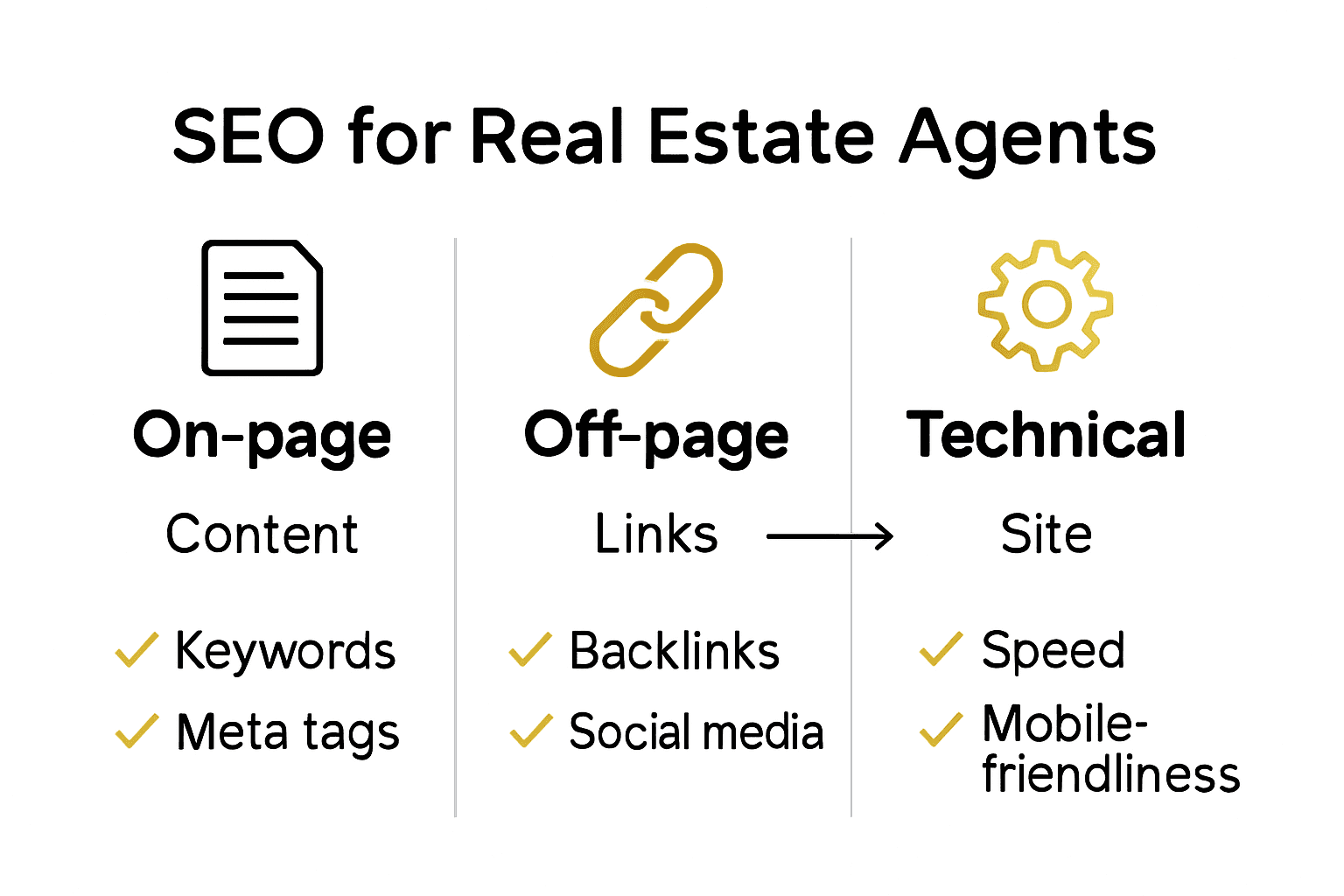
In the dynamic world of real estate digital marketing, understanding different SEO strategies is crucial for agents looking to stand out online. According to Coursera, SEO encompasses three primary approaches: on-page optimization, off-page optimization, and technical SEO, each playing a unique role in improving search engine rankings.
Here’s a summary of the main types of SEO for real estate agents:
| SEO Type | Focus Area | Key Examples |
|---|---|---|
| On-Page SEO | Website content & structure | Keyword-rich property pages Optimized meta tags Local blog posts |
| Off-Page SEO | External reputation & authority | Backlinks from directories Realtor citations Community websites |
| Technical SEO | Website performance & search engine access | Fast loading speed Mobile responsiveness Secure HTTPS |
On-Page SEO focuses directly on your website’s content and structure. For real estate professionals, this means:
- Creating property descriptions with strategic keywords
- Developing suburb-specific landing pages
- Writing informative blog content about local real estate trends
- Optimizing meta titles and descriptions for each page
Off-Page SEO involves building your website’s credibility through external factors. This includes generating quality backlinks from local business directories, real estate platforms, and community websites. Coursera’s search engine optimization research emphasizes that off-page tactics signal to search engines that your website is a trusted resource in the real estate market.
Technical SEO ensures your website meets search engine infrastructure requirements. For real estate agents, this means creating a fast, mobile-responsive site with clean code, secure connections, and easy navigation. By understanding and implementing these SEO tips to boost agent visibility, you’ll dramatically improve your chances of ranking higher in local search results.

Local Keyword Strategies and Content Optimisation
Local keyword strategies are the backbone of successful real estate SEO, enabling agents to connect directly with potential clients searching in specific areas. According to Florida Realtors, creating location-specific content can significantly enhance search engine rankings by providing valuable community information including demographics, schools, amenities, and local points of interest.
Effective local keyword optimization involves multiple strategic approaches:
- Develop detailed suburb and neighborhood landing pages
- Incorporate hyperlocal keywords naturally into website content
- Use location-specific terms in headers, titles, and meta descriptions
- Create blog posts highlighting local market trends and community insights
The Splendour Group emphasizes the importance of hyperlocal content, recommending that real estate agents integrate location details throughout their digital presence. This means going beyond generic property listings to craft content that speaks directly to local buyers and sellers. By understanding the nuanced search behaviors of potential clients, you can create local SEO strategies that position you as the go-to real estate expert in your specific market.
To truly dominate local search results, real estate agents must think like their potential clients. This means anticipating the specific search terms people use when looking for properties, understanding local market dynamics, and creating content that answers their most pressing questions about neighborhoods, property values, and community living.
Optimising Google Business Profile Listings
A Google Business Profile is the digital storefront for real estate agents, serving as a critical first impression for potential clients searching online. According to Energy.gov, optimizing this profile requires providing accurate and comprehensive information, including your business name, address, phone number, and precise operating hours.
Key strategies for maximizing your Google Business Profile effectiveness include:
- Upload high-quality, professional photos of your team and properties
- Write a compelling business description that highlights your unique value
- Select the most relevant business categories
- Verify your business location to increase credibility
- Respond promptly to all customer reviews
The Splendour Group emphasizes that maintaining an up-to-date profile can dramatically improve local search rankings. Encouraging satisfied clients to leave positive reviews not only boosts your visibility but also builds trust with potential customers. By consistently updating your Google Business Profile, you signal to both Google and potential clients that you’re an active, engaged real estate professional.
Remember, your Google Business Profile is more than just a listing—it’s a powerful marketing tool that can significantly influence a potential client’s first impression. Regular maintenance, authentic engagement, and strategic optimization can transform this simple profile into a lead-generating machine for your real estate business.
Common SEO Mistakes and Pitfalls to Avoid
Real estate agents often stumble into SEO traps that can significantly undermine their online visibility. According to Maine, common mistakes include using vague page titles, neglecting comprehensive keyword research, and failing to produce original, high-quality content that truly serves potential clients.
Critical SEO pitfalls for real estate professionals include:
- Keyword stuffing that makes content unreadable
- Neglecting mobile optimization
- Using duplicate content across property listings
- Ignoring local search intent
- Failing to update website content regularly
DX Studio emphasizes the importance of understanding search intent and user behavior. For real estate agents, this means creating content that genuinely answers potential clients’ questions about properties, neighborhoods, and market trends. By exploring these nuanced search behaviors, you can craft SEO myths guide content that resonates with your target audience and improves your search rankings.
The most successful real estate SEO strategies require a holistic approach. Stop treating your website as a static brochure and start viewing it as a dynamic, interactive resource that adapts to potential clients’ evolving needs. Continuous learning, regular content updates, and a genuine commitment to providing value will set you apart in the competitive digital real estate landscape.
Take Control of Your Real Estate SEO Today
Struggling to break through the noise in local search results or frustrated that your property listings do not attract qualified leads? The challenges highlighted in “SEO for Realtors Explained” show how important it is to master local keyword strategies, create compelling Google Business Profile content, and avoid common SEO mistakes like duplicate and poorly optimized content. If you want to be the trusted local expert buyers and sellers find first, your website and content must truly stand out.
At Content Charlie, we specialize in crafting SEO-driven real estate copy that connects with your audience on a suburb level — from targeted property descriptions to engaging blog articles that boost your search rankings. Our tailored approach helps you capture the right traffic by focusing on the exact terms your customers use when searching for homes or agents nearby.

Ready to transform your online presence and dominate local searches? Visit Content Charlie now to explore how our local SEO and real estate copywriting services can turn your website into a lead-generating machine. Don’t let your competition outshine you—take action today and position your brand as the go-to real estate professional in your community.
Frequently Asked Questions
What is SEO for realtors?
Search engine optimization (SEO) for realtors is the practice of improving a real estate website’s visibility in search engine results. It involves various strategies aimed at attracting potential clients through organic search traffic.
What are the main types of SEO strategies for real estate agents?
The main types of SEO strategies for real estate agents include on-page SEO, off-page SEO, and technical SEO. On-page SEO focuses on website content and structure, off-page SEO builds external credibility through backlinks, and technical SEO ensures site performance and search engine accessibility.
How can local keyword strategies enhance my real estate SEO?
Local keyword strategies can enhance your real estate SEO by targeting specific community-related terms. Creating location-specific content helps your website appear in searches for properties in those areas, connecting you directly with potential clients.
What are common SEO mistakes real estate agents should avoid?
Common SEO mistakes to avoid include keyword stuffing, neglecting mobile optimization, using duplicate content, ignoring local search intent, and failing to update website content regularly. These errors can significantly reduce your online visibility and effectiveness.
Recommended

Top Social Media Tools Real Estate – Expert Comparison 2025
Finding the right tools for real estate success can feel overwhelming. In this article we compare social media tools for real estate.
Each product offers unique ways to help you reach buyers, win listings, and tap into new opportunities. Some focus on creating powerful content or eye catching visuals, while others promise smarter communication, easier lead management, or an all in one solution.
Whether you want to attract local clients, polish your online presence, or automate your daily work, you will discover approaches that fit different goals and budgets. Curious about which options could make a real difference for you?
Table of Contents
- Content Charlie
- BoxBrownie.com
- ActivePipe
- Rex Software
- Real Estate Content
- Streettext
- Curaytor
- Agent Sauce
Content Charlie

At a Glance
Content Charlie is a specialist content studio built to get local real estate agents found and chosen. It combines SEO-driven copywriting with suburb-level know-how to attract ready-to-act buyers and sellers, making it especially useful for Brisbane, Gold Coast and Sunshine Coast agents. Bottom line: if your goal is higher local search rankings and consistent, conversion-focused content, Content Charlie delivers a focused, measurable path forward.
Core Features
Content Charlie | Local SEO & Real Estate Copywriting That Gets You Found
At Content Charlie, we help real estate agents and local businesses dominate Google and attract ready-to-act customers. Our specialty? SEO-driven copywriting, high-converting content, and blog articles that boost your visibility in suburb-level searches — from Broadbeach to Burleigh and beyond.
Whether you need suburb guides, property descriptions, or Google Business Profile content, we craft words that rank, engage, and sell. Our tailored local SEO strategies ensure your brand shows up when locals are searching for homes, agents, or property advice in your area.
From compelling web copy to consistent blog content that builds trust and authority, Content Charlie makes your business the local choice buyers and sellers remember.
Key capabilities include SEO-optimized content for higher search engine rankings, social media content creation to build engagement, email marketing sequences to nurture leads, LinkedIn ghostwriting to tell your brand story, and ad copywriting to increase conversions.
Pros
- Offers a comprehensive suite of content services: Content Charlie covers web copy, blogs, social posts, email sequences, LinkedIn ghostwriting, and ad copy so you don’t need to stitch multiple vendors together.
- Customization tailored to business goals: Every piece is framed around listing generation, lead nurture, or brand authority depending on your objective.
- Helps improve search engine ranking and online presence: The focus on suburb-level SEO makes the content directly relevant to local searchers and buying audiences.
- Experienced team with knowledge in digital marketing and real estate: The writers and strategists speak property market language and SEO simultaneously, reducing iteration time.
- Positive customer testimonials: Real-world feedback shows improved visibility and more qualified leads after engagement with their content.
Who It’s For
Content Charlie is ideal for real estate agents and small business owners who want a strategic content partner rather than ad-hoc copy. If you’re an agency or independent agent working local patches—Brisbane suburbs, Gold Coast markets, or Sunshine Coast listings—and you need suburb-specific SEO, this service fits. It’s also a good match for marketing managers who need high-conversion content without training an in-house writer.
Unique Value Proposition
Content Charlie’s unique value is the combination of hyper-local SEO expertise and conversion-first copywriting tailored to property professionals. Unlike generic content mills, the team builds suburb guides, Google Business Profile content, and property descriptions designed to rank in local queries and move prospects toward contact. Their processes prioritize relevance to local intent (for buyers searching “house for sale in Broadbeach”) and the messaging that drives listing enquiries. This focus on local discoverability plus conversion optimization creates a clear edge over broader content providers: you get content that not only ranks but also converts neighbourhood searches into enquiries.
Real World Use Case
A real estate agency partners with Content Charlie to overhaul its website and social content. The result: improved local search rankings, more organic traffic for suburb terms, and a measurable increase in listing enquiries within 3–6 months due to tailored suburb guides and optimized Google Business Profile copy.
Pricing
Not specified on the website.
Website: https://contentcharlie.com
BoxBrownie.com
At a Glance
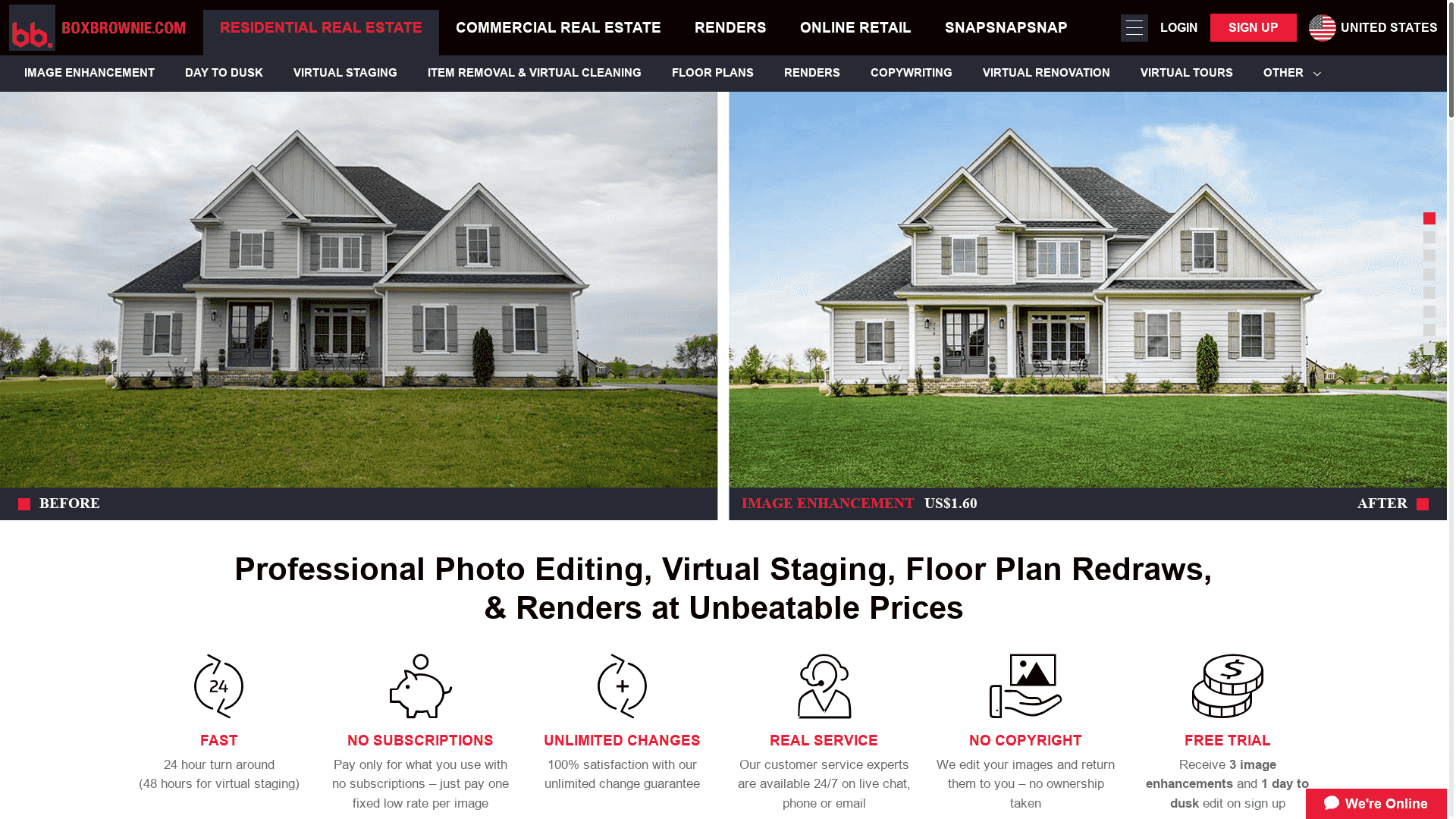
BoxBrownie.com is a specialist digital service for real estate visual marketing that delivers fast, professional photo editing, virtual staging, floor plan redraws, renders, and virtual renovations. It’s built around speed (24-hour turnaround on many services), a pay-as-you-go model, and a broad service catalog geared to agents and developers. If you need polished listing imagery without subscriptions, BoxBrownie is compelling — especially for busy agents who want reliable, outsourced editing. It’s not always the cheapest option for large-scale rendering or staging projects, though.
Core Features
BoxBrownie.com focuses on image-first real estate services: affordable photo editing from $1.60 per image, 2D and 3D virtual staging, floor plan redraws in multiple styles, and rendering services for residential and commercial properties. Additional offerings include virtual renovations, 360° image enhancement, virtual tours, and even copywriting services. The company emphasizes a global professional editing team, a range of deliverable formats, and 24/7 customer support to keep tight listing schedules on track.
Pros
- Fast turnaround: Many services complete within 24 hours and virtual staging within 48 hours, which helps agents meet tight listing deadlines.
- No subscription required: You pay only for what you use, making it simple to control costs on a per-job basis.
- Professional, global editing team: BoxBrownie uses trained editors to deliver consistent, high-quality image enhancements across projects.
- Comprehensive service range: From simple photo touch-ups to renders and floor plans, the platform covers virtually every visual need for a listing.
- 24/7 customer service: Live chat, phone, and email support are available around the clock to troubleshoot jobs and clarify specifications.
Cons
- Variable pricing for custom work: Pricing can vary with project complexity, and detailed cost for bespoke jobs often requires direct contact with the team.
- Higher costs for large or complex jobs: Virtual staging and high-end renders can become expensive for larger portfolios or extensive projects.
- Limited public QA detail: The platform provides little specific information about editing standards and quality assurance processes, which can leave buyers wanting clearer guarantees.
Who It’s For
BoxBrownie.com suits real estate agents, property developers, marketing firms, and commercial real estate professionals who need fast, professional visual content without long-term commitments. It’s ideal when you need quick turnarounds for listings, polished marketing imagery for campaigns, or visualizations that help buyers imagine renovated spaces.
Unique Value Proposition
BoxBrownie combines speed, breadth of services, and a pay-as-you-go model to let agents and developers upgrade listing visuals quickly and on budget. The 24/7 support and global editing resources make it a practical choice for agencies that list properties across multiple time zones.
Real World Use Case
A listing agent submits raw photos of an empty apartment, orders photo enhancement, 3D virtual staging, and a floor plan redraw; within 48 hours the agent receives polished images and a buyer-friendly floor plan to publish with the listing, helping generate stronger buyer interest and more inquiries.
Pricing
Starting at $1.60 per image for photo enhancement; virtual staging from $24; floor plan redraws from $24/$28; renders from $280; virtual renovations $24–$176; virtual tours $16–$24 per set; custom jobs quoted on request.
Website: https://boxbrownie.com
ActivePipe
At a Glance
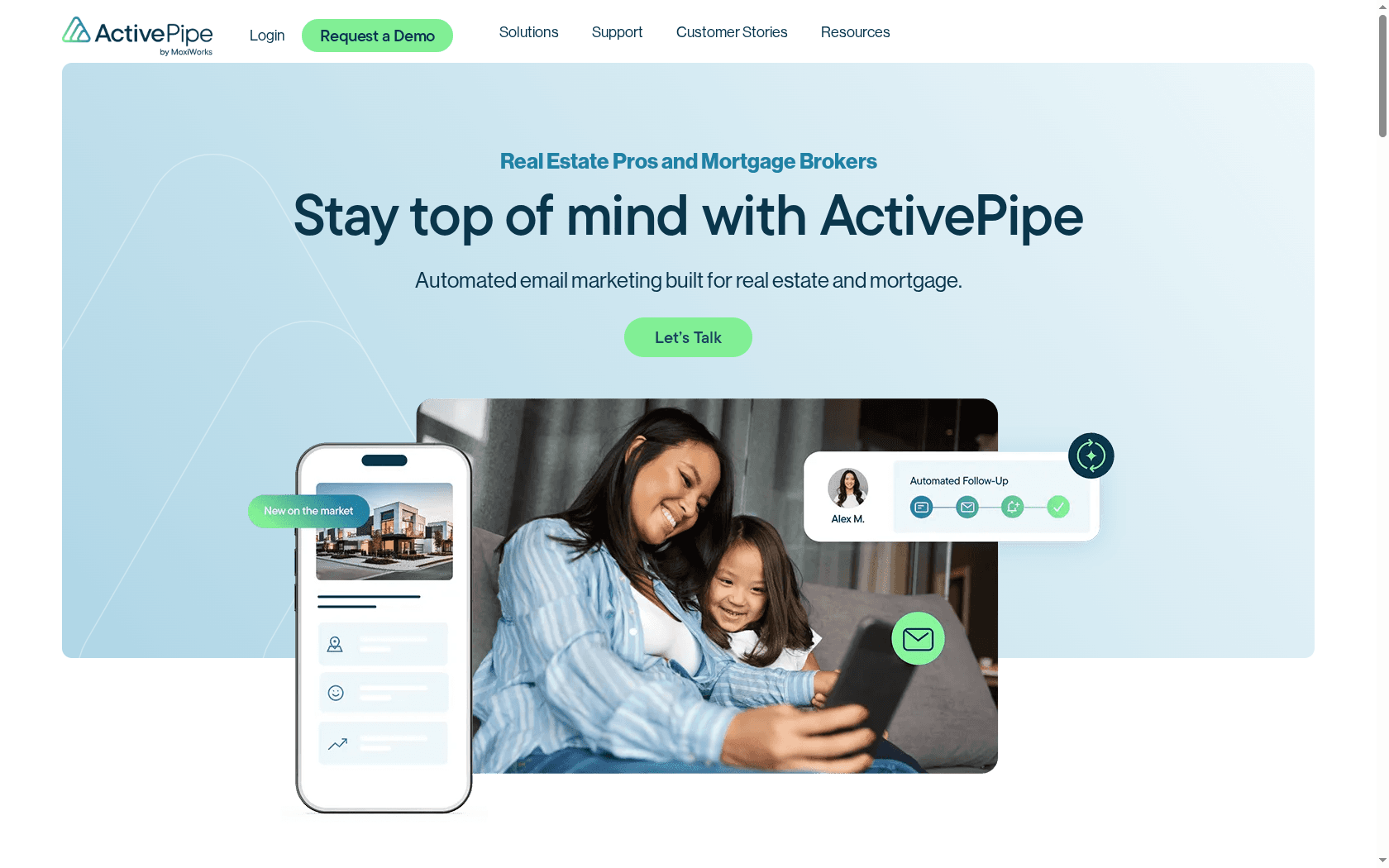
ActivePipe is an email marketing automation platform built specifically for real estate professionals and mortgage brokers. It focuses on behavior-triggered email campaigns, property alerts, and automated follow-ups that help agents stay top of mind with clients. Part of the MoxiWorks family, it brings proven traction across the US, Australia, and New Zealand. Bottom line: ActivePipe is a specialist tool that streamlines client nurture—but it assumes you’ll invest time to learn its email-marketing workflow.
Core Features
ActivePipe’s core capabilities center on automated, behavior-driven communications: email marketing automation tailored to real estate and mortgage workflows, property alerts triggered by user interest, and a drag-and-drop campaign builder for easy campaign assembly. The platform includes pre-built, branded campaigns and hot lead alerts with agent engagement tracking, plus marketplace and CRM integrations. It also supports ASIC-compliant templates, SMS and email campaign automation, and review & referral automation.
Pros
- Automates follow-up and client engagement, saving time: ActivePipe removes repetitive manual outreach by triggering emails and alerts when prospects show interest, helping you maintain consistent contact without extra administrative work.
- Provides detailed analytics and tracking for client interactions: The platform’s engagement tracking and hot lead alerts give clear signals about who’s interacting with listings and campaigns, so you can prioritize outreach based on behavior.
- User-friendly drag-and-drop builder: The visual campaign builder reduces friction when creating emails and property alerts, which speeds up campaign setup for busy agents.
- Established success with multiple brokerages and agencies: Being part of MoxiWorks and operating in several markets suggests a level of maturity and proven workflows relevant to real estate teams.
- Part of a trusted industry network: Integration within an established industry ecosystem can simplify adoption and provide access to complementary tools and support.
Cons
- Requires some familiarity with email marketing tools for optimal use: To get the most from behavior-triggered automation and analytics you’ll need basic email-marketing experience or time to learn the system.
- Pricing details are not specified on the website: The lack of transparent pricing means you’ll need to contact sales to assess fit with your budget, which delays quick evaluation.
- Integration options may require technical support for custom setups: While marketplace and CRM integrations exist, custom or advanced integrations could need help from technical resources.
Who It’s For
ActivePipe is aimed at real estate agents, mortgage brokers, and agency teams that want a specialist email automation platform to nurture leads, deliver timely property alerts, and convert more inquiries into appointments. It suits agents who prioritize automated client journeys and are prepared to invest in setup and process refinement.
Unique Value Proposition
ActivePipe’s strength is its niche focus: real estate-specific automation that combines behavior-triggered emails, property alerts, and pre-built branded campaigns within a networked industry platform. That niche orientation helps agents run more relevant, timely campaigns without building workflows from scratch.
Real World Use Case
A real estate agent integrates ActivePipe with their CRM to send automated property updates and follow-up sequences when a prospect views listings or requests info. Engagement tracking surfaces hot leads and the agent receives alerts, turning passive interest into prompt personal outreach and measurable increases in leads and appointments.
Pricing
Not specified on the website; likely requires contacting sales for details.
Website: https://activepipe.com
Rex Software
At a Glance
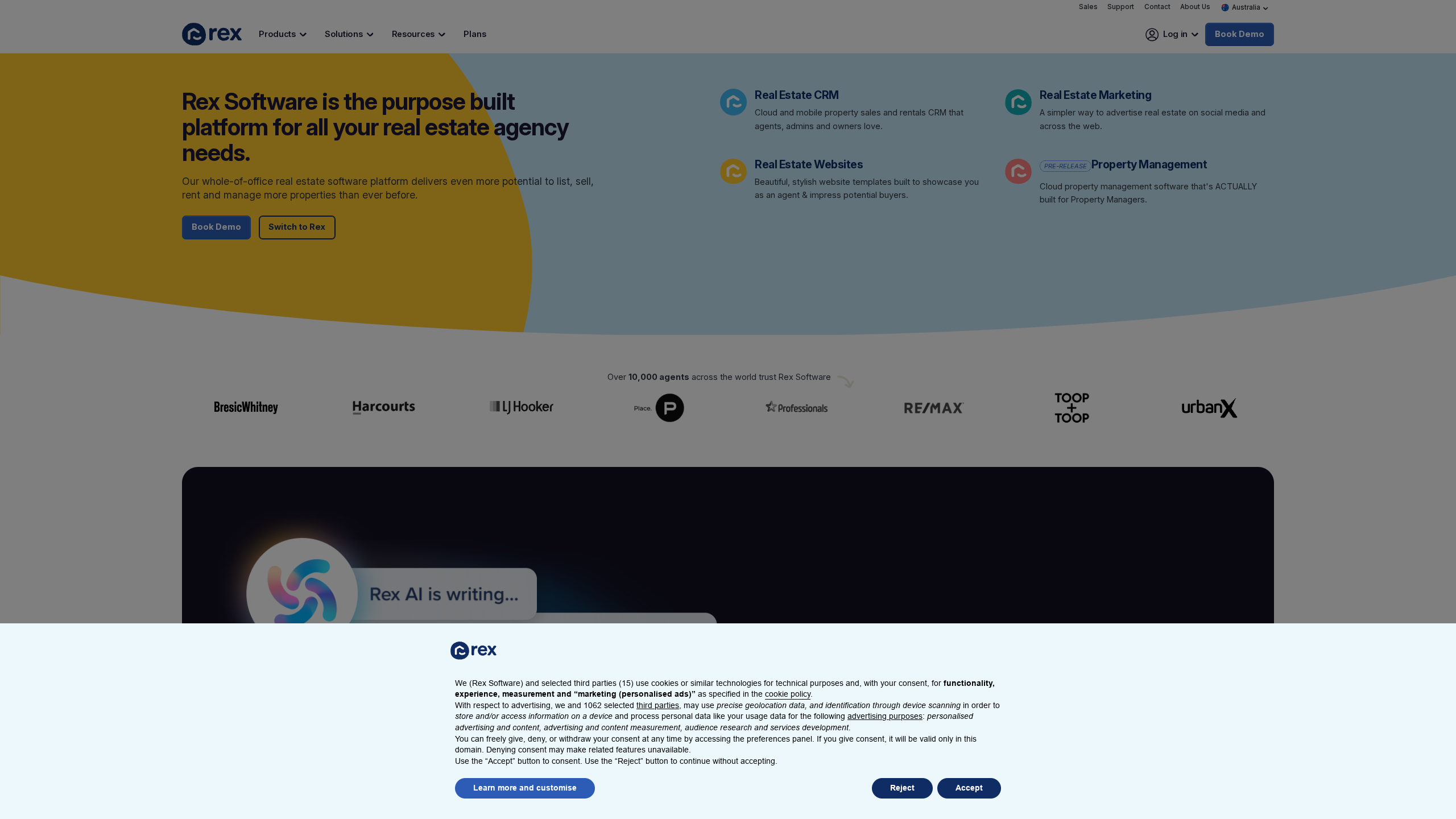
Rex Software is an all-in-one real estate platform built to handle listings, sales, rentals, CRM, marketing and property management across agencies of varying sizes. It centralizes client data, automates marketing and provides lead-generating website templates so your team spends less time on admin and more time closing deals. There’s real power in having prospecting, advertising and property management under one roof — but expect a learning curve if you’re a very small or solo operator.
Core Features
Rex combines a whole-of-office real estate platform with a dedicated real estate CRM and prospecting engine, marketing tools for social and web advertising, and property agency website templates focused on lead generation. Its cloud property management module supports property managers, while Rex AI helps automate marketing and lead nurturing. The product also offers API integrations for connecting other tools and a customer portal, Rex Hub, that keeps vendors updated on marketing progress and campaign results.
Pros
- Comprehensive all-in-one platform: Rex covers CRM, marketing, website building and property management in a single solution, reducing the need to juggle multiple vendors.
- Strong API integration capabilities: The platform’s API makes it easier to connect third-party systems and extend Rex to fit your agency’s tech stack.
- Flexible plans for agency sizes: Rex offers packages tailored to different business sizes, which helps larger teams scale without piecing together disparate tools.
- Automation that saves time: Built-in automation, including Rex AI for marketing and lead nurturing, reduces repetitive tasks and helps maintain consistent follow-up.
- Proven adoption: The platform is trusted by over 10,000 agents worldwide, which speaks to its maturity and industry fit.
Cons
- Pricing requires direct inquiry: Plans and pricing are not published openly and must be requested from Rex, which adds a step to evaluating fit and budget.
- Feature breadth can overwhelm small teams: The extensive feature set may be more than a very small agency or solo operator needs and could complicate onboarding.
- Steep learning curve for new users: Mastering the platform’s full capabilities — especially automation and integrations — can take time and training.
Who It’s For
Rex is aimed at real estate agencies and professionals who want a single, integrated software solution to manage sales, marketing, property management and online presence. If you run a mid-sized to large agency, or a growing boutique firm that values automation and centralized data, Rex is particularly well suited. If you’re solo or just starting out, weigh complexity against the potential efficiency gains.
Unique Value Proposition
Rex’s strength is consolidation: it brings prospecting, CRM, website lead capture, targeted advertising and property management into one platform, backed by API connectivity and AI-driven marketing automation. That combination reduces friction between teams and speeds up the path from lead to contract.
Real World Use Case
An Australian agency uses Rex to manage listings, run automated follow-up sequences, deploy social and web ads from a single dashboard, and operate a branded website that converts inquiries into appointments — resulting in faster deal closures and smoother vendor communication through Rex Hub.
Pricing
Quote-based — plans and pricing are available upon request and are tailored to different sizes of property businesses.
Website: https://rexsoftware.com

At a Glance
This domain currently functions as a parked placeholder and does not host active real estate content or tools. Bottom line: there’s ownership and potential here, but no product to evaluate yet. If you’re looking for an immediately deployable social media tool or real-estate content platform, this parked site provides none of that until development begins.
Core Features
As of now, the site’s only observable capabilities are domain parking and registration maintenance. There are no active features, content, or services related to real estate content creation, SEO, or social media management available on the live page. The core “feature” is essentially an empty slate—courtesy of the domain registrar—waiting for future development.
Pros
- Domain ownership is established: The domain is registered and maintained, which secures the web address for future use.
- Potential for future development exists: The placeholder status means you can plan and build a content strategy tailored to your real estate audience without migration issues.
- Cost-effective parking for now: Parking the domain via the registrar incurs no active development costs and can be a low-cost way to hold the name.
- Clear ownership simplifies transfer or sale: Having registration in place makes acquisition, transfer or rebranding straightforward for agencies or brokers.
- No immediate operational overhead: With nothing live, there are no content updates, hosting configurations, or social accounts to manage yet.
Cons
- No current content or products are available for use: There is no actionable information, tools, or content to support social media or real estate workflows.
- Limited utility until the site is developed further: As a parked page, it provides virtually no value to agents who need immediate marketing or content services.
- Requires development and investment to become useful: Turning the domain into an SEO-driven, conversion-focused real estate asset will need planning, copywriting, design, and technical work.
- Uncertain timeline for a full website launch: There is no indication of when—or if—the domain will be developed into a functioning platform.
- No pricing or service details to evaluate: With no live offerings, you cannot compare costs, plans, or feature tiers.
Who It’s For
This domain is primarily of interest to individuals or businesses who want to secure a real-estate-focused web address now and plan development later. Ideal users include real estate agencies, content creators, and local SEO specialists who need to manage domain ownership or reserve a branded site name while they prepare a full content and marketing plan.
Unique Value Proposition
Right now, the unique value is the domain itself: an owned, parked address that removes the risk of losing a desired real-estate-oriented URL. That ownership can save time and expense when you’re ready to build a targeted local SEO and social media content platform.
Real World Use Case
A Ray White office or an independent agent might purchase or retain this domain while a marketing team drafts suburb-specific guides, listing templates, and social campaigns. When development begins, the existing registration simplifies deployment and preserves brand continuity.
Pricing
No pricing available as the site is parked.
Website: https://realestatecontent.com.au
streettext

At a Glance
streettext is a real-estate-focused advertising platform that bundles Facebook and Instagram ads, remarketing, automated texting, and basic CRM integration into a single workflow for agents and teams. In practice it’s built to generate leads, qualify them quickly, and keep prospects warm through automated sequences — which can save an agent hours every week. It’s especially useful for teams that want predictable ad funnels, though solo agents should weigh the costs carefully.
Core Features
streettext centralizes core social ad and lead workflows: Facebook and Instagram ad creation tailored for property audiences, remarketing to past visitors and prospects, automated SMS to qualify and book appointments, CRM integration and custom audience creation from your contacts, plus ad split-testing and ROI tracking across tiered plans (Grow, Pro, Scale). Training and community resources are included to help you get campaigns live faster.
Pros
- User-friendly platform with easy ad setup: The interface and templates reduce setup time so agents can launch campaigns without deep ad expertise.
- Comprehensive automation for lead engagement: Automated texting and follow-up sequences help convert warmer leads into appointments without constant manual outreach.
- Robust remarketing capabilities: Built-in remarketing keeps you top-of-mind with local prospects who’ve already interacted with your content.
- Community and training support included: Ongoing training and community resources shorten the learning curve and help you optimize campaigns.
- Flexible subscription options and add-ons: Multiple plans and add-ons let teams scale features as their budget and needs grow.
Cons
- Pricing may be high for very small teams or solo agents: Entry-level costs and add-ons (texting, custom domains, management) can push the total monthly bill above what a solo operator expects to spend.
- Some advanced features require higher-tier plans or extra costs: Integrations and higher levels of automation are gated behind Pro/Scale plans or paid add-ons, limiting what you get on the basic plan.
- Dependent on Meta platform ad performance: Results hinge on Facebook and Instagram; when Meta’s ad costs or targeting change, your lead flow can be affected.
Who It’s For
streettext is aimed at real estate professionals and small-to-mid teams who want an integrated platform to generate, nurture, and convert leads specifically through social advertising and texting. If you manage listings, run local campaigns, or coordinate a small team’s follow-up workflows, streettext gives a focused stack without stitching together multiple vendors.
Unique Value Proposition
streettext’s value is its end-to-end focus on social ad funnels for real estate: from targeted Facebook/Instagram ads to automated SMS qualification and remarketing, all tied into audience lists and basic CRM flows. That specialization streamlines campaign builds and keeps messaging consistent.
Real World Use Case
An agent launches a targeted Instagram feed and Facebook lead campaign, uses automated texts to pre-qualify inquiries and book viewings, and then runs remarketing ads to past leads who didn’t convert — increasing booked appointments while reducing manual follow-up time.
Pricing
Plans start at $59/month for Grow, $129/month for Pro, and $199/month for Scale, with discounts for annual payments and additional add-on costs for texting, custom domains, and management services.
Website: https://streettext.com
Curaytor
At a Glance
Curaytor is a digital marketing platform built specifically for real estate agents and teams who want a one-stop solution for listing promotion, lead generation, and brand-building. It combines website creation, IDX integration, targeted ads, email campaigns, and video production into packaged offerings aimed at scaling listings and visibility. For agents willing to invest, Curaytor delivers training, community support, and a clear growth focus — but it can feel expensive for solo agents on tight budgets.
Core Features
Curaytor’s core capabilities center on automating and amplifying marketing for property professionals. Key features include Listing Studio to automate listing promotion, customizable branded websites and landing pages with IDX integration, email campaign tools for nurture sequences, and targeted pay-per-click and social ad campaigns. The platform also offers video production services — shorts, reels, and TikTok content at scale — which is valuable for agents leaning into social-first listing promotion.
Pros
- Tailored for real estate: The toolset is clearly designed around agent workflows, so features like Listing Studio and IDX integration match common industry needs.
- Comprehensive marketing stack: Curaytor bundles websites, ads, email, and video production, reducing the need to stitch together multiple vendors.
- Training and community: The platform includes training, support, and access to a community, helping teams ramp faster and learn best practices.
- Flexible plans for teams: Multiple packages allow teams to choose a level of service that aligns with their size and goals.
- Ad capabilities built in: Integrated digital advertising simplifies running targeted campaigns without managing separate ad vendors.
Cons
- Pricing may be high for individual agents with limited budgets: Even the entry-level options start at several hundred dollars per month, which can strain single-agent cash flow.
- Learning curve for new users: Some features and integrations require time to master, so getting full value may take weeks of setup and training.
- Add-on costs for some features: Certain packages and services — especially video at scale or custom enterprise options — can incur extra fees beyond the base subscription.
Who It’s For
Curaytor is best suited for agents and small-to-medium teams who prioritize consistent digital marketing, brand growth, and lead generation. If you want an integrated platform and are prepared to invest in advertising and production to win listings, Curaytor can centralize those efforts and reduce vendor management. If you’re a solo agent on a shoestring budget, consider whether the monthly commitment fits your ROI timeline.
Unique Value Proposition
Curaytor’s unique value is packaging industry-specific marketing tools — from IDX websites to listing automation and scalable video — with training and community support so agents don’t have to invent a marketing stack. It’s not just software; it’s a marketing system aimed at helping agents grow listings and online presence faster.
Real World Use Case
An agent uses Curaytor to launch a branded website with IDX, runs targeted Facebook and Google ad campaigns for a new suburb listing, and orders short-form video edits for Instagram and TikTok. The result: more listing enquiries, a steady drip of leads via email campaigns, and a stronger local brand presence that supports higher conversion rates.
Pricing
Starting at $300/month for Listing Studio; Curaytor Platform from $650/month; Curaytor Enterprise from $1,200/month, plus custom options and ad spend.
Website: [https://curaytor.com]
Agent Sauce
At a Glance
Agent Sauce is an all-in-one real estate marketing platform built for high-performing agents and small teams who want CRM, marketing, and lead tools in one place. It bundles email marketing, lead generation, mobile CRM, and creative tools like flyers and virtual tours into a single workflow, reducing app-hopping. The mobile-first focus means you can capture leads, scan business cards, and post video tours while you’re out at inspections. Bottom line: strong feature depth for teams that want a unified stack, though cost and some unclear limits may give solo agents pause.
Core Features
Agent Sauce combines a real estate CRM with email marketing and automation, plus lead generation tools and social scheduling. The platform includes flyer and brochure creation, mobile virtual tours and video uploads (with automation to YouTube and other platforms), a mobile CRM app for contact management and business card scanning, testimonial capture, SMS messaging, and comprehensive marketing reporting with call capture. In short: contact capture, nurture, content creation, and reporting live in one system so you can move leads through the funnel without stitching multiple subscriptions together.
Short. Useful.
Pros
- Integrated stack reduces complexity: Because CRM, email, lead-gen, social scheduling, and creative tools are built together, you don’t need separate subscriptions or manual data imports. This simplifies workflows and saves time.
- Mobile-first capabilities: The mobile CRM app and on-the-go tools—like business card scanning and virtual tour uploads—let you act the moment a lead appears. That keeps follow-up fast and personal.
- Creative and social tools included: Flyer and brochure creation, testimonial capture, and social scheduling mean you can produce and publish listing content without hiring a designer each time.
- Supports SMS and call capture: Built-in SMS messaging and call capture help you reach and log prospects across channels, improving conversion tracking and follow-up accuracy.
- Group and broker options: Bulk pricing and custom broker packages make it practical for teams that want centralized billing and shared capabilities.
Cons
- Pricing may be a barrier for solo agents: The platform’s value is clear for teams, but the monthly cost could strain a solo operator who doesn’t fully use every feature.
- Limited transparency on platform limits and extra costs: Publicly available details on add-on fees or feature caps are sparse, making it harder to anticipate total cost as usage scales.
Who It’s For
Agent Sauce is aimed at high-performing real estate agents and small-to-medium teams that want a single, mobile-friendly platform to manage marketing and client relationships. If you run multiple listings, rely on virtual tours and social outreach, or coordinate across agents in a group, this platform fits particularly well. Brokers seeking centralized options will also find the custom packages appealing.
Unique Value Proposition
Agent Sauce’s strength is consolidation: it reduces the number of point solutions an agent needs by combining CRM, marketing automation, creative tools, and mobile capabilities into one product. For teams that value speed—capturing leads in the field, automating video uploads, and sending follow-up sequences—Agent Sauce promises an end-to-end workflow that keeps prospects moving toward a sale.
Real World Use Case
A listing agent scans a vendor’s business card at an open home using the mobile CRM, schedules a social post and an email campaign from the same app, uploads a mobile-shot virtual tour that’s automatically posted to YouTube, and captures testimonials after settlement—all while tracking calls and campaign reporting in one dashboard.
Pricing
Starting at $49.99/month for Agent Plus, which stores up to 5,000 contacts and includes the CRM and to-do tracker; custom pricing is available for brokers.
Website: https://agentsauce.com
Real Estate Marketing and Management Tools Comparison
This table provides a comprehensive comparison of various real estate marketing and management tools. Each product is evaluated based on its features, pros, cons, pricing, and suitability to help agents and agencies select the best solution for their needs.
| Product | Core Features | Pros | Cons | Pricing |
|---|---|---|---|---|
| Content Charlie | SEO-driven copywriting, suburb-level know-how, blog articles | Comprehensive services, customization, improved search rankings, experienced team | Pricing not specified | Not Specified |
| BoxBrownie.com | Photo editing, virtual staging, floor plans, virtual tours | Fast turnaround, pay-as-you-go model, global editing team | Costs can be high for complex projects, variable pricing | From $1.60 per image |
| ActivePipe | Email marketing automation, behavior-triggered campaigns, property alerts | Automation saves time, detailed analytics, user-friendly campaign builder | Requires email marketing knowledge, pricing not specified | Not Specified |
| Rex Software | All-in-one platform, CRM, marketing automation, website templates | Comprehensive platform, API integration, automation saves time | Pricing requires inquiry, steep learning curve | Quote-based |
| streettext | Facebook/Instagram ads, automated texting, CRM integration | Easy ad setup, comprehensive automation, robust remarketing | High costs for small teams, advanced features require higher plans | From $59/month |
| Curaytor | Website creation, IDX integration, targeted ads, email campaigns | Tailored for real estate, comprehensive stack, training and community support | High pricing for individuals, learning curve | From $300/month |
| Agent Sauce | CRM, email marketing, mobile CRM, lead tools, virtual tours | Integrated stack, mobile-first, creative tools included | Pricing barrier for solo agents, limited transparency on extra costs | From $49.99/month |
Boost Your Real Estate Social Media with Local SEO Content That Converts
The article “Top Social Media Tools Real Estate – Expert Comparison 2025” highlights the challenge real estate agents face when trying to stand out on crowded social media platforms. With constant competition for attention, agents need more than just tools—they need content that resonates with their local audience and turns engagement into leads. If you are aiming to attract ready-to-act buyers and sellers, relying solely on social media tools without a strong local SEO strategy can leave your efforts falling short.
Are you struggling to create social media content that truly connects and converts? The key is combining suburb-focused, high-conversion copy with your social campaigns. At Content Charlie, we specialize in crafting SEO-driven property descriptions, suburb guides, and Google Business Profile content designed specifically to elevate your real estate presence where it matters most—local search results. When your content ranks well locally, every social media post gains relevance and authority.
Elevate your social media game now by pairing expert tools with our neighborhood-focused copywriting that gets you found and chosen in markets like Brisbane and the Gold Coast. Visit Content Charlie to see how our tailored local SEO copywriting and conversion-focused blog content can power your social media strategy.
Discover the difference that top-quality local content makes to your social media success.
Boost your visibility today and start turning clicks into clients.
Get started with Content Charlie at https://contentcharlie.com and watch your real estate social media impact grow.
Frequently Asked Questions
What are the key features to look for in social media tools for real estate?
Consider tools that offer features like automated posting, lead generation, audience engagement tracking, and integration with CRM systems. Prioritize tools that allow seamless scheduling and analytics to enhance your social media strategy effectively.
How can I improve my engagement rates using social media tools for real estate?
Utilize tools that provide insights into your audience’s behavior and preferences. By analyzing this data, you can tailor your content to resonate better with potential clients, aiming for a 20% increase in interactions over the next few months.
What type of content should I focus on when using social media tools in real estate?
Focus on high-quality visuals, such as property tours and neighborhood guides, along with client testimonials and market updates. Change your content strategy regularly to maintain interest and boost visibility in your social media feeds.
How can I measure the effectiveness of social media tools for real estate?
Set clear metrics, such as lead conversion rates, engagement rates, and follower growth, to measure effectiveness. Regularly assess these metrics, ideally monthly, to ensure your strategy is on track to achieve your business goals.
Are there specific social media platforms that are more effective for real estate marketing?
Generally, platforms like Instagram and Facebook are considered highly effective due to their visual nature and user engagement capabilities. Evaluate each platform’s user demographics to decide where to focus your social media efforts based on your target audience.
Recommended

Real Estate SERPs Explained: The Complete Guide
If you’re confused about Real Estate SERPs, we don’t blame you. But we’ve got you covered in this article/
Did you know that over 85 percent of home buyers start their search online before contacting an agent? For real estate professionals, that first impression on a search engine results page can mean the difference between winning new business or getting overlooked. With changing algorithms and an explosion of interactive features, understanding the layers of real estate SERPs is crucial for agents who want to stand out and capture qualified leads before their competitors do.
Table of Contents
- Defining Real Estate SERPs And Common Misconceptions
- Types Of SERP Features In Real Estate Searches
- How Real Estate SERPs Work For Agents
- Key Ranking Factors And Local SEO Strategies
- Common Mistakes Agents Make With SERPs
Key Takeaways
| Point | Details |
|---|---|
| Real Estate SERPs Are Competitive | SERPs represent critical digital arenas where visibility is essential for attracting clients, going beyond simple keyword optimization. |
| Emphasis on SERP Features | Rich SERP features like knowledge panels and video results enhance user engagement and should be strategically targeted by real estate agents. |
| Local SEO is Crucial | Real estate professionals must focus on local SEO tactics, including optimized Google Business Profiles and high-quality, localized content to drive visibility. |
| Avoid Common SERP Mistakes | Agents should proactively address optimization errors such as neglecting mobile experience and structured data to improve search performance effectively. |
Defining Real Estate SERPs and Common Misconceptions
A search engine results page (SERP) represents the digital storefront for real estate professionals seeking online visibility. Search Engine Results Pages (SERPs) are the web pages displayed by search engines in response to a user’s specific query, presenting a curated list of ranked results. According to research on search engine mechanics, these pages display a complex mix of organic listings, paid advertisements, local business profiles, and increasingly sophisticated AI-driven features.
For real estate agents, SERPs are more than just a list of links. They’re a competitive battleground where visibility can make or break your online presence. Organic rankings aren’t a guaranteed ticket to increased traffic anymore. As recent studies indicate, AI-driven features like knowledge panels and overview boxes can significantly reduce traditional listing visibility. Potential clients might find summarized information directly on the search page, potentially bypassing individual agent websites.
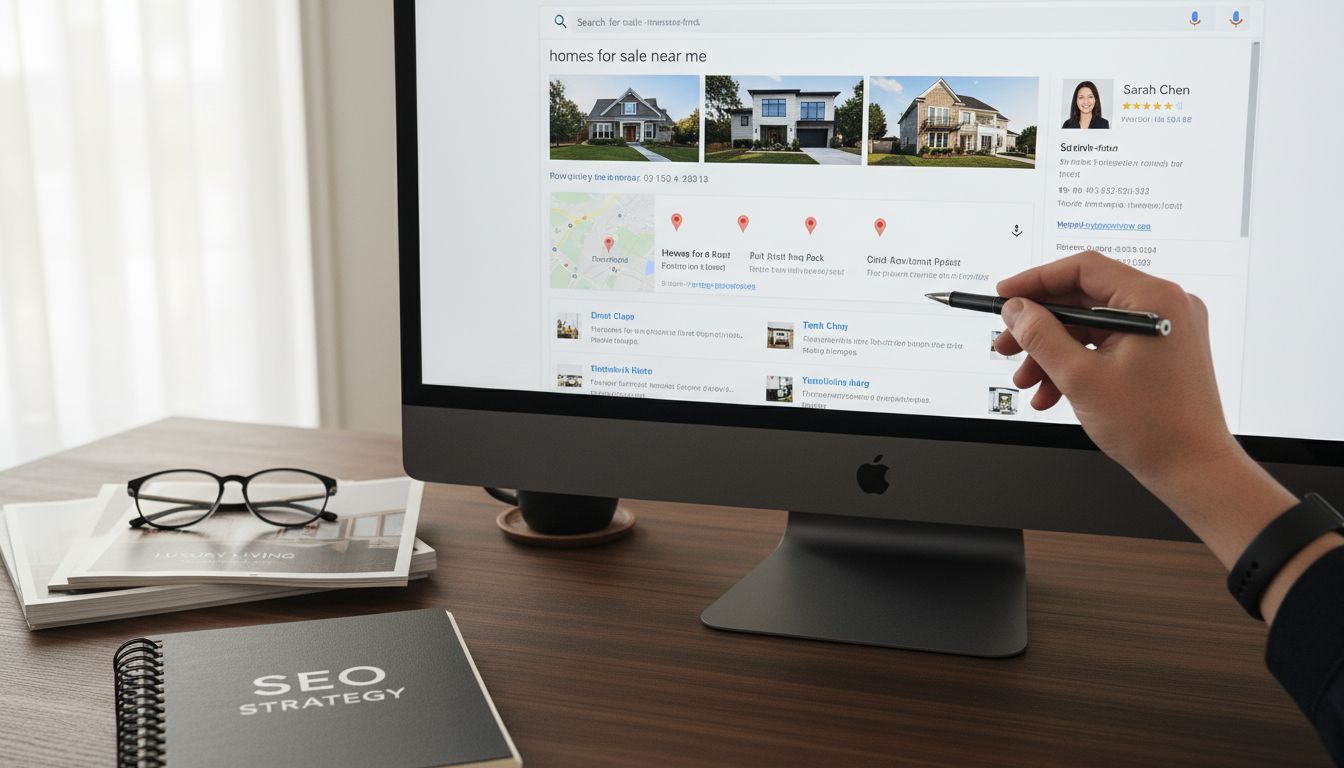
The anatomy of a real estate SERP typically includes several key components:
- Organic property listings
- Google Business Profile snippets
- Local map pack results
- Paid advertisement spaces
- Rich snippets with property details
Understanding these elements is crucial for real estate professionals looking to improve their online strategy.
 While understanding local SEO matters for real estate, mastering SERP dynamics goes beyond simple keyword optimization. It requires a nuanced approach that considers user intent, local search behavior, and the evolving landscape of search engine technologies.
Types of SERP Features in Real Estate Searches
Real estate search results have evolved far beyond simple blue links. SERP features now provide rich, interactive experiences that help potential buyers and sellers quickly access critical information. According to research on search engine results, modern search pages include a variety of specialized features designed to enhance user experience and information accessibility.
The most prominent SERP features in real estate searches include:
Here’s a summary of the most common real estate SERP features and their primary benefits:
| SERP Feature | Description | Key Benefit |
|---|---|---|
| Featured Snippets | Quick answers from web pages | Higher visibility above links |
| Local Pack Results | Maps & contact info | Directs clients to nearby agents |
| Image Carousels | Property and area photos | Attracts visual interest instantly |
| Video Results | Property tours & intros | Boosts engagement and trust |
| Knowledge Panels | Agency or agent profiles | Authority and quick info access |
- Featured Snippets: Concise answers extracted directly from web pages
- Local Pack Results: Maps and contact information for nearby real estate agents
- Image Carousels: Visual representations of properties and neighborhoods
- Video Results: Virtual property tours and agent introduction clips
- Knowledge Panels: Detailed information about real estate agencies and top agents
These dynamic search features transform how potential clients discover and interact with real estate professionals. When searching for properties or agents, users can now access crucial information without clicking through multiple websites. For instance, a local map pack can instantly show nearby properties, agent contact details, and quick review snippets.
Understanding real estate SEO metrics becomes crucial in navigating this complex digital landscape, where visibility means more than just ranking first – it means providing the most relevant and engaging information possible.
Most critically, real estate professionals must recognize that these SERP features are not just decorative elements. They represent sophisticated search algorithms designed to match user intent with the most relevant information. Strategically optimizing content to appear in these features can significantly boost visibility, credibility, and potential client engagement.
How Real Estate SERPs Work for Agents
Search engine results pages represent a critical digital ecosystem where real estate agents can strategically position themselves to attract potential clients. SERP optimization is no longer about simple keyword placement, but about creating comprehensive, engaging content that search engines recognize as valuable. According to research on SERP strategies, agents can significantly enhance their visibility by understanding and strategically targeting specific search features.
Agents can expand their SERP presence through several key strategies:
- Creating rich multimedia content including property videos and virtual tours
- Developing locally-focused blog posts and neighborhood guides
- Optimizing Google Business Profile with current, accurate information
- Generating client testimonials and reviews
- Producing high-quality, informative property descriptions
Multimedia content plays a particularly powerful role in SERP visibility. Real estate SEO tips can dramatically boost agent visibility online, especially when agents incorporate diverse content formats. Research indicates that videos, image galleries, and interactive property maps can activate additional SERP features, providing potential clients with more engaging and comprehensive search experiences.
Ultimately, successful SERP performance requires real estate agents to think beyond traditional marketing approaches. It’s about creating a holistic digital presence that provides genuine value, answers potential client questions, and demonstrates local expertise. By consistently producing high-quality, relevant content and strategically optimizing their online profiles, agents can transform search engine results pages from simple listings into powerful client attraction tools.
Key Ranking Factors and Local SEO Strategies
Search engine rankings for real estate professionals are driven by a complex interplay of strategic elements that go far beyond simple keyword placement. According to research on search engine optimization, the most critical ranking factors revolve around relevance, authority, and delivering an exceptional user experience for potential clients searching for property information.
Key ranking factors for real estate agents include:
- Google My Business optimization
- Consistent local business citations
- High-quality, location-specific content
- Mobile-friendly website design
- Authentic client reviews and testimonials
- Local backlink acquisition
- Schema markup for property listings
Local SEO strategies require a nuanced approach that goes deeper than traditional marketing techniques. Exploring local search ranking factors reveals that search engines prioritize businesses providing genuine value to their local community. This means creating content that speaks directly to local market conditions, neighborhood insights, and hyperlocal property trends.
Successful real estate professionals understand that SERP rankings are not just about technical optimization, but about building a comprehensive digital presence that demonstrates expertise, trustworthiness, and deep local knowledge. By consistently producing high-quality, location-specific content and maintaining an active, engaging online profile, agents can significantly improve their visibility and attract more potential clients through search engine results.
Common Mistakes Agents Make With SERPs
The digital real estate landscape is unforgiving, and SERP optimization requires precision that many agents overlook. Numerous real estate professionals inadvertently sabotage their online visibility through critical strategic errors that can dramatically reduce their search engine performance and potential client engagement.
The most significant mistakes agents consistently make include:
- Neglecting structured data implementation
- Ignoring mobile user experience
- Inconsistent local business citations
- Producing generic, non-localized content
- Failing to manage online reviews
- Overlooking page loading speed
- Minimal multimedia content integration
According to research, one of the most detrimental oversights is failing to implement structured data, which prevents listings from appearing in rich snippets and advanced SERP features. Understanding real estate SEO jargon becomes crucial in navigating these technical nuances. Mobile optimization represents another critical area where agents frequently fall short. Search engines now prioritize mobile-friendly experiences, meaning websites that don’t adapt to smartphone and tablet displays will be systematically pushed down in rankings.
Successful real estate professionals recognize that SERP visibility is not a passive achievement but an active, strategic process. By addressing these common mistakes proactively, agents can transform their digital presence from invisible to irresistible, ensuring they capture potential clients’ attention in an increasingly competitive online marketplace.
Master Your Real Estate SERPs and Get Found Locally
Navigating the complexities of real estate SERPs can feel overwhelming, especially when competing for attention in local searches. The article highlights critical challenges like optimizing for featured snippets, local pack results, and the importance of structured data to stand out. You want more than just rankings — you need visibility that drives action from buyers and sellers searching for homes in your area.
At Content Charlie, we understand these exact pain points. We specialize in crafting targeted local SEO content tailored for tight suburban markets. Whether you need property descriptions, Google Business Profile content, or engaging suburb guides, our expert copywriting boosts your chances of appearing in those valuable SERP features and converting clicks into clients.
Ready to rise above the noise and show up where it counts now?
Discover how our proven local SEO strategies can turn SERP complexities into client connections. Visit Content Charlie today and start dominating your local real estate search landscape with copy that ranks and converts. Explore our solutions crafted to enhance your presence with real estate SEO tips and understanding real estate SEO metrics that deliver measurable results.
Frequently Asked Questions
What are real estate SERPs?
Search Engine Results Pages (SERPs) for real estate are web pages shown by search engines that display various listings, advertisements, and other features relevant to real estate queries. These pages help users find property information and real estate professionals in their area.
How can real estate agents optimize their SERP presence?
Real estate agents can optimize their SERP presence by creating rich multimedia content (like videos and virtual tours), developing locally-focused blog posts, optimizing their Google Business Profile, generating client testimonials, and producing high-quality property descriptions.
What are the key features of real estate SERPs?
Key features of real estate SERPs include organic property listings, local map pack results, Google Business Profile snippets, paid advertisements, and rich snippets that provide details about properties. These features enhance user experience and improve visibility for agents.
What common mistakes do real estate agents make with SERPs?
Common mistakes include neglecting structured data, ignoring mobile user experience, having inconsistent local business citations, producing generic content, failing to manage online reviews, and not integrating multimedia content effectively.
Recommended

Real Estate SEO in 2025: Complete Guide for Agents
Nearly 90 percent of homebuyers start their search online, yet only a fraction of real estate agents achieve top rankings in search results. With digital competition growing fast, staying visible means mastering more than basic website updates.
Cutting-edge real estate SEO in 2025 demands tailored local content, lightning-fast mobile experiences, and powerful tech integrations that connect agents with serious buyers and sellers—right when and where it matters most.
Table of Contents
- Defining Real Estate SEO for 2025
- Core SEO Trends Affecting Real Estate
- How AI and Voice Search Impact Rankings
- Local Search: Suburb-Level SEO Strategies
- Common Real Estate SEO Mistakes to Avoid
Key Takeaways
| Point | Details |
|---|---|
| Local SEO Importance | Hyperlocal content targeting specific neighborhoods is essential for enhancing local search visibility in real estate. |
| AI and Voice Search Adaptation | Real estate professionals must create content that aligns with AI technologies and conversational search patterns to stay competitive. |
| Mobile Optimization | Fast and responsive mobile sites are crucial to reduce bounce rates and improve search rankings. |
| Avoiding SEO Pitfalls | Agents should steer clear of common mistakes such as ignoring mobile responsiveness and duplicating content to maintain a strong digital presence. |
Defining Real Estate SEO for 2025
Real Estate SEO in 2025 is a sophisticated digital strategy that goes far beyond basic website optimization. According to research from The SEO Project, it involves strategic techniques designed to help property professionals rank higher in search engine results while attracting potential buyers and sellers through targeted online visibility.
The core of modern Real Estate SEO centers on three critical elements: local search optimization, mobile-friendly design, and high-quality content. As ZEO resources highlight, agents must adapt to evolving search engine algorithms and integrate AI-driven content strategies that enhance user experience. This means creating hyper-local content that speaks directly to specific neighborhood markets and leveraging technology to make property information instantly accessible.
Key characteristics of Real Estate SEO in 2025 include:
- Microsecond mobile page loading speeds
- Hyperlocal content targeting specific suburbs and neighborhoods
- Rich, schema-enabled property listings with comprehensive details
- Interactive mapping and virtual tour integrations
- Authentic, conversational content that answers specific buyer and seller questions
Successful real estate professionals recognize that SEO is no longer about keyword stuffing, but about creating genuine, valuable connections with potential clients through strategic digital presence. By understanding and implementing these advanced SEO techniques, agents can transform their online platforms from simple listing repositories into powerful lead generation machines.
Core SEO Trends Affecting Real Estate
The real estate digital landscape is rapidly transforming, with SEO becoming increasingly nuanced and sophisticated. Understanding real estate SEO metrics is crucial for agents looking to stay competitive. According to research from The SEO Project, key trends are dramatically reshaping how property professionals approach online visibility, with a growing emphasis on local search listings and organic search results over paid advertisements.
Emerging technological shifts are redefining SEO strategies. As ZEO resources highlight, the rise of voice search and AI-integrated search experiences are creating new challenges and opportunities for real estate professionals. Agents must now craft content that not only ranks well but also directly addresses user intent, providing comprehensive and immediately actionable information.
The most critical SEO trends for real estate professionals in 2025 include:
Here’s a comparison of critical 2025 real estate SEO trends and their practical impact:
| SEO Trend | Description | Impact on Real Estate Agents |
|---|---|---|
| Hyperlocal Content | Content targeting neighborhoods | Increases local search visibility |
| AI-Powered Search | AI matches search intent | Delivers more qualified buyer leads |
| Enhanced Mobile Experience | Fast, responsive mobile sites | Reduces bounce rate, boosts rankings |
| Multimedia Integration | Maps, virtual tours, videos | Engages visitors, increases dwell time |
| Strong Security Protocols | Robust HTTPS, privacy standards | Builds trust, improves search ranking |
- Hyperlocal content optimization
- AI-powered search intent matching
- Enhanced mobile user experience
- Robust online security protocols
- Seamless integration of multimedia content
Successful real estate SEO now requires a holistic approach that goes beyond traditional keyword strategies. By understanding these evolving trends and adapting quickly, agents can position themselves as digital-first professionals who can effectively connect with potential buyers and sellers in an increasingly competitive online marketplace.
How AI and Voice Search Impact Rankings
The integration of artificial intelligence and voice search is fundamentally transforming how real estate websites compete for top search rankings. Exploring AI article analysis techniques reveals the sophisticated ways search engines now evaluate content relevance and quality. According to research from ZEO, AI adoption in search engines is driving more personalized and accurate results, compelling real estate professionals to produce exceptionally high-quality, targeted content.
Voice search is revolutionizing how potential property buyers interact with online search platforms. Modern AI algorithms now prioritize conversational language and natural speech patterns, which means real estate content must evolve beyond traditional keyword optimization. As ZEO research indicates, users are increasingly using long-tail, conversational queries like “three-bedroom house near local schools” instead of fragmented search terms.
Key strategies for adapting to AI and voice search ranking criteria include:
- Creating content that answers specific user questions
- Implementing natural, conversational language
- Developing comprehensive, context-rich property descriptions
- Optimizing for featured snippets and direct answer boxes
- Ensuring mobile and voice search compatibility
Successful real estate professionals will recognize that AI-driven search is not just a technological trend, but a fundamental shift in how potential clients discover and interact with property information. By understanding and strategically adapting to these emerging search technologies, agents can position themselves at the forefront of digital real estate marketing.
Local Search: Suburb-Level SEO Strategies
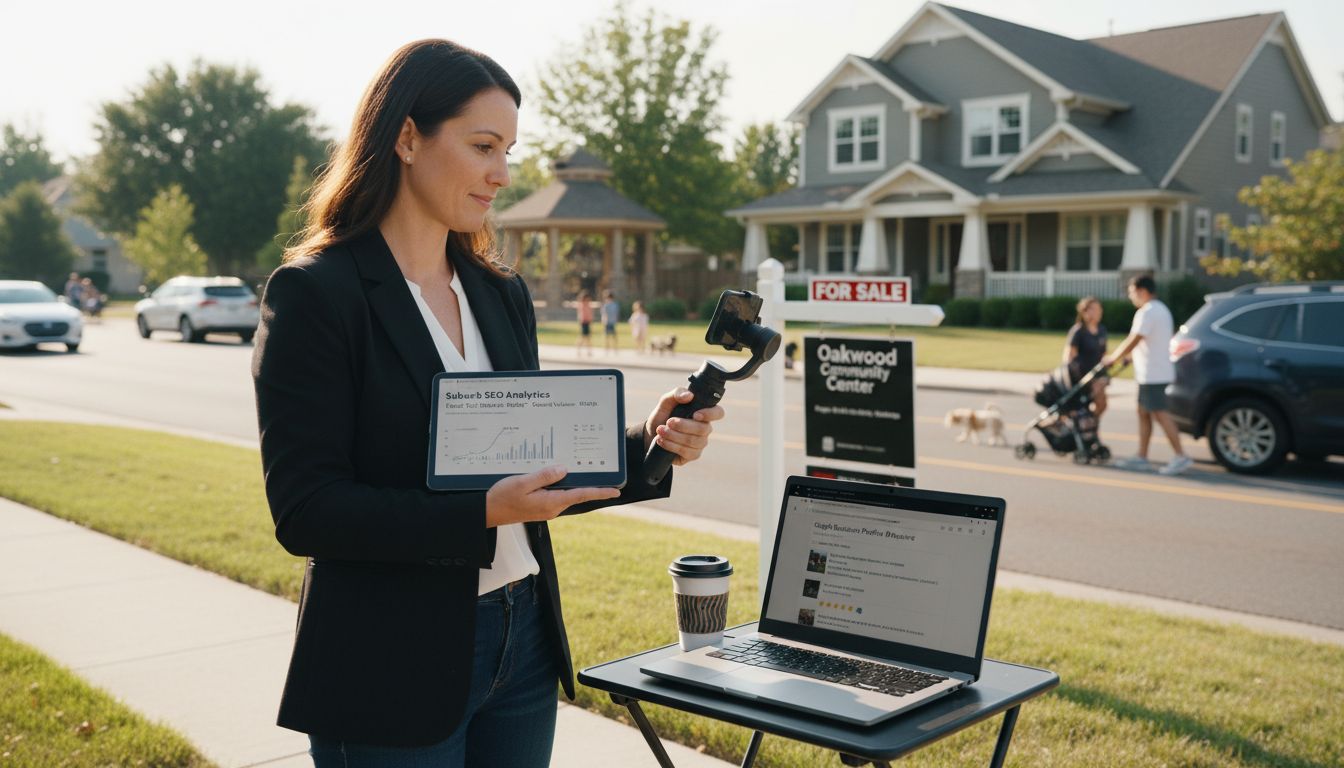
Local SEO has become the cornerstone of digital visibility for real estate professionals in 2025. Understanding why local SEO matters reveals the critical importance of hyper-targeted online strategies. According to research from The SEO Project, optimizing for local search requires meticulous management of business listings, strategic review handling, and providing comprehensive information about properties and neighborhoods.
Suburb-level SEO demands a nuanced approach that goes beyond traditional keyword optimization. As ZEO resources highlight, successful strategies now involve creating geo-targeted content that speaks directly to specific local markets. This means developing rich, context-aware narratives about individual suburbs, their unique characteristics, property trends, and community dynamics.
Key suburb-level SEO strategies for real estate agents include:
- Creating hyperlocal content about specific neighborhood amenities
- Developing suburb-specific property market reports
- Optimizing Google Business Profile with precise local information
- Generating location-specific testimonials and case studies
- Engaging with local community events and online discussions
The most successful real estate professionals will treat suburb-level SEO as an opportunity to become digital neighborhood experts. By crafting content that provides genuine value and insights into local property landscapes, agents can transform their online presence from generic listings to authoritative local resources that potential buyers and sellers genuinely trust.
Common Real Estate SEO Mistakes to Avoid
Boosting agent visibility online requires avoiding critical SEO pitfalls that can dramatically undermine digital performance. According to research from The SEO Project, real estate professionals frequently make mistakes that directly compromise their search rankings, including neglecting mobile optimization, overlooking local search strategies, and failing to secure websites with HTTPS protocols.
Duplicate content remains a significant challenge in real estate SEO. As ZEO resources highlight, search engines penalize websites that reproduce identical property descriptions or listing information across multiple pages. The most sophisticated algorithms now detect and downgrade content that lacks originality, compelling agents to develop unique, compelling narratives for each property listing.
The most common real estate SEO mistakes that agents must avoid include:
- Ignoring mobile responsiveness
- Using generic, non-localized content
- Neglecting website security protocols
- Publishing duplicate property descriptions
- Failing to update listings regularly
- Overlooking page loading speed
- Inconsistent NAP (Name, Address, Phone) information
Successful real estate professionals understand that SEO is an ongoing process of refinement and adaptation. By proactively addressing these common mistakes, agents can create a robust digital presence that not only attracts potential clients but also establishes credibility in an increasingly competitive online marketplace.
Elevate Your Real Estate SEO and Capture Local Leads in 2025
The article reveals that modern Real Estate SEO is all about mastering hyperlocal content, enhancing mobile experience, and leveraging AI to meet evolving search trends. If you find it challenging to create unique, suburb-focused content or struggle with optimizing your listings for voice search and mobile users, you are not alone. Many agents face these hurdles while trying to stand out in competitive neighborhoods and build genuine trust with potential buyers and sellers.
At Content Charlie, we understand that winning local searches from Broadbeach to Burleigh means having SEO-driven, engaging property descriptions, detailed suburb guides, and Google Business Profile content that truly connect with your audience. We help you overcome the common pitfalls like duplicate content and slow mobile pages with tailored strategies designed to boost your rankings and convert clicks into clients.
Ready to transform your digital presence into a powerful lead-generating machine?
Discover how our local SEO and real estate copywriting expertise can make your brand the trusted neighborhood choice. Visit Content Charlie today and explore our services that align perfectly with the latest 2025 SEO trends. Start attracting ready-to-act customers now with content that ranks, engages, and sells. Check out Content Charlie and learn the secrets to dominating your local market through effective SEO strategies tailored just for real estate professionals.
Frequently Asked Questions
What is Real Estate SEO in 2025?
Real Estate SEO in 2025 involves advanced digital strategies that help real estate professionals improve their search rankings and enhance online visibility through local search optimization, mobile-friendly designs, and high-quality content.
Why is local SEO important for real estate agents?
Local SEO is essential for real estate agents as it helps them target specific neighborhoods and markets, increasing their visibility to potential buyers and sellers actively searching for properties in those areas.
How do AI and voice search impact SEO for real estate websites?
AI and voice search enhance SEO by prioritizing content that uses natural language and answers specific user questions, requiring real estate professionals to create targeted and context-rich content that aligns with conversational queries.
What are common SEO mistakes real estate agents should avoid?
Common SEO mistakes include neglecting mobile responsiveness, using duplicate property descriptions, failing to secure websites with HTTPS, and not optimizing local search strategies, which can harm search rankings and online visibility.
Recommended

Real Estate SEO Myths: Complete Guide for Agents
Did you know that over 90 percent of property searches begin online? For real estate agents, showing up on the first page of search results can mean the difference between a flood of leads and an empty inbox. Misunderstandings about Search Engine Optimization often keep agents from realizing their digital potential. Understanding what truly drives real estate SEO gives you a real edge in connecting with tomorrow’s buyers and sellers.
Table of Contents
- Defining Real Estate SEO and Common Myths
- Debunking Popular Real Estate SEO Beliefs
- Local SEO Myths for Australian Agents
- Truths About Google Rankings and Content
- Real-World Impact of Following SEO Myths
Key Takeaways
| Point | Details |
|---|---|
| Continuous SEO Effort | Real estate SEO is an ongoing process requiring regular updates and strategic monitoring for effective results. |
| Quality Over Quantity | Focusing on high-quality, relevant content is essential for improving search engine rankings, rather than just increasing keyword usage. |
| Local Optimization is Crucial | Hyper-targeted local SEO strategies, including unique content and optimized listings, significantly enhance visibility in competitive markets. |
| Understanding Realistic Expectations | SEO should not be viewed as a quick fix; agents must commit to long-term strategies to improve online visibility and client acquisition. |
Defining Real Estate SEO and Common Myths
Real estate Search Engine Optimization (SEO) is the strategic process of enhancing your online visibility to attract potential property buyers and sellers through organic search results. According to research from Zillow, SEO involves optimizing your website to improve its ranking in search engine results, ultimately driving more targeted traffic to your real estate business.
Many agents misunderstand SEO, believing it’s a simple one-time task with guaranteed immediate results. As insights from Breakthrough Broker reveal, SEO is actually a continuous process requiring regular updates and strategic monitoring. Common myths that can derail an agent’s digital strategy include:
- Believing more keywords automatically mean better rankings
- Assuming social media directly impacts search engine rankings
- Thinking SEO is a quick fix rather than an ongoing effort
Successful real estate SEO requires understanding that search engines prioritize high-quality, relevant content that genuinely helps potential clients. This means creating suburb guides, property market insights, and targeted local content that answers specific questions your audience might have. By focusing on providing value and maintaining consistent website optimization, you’ll gradually improve your online visibility and attract more qualified leads.
For a comprehensive breakdown of real estate SEO terminology, check out our guide on real estate SEO jargon to help you navigate this complex digital landscape.
Debunking Popular Real Estate SEO Beliefs
Real estate agents often fall prey to common misconceptions about Search Engine Optimization (SEO) that can significantly hinder their online marketing efforts. According to insights from Realty Ninja, one critical mistake is using identical listing descriptions across multiple platforms, which creates duplicate content and negatively impacts search rankings.
Beyond content uniqueness, many agents misunderstand the fundamental nature of SEO. As Breakthrough Broker explains, SEO is not a one-time task but a continuous process requiring consistent effort and strategic updates. Common myths that can derail your digital strategy include:
Here’s a breakdown of top real estate SEO myths versus the reality:
| SEO Myth | The Reality | Impact if Believed |
|---|---|---|
| More keywords mean better rankings | Quality and relevance matter more | Poor search performance |
| Social media directly improves rankings | Social signals have indirect effect only | Misallocated marketing focus |
| SEO is a quick, one-time fix | SEO is ongoing and requires updates | Loss of long-term visibility |
| Duplicate listings are harmless | Unique content is critical | Lowered search ranking |
| Location-specific keywords are unnecessary | Hyper-local terms boost local results | Missed local opportunities |
- Believing you can achieve instant search ranking improvements
- Assuming more keywords automatically mean better search results
- Thinking SEO is a set-it-and-forget-it marketing approach
To truly enhance your online visibility, you must develop a dynamic SEO strategy that focuses on creating unique, valuable content tailored to your local market. This means crafting original property descriptions, developing suburb-specific guides, and regularly updating your website with fresh, relevant information. By understanding how blogging can boost your real estate SEO, you’ll create a more robust and effective digital marketing approach that attracts potential clients and improves your search rankings over time.
Local SEO Myths for Australian Agents
Local Search Engine Optimization (SEO) is a critical strategy for real estate agents looking to dominate suburb-specific markets across Australia. According to Web Globals, many agents mistakenly believe that a generic online presence is sufficient to attract local clients. In reality, hyper-local optimization is key to standing out in competitive real estate markets.
Common misconceptions about local SEO can significantly hinder an agent’s digital marketing efforts. Locally.net.au highlights the importance of creating targeted local landing pages and maintaining consistent business listings across different platforms. Myths that can derail your local search strategy include:
- Assuming all online listings are equally effective
- Believing location-specific keywords are unnecessary
- Thinking social media followers automatically translate to local visibility
To truly excel in local SEO, agents must develop a hyper-targeted digital presence that speaks directly to specific suburbs and local communities. This means creating unique content for each area you serve, optimizing Google Business Profile listings, and understanding local market differentiation strategies that set you apart from competitors. By focusing on authentic, locally-relevant content and precise geographic targeting, you’ll improve your chances of appearing in crucial suburb-level searches and attracting potential clients in your specific real estate market.

Truths About Google Rankings and Content
Google Rankings are far more nuanced than most real estate agents realize. According to Realty Ninja, one critical mistake that can torpedo your search visibility is using duplicate content, such as recycling identical listing descriptions across multiple platforms. Search engines penalize websites that don’t offer unique, valuable information.
Breakthrough Broker emphasizes that SEO is a long-term strategy, not an overnight miracle. Agents often harbor unrealistic expectations about search rankings, believing they can achieve top positions through quick tricks. The truth is more complex:
- Rankings improve through consistent, high-quality content
- Unique property descriptions matter more than keyword stuffing
- Patience and strategic effort are essential for SEO success
To truly understand how to improve your digital presence, dive into the role of content in SEO and recognize that Google rewards websites providing genuine value to potential clients. This means crafting original suburb guides, detailed property insights, and locally targeted content that answers real questions your audience is asking. Your goal isn’t just to rank, but to become a trusted local authority that search engines and clients both respect.
Real-World Impact of Following SEO Myths
Believing in SEO misconceptions can have devastating consequences for real estate agents’ digital marketing efforts. According to Realty Ninja, minimal content is a critical error that directly impacts search engine visibility. Agents who skimp on comprehensive, unique content essentially render themselves invisible in the digital marketplace.
Breakthrough Broker highlights the long-term repercussions of treating SEO as a one-time task. The real-world consequences of following outdated SEO myths include:
- Dramatically reduced online visibility
- Lower client acquisition rates
- Missed opportunities in competitive markets
- Potential loss of potential commission income
To understand the true financial impact of SEO strategies, real estate professionals must recognize that digital marketing is an ongoing investment. Poor SEO practices don’t just limit your online presence they directly translate to fewer leads, fewer property viewings, and ultimately, less revenue. Your digital strategy needs to be as dynamic and adaptable as the real estate market itself – constantly evolving, always engaging, and strategically positioned to capture potential clients’ attention.
Break Free from Real Estate SEO Myths and Get Found Locally
If you are struggling with common SEO misconceptions like quick fixes or copy-pasting listing descriptions, you are not alone. The article highlights how ongoing, strategic local SEO and unique, relevant content make the difference between invisibility and becoming a trusted market leader. Without a clear, focused approach, your online presence will remain buried beneath competitors who understand how to win suburb-level searches.
Content Charlie specializes in crafting exactly the kind of high-quality, localized copy that Google and your clients crave. From detailed suburb guides to engaging property descriptions and optimized Google Business Profile content, we help real estate agents rise above SEO myths and shine in their communities.
Take control of your digital future today by partnering with Content Charlie. Visit us at Content Charlie now to unlock local SEO strategies that deliver real results and make your brand the first choice for buyers and sellers in your market.
Frequently Asked Questions
What is real estate SEO?
Real estate SEO is the process of optimizing a real estate website to improve its visibility in search engine results, attracting potential buyers and sellers through organic search traffic.
Is SEO a one-time task for real estate agents?
No, SEO is an ongoing process that requires continuous updates and regular monitoring to maintain and improve search rankings over time.
How important is unique content for real estate websites?
Unique content is critical as it helps avoid duplicate content penalties from search engines, improves search rankings, and provides genuine value to potential clients.
Can social media presence improve my real estate SEO results?
Social media can indirectly impact SEO results by driving traffic to your website and increasing brand visibility, but it does not directly influence search engine rankings.
Recommended
- Real Estate SEO Jargon Explained: Essential Guide – Content Charlie
- Real Estate Website Essentials: Complete Guide for Agents – Content Charlie
- Complete Guide to Copywriting in Real Estate – Content Charlie
- SEO for Real Estate Agencies: Simple Strategies to Grow Your Business
- Understanding SEO Best Practices for Your Business – My Blog

7 Best Real Estate Blog Ideas for Local Agents
You need the best real estate blog ideas for local agents to help searchers.
Did you know that over 95 percent of homebuyers start their search online before ever speaking to an agent?
People crave real, local insights that help them feel confident about where they might put down roots. A well crafted real estate blog can meet that demand by sharing local knowledge, genuine stories, and expert guidance that turn casual browsers into loyal clients ready to move forward.
Table of Contents
- 1. Create Suburb Guides That Attract Local Searches
- 2. Share Latest Market Updates And Price Trends
- 3. Publish Success Stories And Client Testimonials
- 4. Offer Home Buying And Selling Tips For Locals
- 5. Highlight Community Events And Local Businesses
- 6. Explain Real Estate Terms In Simple Language
- 7. Showcase Property Spotlights And Virtual Tours
Quick Summary
| Takeaway | Explanation |
|---|---|
| 1. Create detailed suburb guides | These guides attract local searches and position you as a neighborhood expert. Include demographics, schools, amenities, and unique local insights. |
| 2. Provide regular market updates | Keep your audience informed with accurate market data and trends. This builds credibility and positions you as a knowledgeable local authority. |
| 3. Showcase client success stories | Personal narratives from satisfied clients serve as powerful testimonials. They build trust and showcase your expertise in guiding buyers and sellers. |
| 4. Offer practical home buying tips | Providing actionable advice demystifies the real estate process. Help local buyers and sellers make informed decisions with clear guidance on market conditions. |
| 5. Highlight community events and local businesses | Showcasing local culture and happenings builds community connection. This positions you as a reliable resource for potential buyers seeking lifestyle insights. |
1. Create Suburb Guides That Attract Local Searches
Transform your real estate blog into a local buyer’s ultimate neighborhood resource by developing comprehensive suburb guides that showcase your expertise and attract targeted search traffic. by giving best real estate blog ideas for local agents.
When potential homebuyers start researching areas to live, they want more than just property listings. They crave deep local insights that help them understand the neighborhood vibe, amenities, and lifestyle potential.
According to real estate content strategies, creating detailed neighborhood profiles is a powerful way to connect with potential clients. These guides should go beyond surface level information and provide meaningful local context that helps buyers envision their life in the area.
What makes an exceptional suburb guide? Think like a local insider. Cover key elements such as:
- Neighbourhood demographics
- School district ratings
- Local transportation options
- Nearby parks and recreational facilities
- Shopping and dining scenes
- Community events and culture
By crafting these comprehensive guides, you position yourself as the go to local expert. Each suburb guide becomes a magnet for search traffic from people seriously considering moving to that specific area. The more detailed and genuine your content, the more likely you are to attract qualified leads who see you as a trusted local resource.
For maximum impact, include high quality photos, local maps, and even first hand insights about what makes each suburb unique. Your goal is to help potential buyers feel like they already know the neighborhood before they even schedule a viewing.
2. Share Latest Market Updates and Price Trends
Be the local real estate expert your community trusts by consistently sharing the best real estate blog ideas for local agents including professional market insights and price trend analysis. In a rapidly changing property landscape, potential buyers and sellers are hungry for accurate local market intelligence that helps them make informed decisions.
Providing professional analysis of current market conditions demonstrates your expertise and keeps your audience engaged. According to real estate SEO strategies, regular market updates position you as a thought leader and reliable information source in your local area. Best real estate blog ideas for local agents can cement your position. Here’s how
Why market updates matter:
- Build credibility with data driven insights
- Showcase your deep understanding of local property dynamics
- Attract potential clients seeking professional guidance
- Improve your website’s search engine visibility
To create compelling market updates, focus on presenting complex data in an easily digestible format. Break down median property prices, average days on market, sale price to list price ratios, and inventory levels. Include visual elements like graphs or charts to make the information more engaging and accessible.
Consider creating a monthly or quarterly market report that becomes a go to resource for local property enthusiasts. By consistently delivering valuable insights, you transform your blog from a simple listing platform into a trusted local real estate information hub that attracts and retains potential client interest.
3. Publish Success Stories and Client Testimonials
Turn your satisfied clients into your most powerful marketing tool by strategically showcasing their property journey and success stories. Client testimonials are pure gold in real estate marketing, offering authentic social proof that builds trust and credibility with potential buyers and sellers.
According to client success stories research, sharing genuine experiences from past clients can significantly influence potential customers. These narratives do more than just highlight your achievements they provide real world evidence of your expertise and commitment.
Key elements of compelling client stories:
- Personal transformation details
- Specific challenges overcome
- Emotional journey of buying or selling
- Tangible results achieved
- Genuine client quotes
When crafting these stories, focus on the human element. Do not just list transaction details. Illustrate how you helped clients navigate complex real estate challenges. Perhaps you assisted a first time homebuyer in finding their dream property or helped a family sell their home quickly during a challenging market. This is a must do best real estate blog ideas for local agents.
Consider incorporating multimedia elements like photos, video testimonials, or before and after images to make your stories more engaging. Professional yet personal storytelling transforms generic marketing content into powerful trust building narratives that resonate with potential clients searching for a reliable real estate partner.
4. Offer Home Buying and Selling Tips for Locals
Transform your blog into a go to resource for local homeowners and buyers by providing practical, actionable advice that demystifies the real estate process. By sharing insider tips and local market knowledge, you position yourself as a trusted advisor who genuinely helps community members navigate their property journeys.
According to local real estate marketing strategies, providing clear guidance can significantly improve your credibility and attract potential clients who are seeking professional insights.
Key tips to cover in your blog posts:
- First time buyer mortgage preparation
- Home staging techniques for sellers
- Understanding local property valuation trends
- Negotiation strategies for competitive markets
- Home inspection best practices
- Financial planning for real estate investments
Focus on breaking down complex real estate concepts into easy to understand language. For buyers, explain the step by step process of securing a mortgage, understanding local market conditions, and making competitive offers. For sellers, provide actionable advice on preparing their home for sale, pricing strategies, and maximizing property value.
Remember that your goal is not just to showcase your expertise but to genuinely help your local community make informed real estate decisions. By consistently delivering valuable, practical advice, you become more than just an agent you become a trusted local resource that people will turn to when they are ready to buy or sell a property.
5. Highlight Community Events and Local Businesses
Transform your real estate blog into a vibrant community hub by showcasing the unique local landscape that makes your neighborhood special. Prospective homebuyers do not just purchase a property they invest in a community and your blog can be their insider guide to understanding what makes your area truly remarkable.
According to community engagement research, highlighting local businesses and events positions you as more than just a real estate agent. You become a trusted community connector who understands the heartbeat of the neighborhood.
Content ideas for community spotlights:
- Annual local festivals and celebrations
- Profiles of family owned businesses
- New restaurant and shop openings
- Community improvement projects
- Local school and sports achievements
- Neighborhood volunteer opportunities
Think beyond traditional real estate content. Share stories that capture the spirit of your community. Interview local business owners, attend community events, and create content that shows potential buyers the lifestyle they could experience by moving to your area.
By consistently sharing authentic local insights, you build trust and credibility. Potential clients will see you as a knowledgeable local expert who offers more than just property listings. You become a valuable resource that helps people understand the true essence of living in your community.
6. Explain Real Estate Terms in Simple Language
Cut through the complexity of real estate jargon by creating content that transforms complicated industry terminology into clear, understandable language. Demystifying real estate speak helps potential buyers and sellers feel more confident and empowered in their property journey.
According to real estate SEO jargon insights, breaking down technical terms can significantly improve client understanding and trust. Most people feel overwhelmed by the technical language surrounding property transactions.
Terms to explain in your blog posts:
- Loan to value ratio
- Amortization schedule
- Earnest money deposit
- Title search
- Closing costs
- Contingency clauses
- Fixed versus adjustable rate mortgages
Create dedicated best real estate blog ideas for local agents or a recurring series that tackles one complex term at a time. Use real world examples and analogies that help people understand these concepts intuitively. For instance when explaining loan to value ratio, compare it to how a bank might assess risk when lending money for a car purchase.
By consistently translating complex real estate language into everyday terms, you position yourself as an approachable and trustworthy professional who genuinely wants to help clients understand the intricacies of property transactions. Your blog becomes a valuable educational resource that demystifies the real estate process.
7. Showcase Property Spotlights and Virtual Tours
Elevate your real estate blog by creating immersive property experiences that go far beyond traditional listings. Virtual tours and property spotlights transform passive browsing into an interactive journey that helps potential buyers emotionally connect with properties before they even step inside.
According to virtual tour insights, modern homebuyers expect more than static images. They want dynamic, engaging content that allows them to explore properties from the comfort of their own homes.
Key elements of compelling property content:
- High quality 360 degree virtual tours
- Detailed neighborhood context
- Professional photography
- Video walkthroughs
- Floor plan breakdowns
- Unique property storytelling
- Authentic property highlights
Create a consistent series like ‘Weekly Property Spotlight’ that gives readers an in depth look at unique homes in your local market. Go beyond square footage and list prices. Share the story behind each property. What makes this home special? What neighborhood amenities surround it? How might a specific type of buyer fall in love with this space?
By crafting narrative driven property content, you transform your blog from a simple listing platform into an engaging real estate storytelling hub that attracts and captivates potential buyers seeking their dream home.
Below is a comprehensive table summarizing the strategies discussed for transforming a real estate blog into a valuable resource by attracting local searches and engaging potential clients with various content approaches.
| Strategy | Implementation | Expected Results |
|---|---|---|
| Suburb Guides | Create detailed guides featuring demographics, schools, transport, etc. | Attracts targeted local search traffic and positions you as a local expert. |
| Market Updates | Share professional insights on price trends and market conditions. | Builds credibility, attracts potential clients, and enhances search visibility. |
| Client Success Stories | Showcase client journeys with testimonials and storytelling. | Builds trust, adds social proof, and demonstrates expertise. |
| Home Buying/Selling Tips | Provide practical advice on real estate processes and strategies. | Increases credibility and attracts clients seeking professional guidance. |
| Community Highlights | Feature local events and businesses to engage the community. | Builds trust and positions you as a community connector. |
| Simplifying Real Estate Terms | Explain complex jargon in simple language for better understanding. | Empowers clients and improves trust and understanding. |
| Property Spotlights & Virtual Tours | Use virtual tours and storytelling for immersive property experiences. | Attracts and captivates potential buyers with engaging content. |
Boost Your Local Real Estate Blog with Expert SEO Copywriting
Struggling to turn your best real estate blog ideas for local agents that truly attracts local buyers and sellers? This article highlights key challenges like creating detailed suburb guides, sharing market updates, and producing engaging client success stories. You want to be seen as the trusted local expert who simplifies real estate terms and showcases community spirit but may feel overwhelmed by how to get found on Google in your specific neighborhoods.
At Content Charlie, we understand that capturing suburb-level search traffic and crafting content that resonates emotionally are crucial for your success. Our specialized local SEO strategies and tailored real estate copywriting help you rank higher for the exact topics homebuyers are searching for. We write suburb guides that feel authentic, market updates that build credibility, and blog articles that inspire trust — all designed to turn visitors into ready-to-act clients.
Discover how our content solutions can transform your blog into the ultimate resource your community depends on.
Ready to dominate your local market with blog content that works? Visit Content Charlie to explore how our services can empower your real estate business today. Don’t wait until your competitors outrank you in neighborhood searches. Start crafting your local authority now with our proven approach. Also, learn more about our full range of SEO-driven copywriting services and how we help agents like you attract serious buyers and sellers.
Frequently Asked Questions
What types of content should I include in suburb guides for my real estate blog?
To create effective suburb guides, include key elements like demographics, school district ratings, local amenities, and community events. Focus on providing comprehensive, engaging insights that showcase what makes each area unique, helping potential homebuyers envision their future there.
How can I make market updates more engaging for my readers?
To make market updates engaging, present complex data in easy-to-understand formats, such as infographics or charts. Break down metrics like median property prices and inventory levels into clear visuals, and aim to publish these updates monthly or quarterly for consistent readership.
What elements should I highlight in client success stories?
When showcasing client success stories, focus on personal transformations, specific challenges overcome, and tangible results achieved. Include genuine quotes from clients and consider using multimedia elements like photos or videos to make these stories more relatable and engaging.
How can I provide home buying and selling tips that resonate with locals?
Offer practical, actionable tips tailored to your local market, such as advice on mortgage preparation or home staging techniques. Break complex concepts into easily understandable language to help local buyers and sellers feel empowered throughout their real estate journey.
What community events and local businesses should I feature in my blog?
Highlight annual festivals, local business profiles, and community improvement projects to showcase your area’s vibrant culture. Engaging with local stories and events helps position you as a trusted community expert, making your blog a go-to resource for potential clients.
How can I simplify real estate jargon for my audience?
To simplify real estate jargon, define complex terms in straightforward language and use real-world analogies for context. Consider creating a dedicated blog series that tackles one term at a time, helping readers build their understanding and confidence as they navigate the real estate process.
Recommended
- Why Use Blog Content: Essential Guide for Real Estate – Content Charlie
- 7 Essential Types of Real Estate Leads Agents Must Know – Content Charlie
- 7 Innovative Real Estate Newsletter Ideas for Agents – Content Charlie
- 7 Types of Real Estate Content Every Agent Should Use – Content Charlie
- 7 Content Curation Strategies Every Business Owner Needs – My Blog
- Best Blog Post Ideas for 2025: Inspiration for Marketers & Businesses

Real Estate SEO Jargon Explained: Essential Guide
Real Estate SEO Jargon can be confusing. In this article we’ll explain the basics to get you sorted.
Only about 5.7 percent of websites reach Google’s top 10 rankings within their first year, which leaves many real estate agents wondering how to stand out online. Understanding the world of real estate SEO can make the difference between languishing on page five or popping up when local clients search for listings. Grasping the true meaning behind common SEO terms helps agents sidestep costly mistakes and build digital strategies that actually connect with buyers and sellers.
Table of Contents
- Defining Real Estate SEO Jargon And Misconceptions
- Key Categories Of SEO Terms In Property Marketing
- Essential On-Page And Off-Page SEO Vocabulary
- How Agents Apply SEO Jargon In Practice
- Common Jargon Mistakes And What To Avoid
Key Takeaways
| Point | Details |
|---|---|
| Understanding SEO’s Importance | Real estate SEO is critical for enhancing online visibility, with only 5.7% of websites achieving top Google rankings in a year. |
| Implementing Key Strategies | Effective SEO requires targeted actions such as location-specific content, mobile optimization, and consistent content updates. |
| Mastering On-Page and Off-Page SEO | Both on-page and off-page SEO strategies are essential for improving search rankings and establishing credibility. |
| Avoiding Common Mistakes | Agents should ensure accuracy in Google Business Profile management and select a balanced domain name to enhance online presence. |
Defining Real Estate SEO Jargon and Misconceptions
Search Engine Optimization (SEO) represents the strategic process of enhancing website visibility and ranking within search engine results. Real estate SEO focuses specifically on helping property professionals increase their online presence and attract potential clients through targeted digital strategies. According to research from Kent University, only 5.7% of websites successfully reach top 10 Google rankings within a year, highlighting the critical importance of understanding SEO fundamentals.
In the competitive real estate landscape, SEO isn’t just about keywords – it’s about creating a comprehensive digital strategy that connects agents with potential buyers and sellers. Strategic domain name selection plays a crucial role in this process, making websites more discoverable and memorable. Understanding Real Estate SEO Metrics Explained can provide deeper insights into measuring and improving your online performance.
Common SEO misconceptions can significantly hinder a real estate professional’s online marketing efforts. Many agents mistakenly believe that simply having a website guarantees visibility, when in reality, targeted optimization is required. Key SEO strategies for real estate professionals include:
- Creating location-specific content
- Optimizing website loading speeds
- Developing mobile-responsive designs
- Generating high-quality, relevant backlinks
- Consistently updating website content
By demystifying SEO jargon and implementing strategic techniques, real estate agents can transform their digital presence and attract more potential clients through improved search engine rankings.
Key Categories of SEO Terms in Property Marketing
Keyword optimization is the foundational pillar of effective real estate digital marketing strategies. According to research from Kent University, SEO success hinges on making content as relevant as possible, which includes strategic use of tags, page titles, categories, and carefully selected keywords. In the competitive real estate landscape, understanding these critical SEO categories can dramatically improve online visibility.
The primary categories of SEO terms in property marketing can be broken down into several key areas. Keyword optimization techniques play a crucial role in helping real estate professionals target specific search queries. These categories typically include:
- Domain Keywords: Incorporating location-specific or property-type terms
- On-Page SEO: Optimizing page titles, meta descriptions, and content
- Local SEO: Targeting geographically relevant search terms
- Technical SEO: Improving website performance and crawlability
- Content SEO: Creating valuable, search-engine-friendly property descriptions
Research indicates that strategic keyword incorporation can be particularly powerful in real estate digital marketing. As noted in domain name optimization studies, keywords like ‘homes’, ‘realty’, ‘properties’, or location-specific terms can directly target common search queries, making your online presence more discoverable and attractive to potential clients. By mastering these SEO categories, real estate professionals can significantly enhance their digital marketing effectiveness and attract more qualified leads.

Essential On-Page and Off-Page SEO Vocabulary
Understanding the critical vocabulary of Search Engine Optimization (SEO) is fundamental for real estate professionals seeking to enhance their digital marketing strategies. According to research from Kent University, SEO optimization involves making content as relevant as possible through strategic use of tags, page titles, categories, and carefully selected keywords.
On-Page SEO terminology focuses on elements directly within your website that can be optimized. On-page optimization techniques encompass critical elements such as:
- Meta Descriptions: Concise page summaries
- Title Tags: Webpage headline text
- Header Tags (H1, H2): Content structure indicators
- Internal Linking: Connecting related website pages
- Keyword Density: Frequency of target search terms
Off-Page SEO terminology, conversely, refers to external factors that influence your website’s search rankings. These include backlink quality, social media mentions, and domain authority. Just as domain name optimization studies suggest using keywords like ‘homes’ or ‘properties’ to target specific search queries, off-page strategies help establish your website’s credibility and relevance in the broader digital ecosystem.
By mastering both on-page and off-page SEO vocabularies, real estate professionals can create a comprehensive digital strategy that improves search engine visibility and attracts more potential clients.
Here’s a summary of essential on-page vs. off-page SEO terms in real estate:
| SEO Aspect | On-Page SEO | Off-Page SEO |
|---|---|---|
| Focus Areas | Content quality Meta tags Internal linking |
Backlinks Social mentions Domain authority |
| Key Elements | Title tags Header tags Keyword density |
Referring domains Google My Business Online reviews |
| Primary Goal | Improve website relevance | Build website credibility |
| Control Level | Full (by website owner) | Partial (influenced by others) |
How Agents Apply SEO Jargon in Practice
In the competitive real estate market, digital marketing strategies have become essential for agents looking to stand out. According to digital marketing research, strategic online presence can dramatically improve an agent’s ability to attract potential clients and close sales. Digital marketing insights reveal that successful real estate professionals leverage SEO techniques to increase their visibility and credibility.
Practical application of SEO jargon requires a strategic approach to online presence. Agents must pay careful attention to critical elements like:
- Google Business Profile (GBP) Optimization: Ensuring 100% consistency in Name, Address, and Phone (NAP) details
- Local Keyword Targeting: Using location-specific search terms
- Content Localization: Creating neighborhood-specific property descriptions
- Backlink Building: Establishing credibility through quality external references
- Mobile-Friendly Website Design: Ensuring seamless user experience across devices
One of the most crucial practical applications involves domain name strategy. As research indicates, a strategic domain name can significantly boost a real estate business’s online presence, making it easier for potential buyers and sellers to find and trust an agent. By understanding and implementing these SEO techniques, real estate professionals can transform their digital marketing approach from generic to highly targeted, ultimately increasing their chances of connecting with potential clients in an increasingly competitive market.
Common Jargon Mistakes and What to Avoid
In the intricate world of real estate digital marketing, SEO terminology can become a minefield of potential missteps. Keyword research strategies reveal that agents often fall into common traps that can significantly diminish their online visibility and credibility.
One of the most critical areas for avoiding mistakes is Google Business Profile (GBP) management. According to digital marketing research, common GBP errors can substantially impact an agent’s online reputation. These mistakes include:
- Using a P.O. box instead of a physical address
- Leaving business hours incomplete or inaccurate
- Uploading low-resolution or generic stock photos
- Neglecting to respond to customer reviews
- Skipping the Q&A section entirely
Another significant pitfall involves domain name selection. Experts caution that agents must strike a delicate balance between keyword relevance and brand identity. A domain name that’s too generic risks blending into the background, while an overly specific name can artificially limit business potential. By carefully navigating these linguistic nuances, real estate professionals can create a robust online presence that speaks directly to potential clients while maintaining a strong, distinctive brand identity.
Master Real Estate SEO Jargon with Content Charlie
Struggling to turn confusing real estate SEO jargon into actionable results for your business Is your goal to attract more local clients and boost your Google rankings with clear and effective digital marketing strategies The article highlights key challenges like optimizing your Google Business Profile and selecting the right domain keywords all crucial for standing out online
At Content Charlie, we specialize in crafting SEO-driven copy that speaks directly to local buyers and sellers. From creating compelling Google Business Profile content to writing suburb guides and property descriptions focused on keyword optimization, we turn complex SEO concepts into real results for your agency. Take control of your online presence now and avoid common pitfalls that hold agents back.
Ready to rise above the competition and dominate local search Results Visit Content Charlie today for tailored real estate SEO solutions designed to get you found and chosen by clients actively looking in your market. Don’t let SEO jargon keep you stuck when expert help is just a click away.
Frequently Asked Questions
What is Real Estate SEO?
Real Estate SEO refers to the strategic process of enhancing the online visibility and ranking of real estate websites within search engine results. It focuses on attracting potential clients through targeted digital strategies.
Why is keyword optimization important in real estate SEO?
Keyword optimization is critical because it helps real estate professionals target specific search queries relevant to their services. Incorporating location-specific or property-type keywords can make your online presence more discoverable to potential clients.
What are some essential on-page SEO techniques for real estate professionals?
Essential on-page SEO techniques include optimizing meta descriptions, title tags, header tags, internal linking, and maintaining an appropriate keyword density throughout the website content.
How can agents improve their Google Business Profile for better SEO?
Agents can improve their Google Business Profile by ensuring consistency in their Name, Address, and Phone (NAP) details, providing accurate business hours, uploading high-quality images, responding to customer reviews, and using the Q&A section to engage with potential clients.
Recommended

Complete Guide to Copywriting in Real Estate
Copywriting in Real Estate sounds hard; dificult even but now if you know how. Here’s the complet guide. Grab a coffee and take notes.
Did you know that homes with persuasive listing descriptions can sell for up to 6 percent more than those with standard copy? Words do more than fill space in real estate—they spark emotions and help buyers imagine their next chapter. Clear, intentional copywriting can change a simple listing into an invitation to dream, setting agents apart and driving stronger interest in every property featured.
Table of Contents
- Copywriting In Real Estate Defined And Debunked
- Types Of Real Estate Copywriting Services
- How Effective Copywriting Drives Sales And Visibility
- Seo Strategies For Local Real Estate Markets
- Common Copywriting Mistakes Real Estate Agents Make
Key Takeaways
| Point | Details |
|---|---|
| Emotional Connection | Real estate copywriting should create compelling narratives that connect emotionally with potential buyers to inspire action. |
| Targeted Strategies | Effective messaging tailored to specific audiences enhances engagement and drives property inquiries, especially in niche markets like luxury real estate. |
| SEO Importance | Implementing local SEO strategies, including keyword optimization and community content, is essential for increasing online visibility in regional real estate markets. |
| Common Pitfalls | Avoid generic descriptions and overuse of jargon; instead, craft personalized, active narratives that resonate with buyers’ aspirations and needs. |
Copywriting in Real Estate Defined and Debunked
Real estate copywriting is the strategic art of crafting persuasive written content designed to transform property listings from bland descriptions into compelling narratives that inspire potential buyers to take action. According to research from copywriting experts, this specialized form of writing goes far beyond simply listing property features – it’s about creating an emotional connection that highlights the lifestyle potential of a property.
Effective real estate copywriting focuses on three critical elements: showcasing the property’s unique value proposition, painting a vivid picture of potential living experiences, and strategically addressing the desires and pain points of target buyers. As industry research indicates, successful copy doesn’t just describe a property, but builds inquiry, elevates an agent’s brand, and transforms passive readers into motivated prospects.
The core objectives of real estate copywriting include:
- Capturing potential buyers’ imagination
- Highlighting location and lifestyle benefits
- Creating an emotional narrative around property features
- Driving meaningful engagement and property inquiries
At its heart, real estate copywriting is about storytelling. It transforms a simple square footage listing into an invitation to imagine a new life, connecting rational property details with the emotional journey of finding a perfect home. Learn more about effective copywriting strategies that can help real estate professionals craft compelling property narratives.
Types of Real Estate Copywriting Services
Real estate copywriting services are comprehensive content solutions designed to help professionals effectively market properties and build their brand. According to research from professional marketing sources, these services encompass a wide range of written materials that transform property information into compelling narratives that attract potential buyers and showcase property value.
Property Listing Descriptions represent the core of real estate copywriting, where each property gets a unique, engaging narrative that goes beyond basic details. As industry research indicates, these services extend far beyond simple descriptions and include:
Here’s a summary of the main types of real estate copywriting services:
| Service Type | Purpose | Example Content |
|---|---|---|
| Property Listing Descriptions | Highlight unique features Create emotional appeal |
Engaging property ads MLS listings |
| Website Content | Build brand credibility Enhance SEO |
Home pages About us sections |
| Blog Posts | Educate buyers Boost search rankings |
Market tips Neighborhood spotlights |
| Lead Generation Materials | Attract prospects Drive interest |
Neighborhood guides Downloadable checklists |
| Email Newsletters | Nurture client relationships Promote new listings |
Monthly updates Open house invites |
| Market Reports & White Papers | Establish expertise Build authority |
Trend analysis In-depth reports |
| Press Releases | Announce news Increase visibility |
Agency updates New property launches |
- Website content development
- Blog post creation
- Lead generation materials like neighborhood guides
- Email newsletter writing
- Market trend reports
- White papers
- Press releases
The strategic objective of these copywriting services is to create a comprehensive content ecosystem that positions real estate professionals as trusted local experts. By crafting targeted, informative, and emotionally resonant content, copywriters help agents communicate not just property features, but the lifestyle and potential each property represents.
 Explore our comprehensive guide on real estate copy strategies to understand how professional copywriting can transform your marketing approach.
How Effective Copywriting Drives Sales and Visibility
Effective real estate copywriting is a powerful catalyst for driving sales and increasing market visibility. According to strategic marketing research, compelling copy goes beyond mere property descriptions by emphasizing an agent’s qualifications, regional expertise, and personal connections – ultimately building trust and encouraging potential clients to engage.
The strategic approach to copywriting involves creating content that resonates with specific target audiences. Targeted messaging can significantly impact sales performance, particularly in specialized market segments. Industry insights reveal that luxury real estate copywriting, for instance, prioritizes exclusivity and sophistication, effectively appealing to high-end buyers and enhancing property visibility in competitive markets.
Key strategies for driving sales through copywriting include:
- Highlighting unique property features
- Creating emotional connections with potential buyers
- Demonstrating deep local market knowledge
- Presenting clear value propositions
- Building credibility through professional storytelling
By crafting narratives that transform static property listings into compelling stories, real estate professionals can differentiate themselves in a crowded marketplace.
Learn more about advanced sales copywriting techniques to elevate your real estate marketing approach and drive meaningful client engagement.
SEO Strategies for Local Real Estate Markets
Local real estate SEO is a critical strategy for agents looking to dominate their regional markets and attract potential buyers searching online. According to industry research, implementing targeted SEO strategies in copywriting can significantly improve search engine rankings by optimizing website content and blogs with relevant keywords that resonate with local searchers.
Local keyword optimization stands at the core of effective real estate SEO. Strategic marketing insights reveal that focusing on regional expertise and incorporating location-specific keywords can dramatically enhance online visibility, making it easier for potential clients to find agents specializing in their desired neighborhoods.
Key local SEO strategies for real estate professionals include:
- Developing neighborhood-specific content
- Using geo-targeted keywords in property descriptions
- Creating location-based landing pages
- Optimizing Google Business Profile listings
- Generating local backlinks from community websites
Discover comprehensive local SEO strategies that can transform your online presence and help you become the go-to real estate expert in your local market. By strategically crafting content that speaks directly to local buyers, you’ll not only improve your search rankings but also establish yourself as a trusted community resource.
Common Copywriting Mistakes Real Estate Agents Make
Language and style can make or break real estate copywriting effectiveness. According to professional writing research, many agents fall into the trap of using passive voice, overloading their copy with unnecessary adverbs and adjectives, and failing to leverage active, compelling verbs that truly engage potential buyers.
Another critical mistake is neglecting audience specificity. Industry insights reveal that failing to tailor copy to specific market segments – such as luxury buyers, first-time homeowners, or real estate investors – results in messaging that feels generic and fails to resonate with intended readers.
Common copywriting pitfalls for real estate agents include:
- Using generic, bland property descriptions
- Neglecting emotional storytelling
- Overusing technical jargon
- Ignoring local market nuances
- Writing from a seller’s perspective instead of a buyer’s
Explore real estate copy examples to understand how professional copywriting transforms mundane listings into compelling narratives that capture potential buyers’ imagination and drive meaningful engagement. The key is crafting copy that speaks directly to the reader’s dreams, aspirations, and lifestyle goals.
Unlock the Power of Real Estate Copywriting and Local SEO Today
The “Complete Guide to Copywriting in Real Estate” highlights common challenges agents face such as creating emotionally compelling narratives, targeting the right local buyers, and avoiding generic, uninspired property descriptions. If you want to break free from bland listings and build trust with readers who are ready to take action you need copy that connects on a deeper level and ranks in local search results.
At Content Charlie, we specialize in exactly that. Our real estate copywriting services craft high-converting property descriptions and suburb guides designed to capture imagination and engage your market. Combine that with our laser-focused local SEO strategies and you get content that makes your agency the first choice when buyers search in your area. Don’t let your listings get lost in the crowd. Visit us now to start transforming your real estate marketing with words that rank, engage, and sell.
Frequently Asked Questions
What is real estate copywriting?
Real estate copywriting is the strategic process of creating persuasive written content that transforms property listings into engaging narratives, highlighting not only the property’s features but also the lifestyle potential it offers to buyers.
Why is emotional storytelling important in real estate copywriting?
Emotional storytelling is crucial because it helps create a connection with potential buyers by illustrating how a property can fulfill their dreams and lifestyle aspirations, turning a simple listing into a compelling invitation.
How can effective copywriting increase property visibility and sales?
Effective copywriting enhances property visibility and drives sales by using targeted messaging that resonates with specific audiences, emphasizing unique property features, and demonstrating local market knowledge and credibility.
What common mistakes should agents avoid in real estate copywriting?
Agents should avoid using generic descriptions, neglecting emotional connections, overusing jargon, writing from a seller’s perspective, and failing to tailor their copy to specific buyer segments.
Recommended

Role of Blogs in Real Estate SEO: Complete Guide
Role of Blogs in Real Estate SEO is crucial if you want to attract more customers. Let me explain.
Over 70 percent of home buyers now begin their search online, making a strong digital presence more important than ever for real estate professionals. Quality blogs do more than share property listings, they offer valuable insights into neighborhoods, market trends, and investment tips. By providing information that answers real questions from buyers and sellers, blogs help agents stand out, build authority, and create real connections with their community.
Table of Contents
- Defining Blogs In Real Estate SEO
- Types Of Real Estate Blog Content
- How Blog Articles Drive SEO Results
- Maximizing Local SEO With Blogging
- Common Blogging Mistakes To Avoid
Key Takeaways
| Point | Details |
|---|---|
| Empower Clients with Quality Content | Blogs should focus on providing valuable information on market trends, investment strategies, and local community insights to attract and retain potential clients. |
| Diversify Content for Engagement | Utilize various content types, such as neighborhood guides and market analyses, to appeal to different audience segments and enhance SEO. |
| Leverage Local SEO Strategies | Create hyper-targeted content relevant to local markets to improve search rankings and position as a neighborhood expert. |
| Avoid Common Blogging Pitfalls | Maintain consistent posting schedules and prioritize quality over quantity to enhance the blog’s effectiveness and digital presence. |
Defining Blogs in Real Estate SEO
Blogs in the real estate industry are strategic online platforms where agents and firms publish valuable content to enhance digital visibility and engage potential clients. According to research from Understanding Why Blogging Boosts SEO, these digital resources serve multiple critical functions beyond traditional marketing.
Role of Blogs in Real Estate SEO, blogs function as educational tools that provide authentic insights into housing markets, property investment strategies, and local neighborhood dynamics. Unlike spam blogs designed purely to manipulate search rankings, legitimate real estate blogs focus on delivering quality information that attracts and retains client interest. Research indicates these platforms help establish professional credibility and demonstrate an agent’s market expertise.
Key characteristics of effective real estate blogs include:
- Informative market trend analysis
- Localized property insights
- Neighborhood and community information
- Investment strategy guidance
- Transparent market commentary
By consistently publishing relevant, high-quality content, real estate professionals transform blogs from simple web pages into powerful SEO assets that improve search engine rankings and build meaningful connections with potential buyers and sellers.
Types of Real Estate Blog Content
Role of Blogs in Real Estate SEO content represents a strategic approach to digital marketing that goes far beyond simple property listings. Why Use Blog Content demonstrates that successful real estate blogs leverage diverse content types to engage potential clients and showcase professional expertise.
According to research, real estate blogs can effectively cover multiple content categories that appeal to different audience segments. These typically include neighborhood guides, market trend reports, homebuyer and seller tutorials, and hyperlocal insights. As sources indicate, the most compelling blogs blend informative content like current market conditions, neighborhood histories, and practical home buying/selling process explanations.
Key types of real estate blog content include:
Here’s a comparison of key real estate blog content types and their primary SEO benefits:
| Content Type | Example Topics | Main SEO Benefits |
|---|---|---|
| Neighborhood Profiles | Local amenities School districts Community features |
Increases local keyword usage Establishes area expertise |
| Market Trend Reports | Housing prices Economic updates Sales analysis |
Attracts investment-focused searches Shows market knowledge |
| Buyer/Seller Guides | Home buying steps First-time seller tips |
Targets high-intent queries Builds trust and authority |
| Investment Strategies | Rental ROI tips Property flips Tax guidance |
Draws in investors Targets niche keywords |
| Community/Lifestyle Features | Local events Restaurant spotlights Resident interviews |
Engages local readers Encourages sharing and backlinks |
- Neighbourhood profile articles
- Market trend and economic analysis reports
- First-time homebuyer guides
- Investment property strategy posts
- Local community and lifestyle features
- Property maintenance and home improvement tips
- Real estate myth debunking articles
By strategically diversifying content, real estate professionals can create engaging blogs that not only improve SEO rankings but also establish credibility, build trust, and demonstrate deep understanding of local real estate landscapes.

How Blog Articles Drive SEO Results
Blog articles are powerful engines for improving real estate website search engine rankings, functioning as strategic tools that signal relevance and expertise to search algorithms. Google SEO techniques highlight the critical role of consistent, high-quality content in enhancing online visibility and attracting potential clients.
According to research, regularly updated blog content provides multiple SEO benefits. These articles incorporate targeted keywords, directly address user queries, and establish the author’s industry authority. By creating content that speaks directly to potential buyers’ and sellers’ interests, real estate professionals can significantly improve their website’s organic search performance and lead generation potential.
Key SEO advantages of blog articles include:
- Increasing website crawl frequency
- Expanding keyword targeting opportunities
- Creating internal linking structures
- Generating fresh, relevant content
- Demonstrating local market expertise
- Improving website domain authority
- Attracting high-quality backlinks
By strategically developing blog content that combines local insights, market trends, and practical advice, real estate professionals can transform their websites from static listings into dynamic, search-engine-friendly platforms that consistently attract and engage potential clients.
Maximizing Local SEO With Blogging
Local SEO represents a critical strategy for real estate professionals seeking to dominate neighborhood-specific search results. Keyword Strategy plays a pivotal role in crafting content that resonates with local audiences and search engine algorithms.
Research demonstrates that successful local SEO blogs go beyond generic property listings by creating hyper-targeted content that speaks directly to community interests. By developing articles that highlight neighborhood events, market trends, and local lifestyle insights, real estate professionals can position themselves as authoritative local experts who understand the nuanced dynamics of specific areas.
Key strategies for maximizing local SEO through blogging include:
- Writing detailed neighborhood profile articles
- Covering local real estate market trends
- Highlighting community events and developments
- Sharing insights about local schools and infrastructure
- Creating location-specific buying and selling guides
- Discussing upcoming local development projects
- Featuring interviews with community leaders
Through strategic, locally-focused content, real estate professionals can transform their blogs into powerful SEO tools that not only improve search rankings but also establish deep connections with potential clients in their specific geographic markets.
Common Blogging Mistakes to Avoid
Real estate professionals often stumble into predictable blogging pitfalls that can significantly undermine their digital marketing efforts. Blogging Consistency is crucial in avoiding these common traps that can derail an otherwise promising content strategy.
Research highlights several critical mistakes that can diminish a blog’s effectiveness and search engine performance. These missteps include inconsistent posting schedules, creating generic content that lacks local specificity, and prioritizing quantity over quality. Real estate bloggers frequently fail to understand that successful content requires a strategic approach that balances informative writing with targeted, audience-specific insights.
Key blogging mistakes to avoid include:
- Irregular or infrequent posting schedules
- Neglecting local market and neighborhood-specific content
- Using generic, non-targeted keywords
- Failing to proofread and edit content
- Ignoring audience engagement and comments
- Overlooking the importance of visual content
- Writing overly sales-focused articles
- Neglecting to update older blog posts
By recognizing and addressing these common pitfalls, real estate professionals can transform their blogs from ineffective digital noise into powerful, engaging platforms that attract, inform, and convert potential clients.
Unlock the Full Power of Real Estate Blogging for SEO Success
If you are struggling with inconsistent posting or generic content that fails to capture your local market, you are not alone. Role of Blogs in Real Estate SEO is critical for success.
As the article points out, real estate blogs thrive when they combine targeted neighborhood insights, market trend analysis, and buyer-focused guides. These are exactly the challenges Content Charlie helps you overcome with tailored, SEO-driven blog content designed to establish your credibility and boost your search rankings across your local areas.
Don’t let common blogging mistakes hold your real estate business back. Take action now to transform your website into a dynamic platform that attracts ready-to-act clients with focused local SEO strategies and compelling copywriting. Discover how our expert team crafts property descriptions, suburb guides, and continuous blog articles that build trust and drive leads. Visit Content Charlie and explore how local SEO & real estate copywriting can help your business stand out in search results and the minds of local buyers and sellers.
Frequently Asked Questions
What is the purpose of blogging in real estate SEO?
Blogging in real estate SEO serves to enhance digital visibility, engage potential clients, and establish professional credibility by providing valuable insights and information about the housing market and local neighborhoods.
How does blog content improve SEO for real estate websites?
Blog content improves SEO by incorporating targeted keywords, increasing website crawl frequency, creating internal linking structures, and generating fresh, relevant content that appeals to both search engines and users.
What types of content are most effective for real estate blogs?
Effective real estate blog content includes neighborhood profiles, market trend reports, homebuyer and seller guides, investment strategies, and community lifestyle features, each aimed at attracting different audience segments.
What common mistakes should be avoided when blogging for real estate SEO?
Common mistakes include inconsistent posting schedules, creating generic content, neglecting local specifics, using non-targeted keywords, and failing to engage with the audience. It’s important to focus on quality and relevance to maximize the blog’s effectiveness.
Recommended

Lead Generation Workflow Real Estate: Step-by-Step Success
Lead Generation Workflow Real Estate is necessary for all real estate agents to understand.
Did you know that over 90 percent of home buyers begin their search online? In a crowded real estate market, getting high quality leads makes all the difference for agents who want lasting success. Understanding who your ideal client is and how to reach them not only shapes your strategy but also determines how much value you deliver. Discover the steps to turn curiosity into solid connections and grow your business.
Table of Contents
- Step 1: Define Your Ideal Client And Market Focus
- Step 2: Set Up Essential Lead Capture Channels
- Step 3: Develop Compelling Lead Magnets And Offers
- Step 4: Implement Automation For Lead Nurturing
- Step 5: Track Results And Optimise Your Workflow
Quick Summary
| Key Point | Explanation |
|---|---|
| 1. Define Your Ideal Client | Understand your target audience and their specific needs to tailor your marketing strategies effectively. |
| 2. Set Up Lead Capture Channels | Create multiple engagement points like a professional website and optimize Google Business Profile for better visibility. |
| 3. Develop Compelling Lead Magnets | Design valuable offers that address specific problems of your target market to increase lead capture rates. |
| 4. Implement Automated Lead Nurturing | Use segmented email campaigns to provide personalized communication, enhancing client engagement throughout their journey. |
| 5. Track Performance and Optimize | Regularly analyze KPIs to refine your lead generation strategies and improve overall effectiveness in conversions. |
Step 1: Define your ideal client and market focus
Successful real estate lead generation starts with knowing exactly who you want to serve. According to Dataconomy, building trust through targeted content marketing requires a crystal clear understanding of your target audience and locality.
Begin by mapping out your specific market segment. Are you focusing on first time homebuyers in suburban areas? Luxury property investors? Retirees looking to downsize? Your target client profile determines everything from your marketing strategy to the properties you showcase.
Create a detailed client persona that goes beyond basic demographics. Think about their motivations, challenges, and aspirations. A young professional might prioritize proximity to public transport and modern amenities. A growing family will likely want school districts and spacious layouts. Understanding these nuanced preferences helps you craft more compelling communications.
Here’s a comparison of common real estate client personas and their unique needs:
| Client Persona | Key Motivations | Top Priorities |
|---|---|---|
| First-Time Homebuyer | Security Affordability |
Proximity to transit Modern amenities |
| Luxury Investor | ROI Status |
Prime locations Exclusive properties |
| Retiree Downsizer | Simplicity Accessibility |
Walkability Low maintenance |
| Growing Family | Space Stability |
Schools Safe neighborhoods |
Research your local market thoroughly. Examine recent sales data, neighborhood trends, and economic indicators. This helps you identify not just who your ideal clients are but where they are most likely to be searching for properties.
Pro Tip: Use local real estate data platforms and government statistics to build a comprehensive market understanding.
Once you have defined your ideal client, everything from your website copy to your social media content can be strategically tailored to speak directly to their needs and desires. Your marketing becomes more precise powerful and effective.
Ready to move to the next step? You will now develop a targeted content strategy that speaks directly to your defined market segment.
Step 2: Set up essential lead capture channels
Your lead generation strategy hinges on creating multiple touchpoints where potential clients can discover and engage with your real estate services. According to Dataconomy, successful real estate agents integrate diverse channels like CRM systems email platforms and social media to maximize lead capture opportunities.
Start by establishing a robust online presence through a professional website with clear contact forms. Your website should not just showcase properties but actively invite interaction. Implement strategic call to action buttons that make it easy for visitors to request more information schedule viewings or download market reports.
Expand your digital reach by optimizing your Google Business Profile. Inman highlights the importance of creating a searchable profile that appears in local searches. Include high quality property images comprehensive business information and encourage client reviews to boost your credibility.
Consider innovative capture methods beyond traditional websites. QR codes on property signage mailers or business cards can instantly connect potential clients to your landing pages. Create engaging YouTube videos about local property markets neighborhood guides and client testimonials that provide value while subtly capturing viewer contact details.
Pro Tip: Always offer something of genuine value in exchange for contact information such as a free market analysis report or exclusive property listing guide.
Develop a comprehensive CRM system that tracks interactions across all channels. This allows you to nurture leads systematically and personalize your communication based on their specific interests and interactions.
Ready for the next step? You will now learn how to craft compelling content that attracts and converts these captured leads into potential clients.
Step 3: Develop compelling lead magnets and offers
Lead magnets are your secret weapon for transforming casual website visitors into potential clients. According to LinkedIn, high converting lead magnets in real estate include homebuyer guides free property valuation PDFs and local moving resources that provide genuine value to potential clients.
Design your lead magnets with laser focus on solving specific problems your target market experiences. A first time homebuyer might appreciate a comprehensive guide walking them through the purchasing process. Investors could be drawn to a detailed market analysis report showcasing neighborhood property value trends. The key is creating content so useful that people willingly exchange their contact information to access it.
Inman suggests innovative approaches like QR code mailers linking to exclusive reports such as “7 Secrets That Make Owning a Home Easier” or unsolicited video comparative market analyses. These unexpected value offerings can dramatically increase your lead capture rates.
Consider multiple formats for your lead magnets digital PDFs video walkthroughs webinar recordings interactive property valuation tools. Diversifying your offerings increases the likelihood of attracting different types of potential clients with varying content preferences.
Pro Tip: Ensure your lead magnet directly relates to the specific needs of your ideal client persona you developed in the previous step.
Track the performance of each lead magnet.
 Some will resonate more strongly than others and understanding these nuances helps you refine your approach continuously.
Ready for the next step? You will now learn how to create a systematic follow up process that converts these captured leads into actual clients.
Step 4: Implement automation for lead nurturing
Automation transforms how real estate agents manage and engage potential clients. According to Fran Funnel, effective lead nurturing requires strategic drip email campaigns precisely segmented by buyer personas ensuring consistent personalized communication throughout the client journey.
Start by designing targeted email workflows for different client segments. First time homebuyers will need educational content about purchasing processes. Investors require market trend analyses and investment property insights. Retirees might appreciate neighborhood lifestyle guides. Your automation should feel like a personalized conversation not a generic broadcast.
Zavops highlights the importance of multichannel automation beyond traditional email. Consider integrating SMS marketing which boasts significantly higher open rates and implementing click to call features on your website for immediate engagement.
Create a logical sequence of touchpoints that gradually build trust. Your first email might offer the free guide they downloaded. Follow ups could include neighborhood market reports community event invitations or personalized property recommendations based on their initial interaction.
Pro Tip: Set up triggered emails that respond instantly to specific lead actions like downloading a resource or clicking a particular link.
Track engagement metrics closely. Which emails get opened? What content generates the most clicks? Use these insights to continuously refine your automation strategy making each interaction more compelling than the last.
Ready for the next step? You will now learn how to convert these nurtured leads into actual client meetings and property transactions.
Step 5: Track results and optimise your workflow
Data drives success in real estate lead generation. According to Dataconomy, integrating comprehensive CRM systems allows agents to monitor lead interactions across multiple channels enabling precise performance tracking and strategic optimization.
Start by establishing key performance indicators specific to your lead generation workflow. Conversion rates cost per lead engagement levels and client acquisition metrics will be your north star. Track how many website visitors transform into actual leads and what percentage of those leads convert into signed clients.
ShareLoApp recommends analyzing performance across diverse channels. Examine metrics from content marketing social media advertising virtual tours and blog engagement. Which platforms generate the most qualified leads? Where are you seeing the highest return on investment?
Implement monthly review sessions where you deep dive into your analytics. Look beyond surface level numbers and understand the story behind the data. Are certain lead magnets performing better than others? Do specific email sequences generate more responses? Your workflow should be a living document constantly refined by real world performance.
Pro Tip: Create a dashboard that consolidates all your key metrics making it easy to spot trends and make rapid strategic adjustments.
Remember that optimization is an ongoing process. What works today might change tomorrow. Stay curious experiment regularly and be willing to pivot your approach based on solid data insights.
Ready for the final step? You will now learn how to continuously improve and scale your real estate lead generation strategy.
Elevate Your Real Estate Lead Generation with Content Charlie
The challenge of crafting a precise lead generation workflow that truly connects with your ideal client can feel overwhelming. This article highlights how defining client personas, creating compelling lead magnets, and automating nurturing processes are essential steps. Yet, without the right content strategy focused on local SEO and persuasive copywriting, even the best workflows may fail to capture and convert leads effectively.
At Content Charlie, we understand that your success depends on being discovered by motivated buyers and sellers right in your neighborhood. Our expertise lies in producing targeted real estate copy, suburb guides, and Google Business Profile content that ranks on Google and speaks directly to your defined market segment. Combine your strategic workflow with our high-converting content solutions to build trust, boost engagement, and turn prospects into clients.
Don’t let your leads slip away due to unclear messaging or poor local visibility. Visit Content Charlie now to start transforming your real estate marketing strategy with SEO-driven copy that gets found and brings results. Explore our services to find out how suburb-specific content and consistent blog articles can complement your lead generation pipeline. Take the next step toward dominating your market today.
Frequently Asked Questions
How can I define my ideal client in real estate lead generation?
To define your ideal client, create a detailed client persona that includes their motivations, challenges, and aspirations. Start by identifying specific segments like first-time homebuyers or luxury investors to tailor your marketing strategy effectively.
What are effective lead capture channels for real estate agents?
Effective lead capture channels include a professional website with clear contact forms and optimized Google Business Profiles. Ensure your website invites interaction, such as scheduling viewings, and utilize social media platforms for broader reach.
What types of lead magnets should I create for my real estate business?
Create lead magnets that address specific problems faced by your target market, like homebuyer guides or market analysis reports. Aim to make these resources so valuable that potential clients are willing to exchange their contact information for access.
How can I implement automation to nurture my real estate leads?
Implement automation by setting up targeted email workflows based on client segments, ensuring that each email delivers personalized content. Design touchpoints that gradually build trust and track engagement metrics to refine your approach continuously.
What key performance indicators should I track in my lead generation workflow?
Key performance indicators to track include conversion rates, cost per lead, and engagement levels. Regularly analyze these metrics to identify areas for improvement and refine your workflow based on real-world performance.
How often should I review my lead generation strategy for optimal results?
Conduct monthly review sessions to analyze your lead generation performance and uncover trends. By frequently evaluating your strategy, you can make timely adjustments, potentially improving efficiency and results by up to 30%.